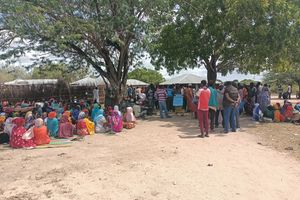
In the arid expanse of Turkana West, thousands of people from neighbouring countries call the Kakuma Refugee Camp and Kalobeyei Settlement home.
But lately, it has become unbearable, forcing the inhabitants into tough choices. They have engaged in street protests, made demands to authorities and complained of reduced rations.
Now some are opting to trek back home, a dangerous trip.
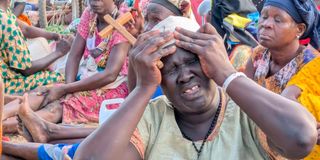
Refugees at Kakuma Refugee Camp and Kalobeyei Integrated Settlement protest over scarcity of food and water on March 3, 2025.
Photo credit: Sammy Lutta | Nation Media Gruop
For some months now, the government and partners have been implementing a Differentiated Assistance model, meant to utilise the reduced rations by giving to the neediest first. It turns out everyone is needy.
Mr James Ayuen, a South Sudanese refugee, said that life has become unbearable ever since the introduction of categorisation model.
"I am in Category Three, which is not supposed to receive any food aid. This is a mockery because, as a community leader in Kalobeyei Integrated Settlement, I was part of the team that created awareness about the categories,” he told the Nation .
“I used myself as a perfect example of someone who fits into Category One because I am vulnerable, blind, and without a reliable source of food aid," Mr Ayuen said.
"I cry every morning when I wake up, knowing the children have gone to bed and woken up on empty stomachs. Though I can't see them, I can feel how weak they are becoming with each passing day. Their painful reminders about what they will eat torture me. I receive no support from South Sudan, Kenya, or even abroad,” he said.
Some of his neighbours, he said, gave up and started walking back to South Sudan, if they couldn’t raise bus fare that is.
"I can't walk on foot with these children to South Sudan. Many would die along the way because we are all malnourished. If I ever get enough money, I won’t buy food; I will just pay bus fare for us to leave Kenya,” he said.
As an elder, he said, he tried to revise his own categorisation, as well as others he knew, and reported the matter to authorities. The response hasn’t come yet.
The Kenyan Department of Refugee Services said it was aware of the dire conditions in Kakuma Refugee Camp and Kalobeyei Integrated Settlement.
Edwin Chabari the camp manager, confirmed that the new humanitarian aid system is driving those not receiving food aid to leave the camps.
"Some people in categories three and four have left the refugee camps, mainly heading to South Sudan. We cannot stop them, as we do not hold people by force.
“We are trying alternative survival methods, such as implementing the Shirika Plan by emphasising integration and building self-reliance through empowerment," Mr Chabari said.
The categories are numbers one to four, where one is the neediest, and four is considered able to sustain themselves. But refugees have complained that some people were put in categories without regard to their pleas.
Chabari explained that those not receiving food aid are being prioritised for other forms of support, such as business loans and grants, and are being provided with a conducive environment to start businesses.
Category One receives 40 percent of the food ration, while Category Two, comprising moderately vulnerable individuals, receives 20 percent.
Civil society organisations in Turkana County believe that new policies introduced in refugee camps and host communities, such as the Shirika Plan and Differentiated Assistance, lacked public participation. This has led to increased pain and suffering.
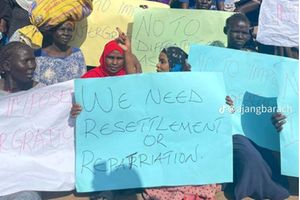
A refugee at Kakuma Refugee Camp and Kalobeyei Integrated Settlement displays a placard during a protest over scarcity of food and water on March 3, 2025.
Photo credit: Sammy Lutta | Nation Media Group
Ms Eunice Ateyo, an official from local environmental lobby Friends of Lake Turkana, said officials have not handled the problems identified in the system.
"The current situation shows that little or no action was taken to fix the issues within the Differentiated Assistance model. We are still waiting for communication from the Department of Refugee Services on when public participation forums will be held," she stated.
"We should have structures down to the smallest units in the villages or camps to participate in the implementation process, liaise with the National Steering Committee and National Technical Committee, and provide oversight,” Ms Ateyo said.
The new system has seen a digital uprising too, with young refugees harnessing TikTok and other social media platforms to spotlight a deepening humanitarian crisis following recent aid cuts.
With food supplies dwindling and a controversial aid programme leaving many hungry, these youths are using their phones to share the unvarnished reality of life in the camps. Their videos challenge global indifference and call for urgent intervention.
From Kakuma’s dusty paths to Kalobeyei’s overcrowded quarters, the clips are far from entertainment. They reveal what official reports often omit: children going days without food, families selling their last possessions, and a new aid system forcing some to return to war-torn homelands.
Their online activism is indicative of growing gaps in humanitarian support—shortages of food and water, overcrowding, and desperate survival tactics.
Among the digital chroniclers is Jemo Emot, who uses his motorcycle to travel between Kakuma (17km2) and Kalobeyei (15km2), located roughly 20 kilometres apart. On Monday, he was documenting the impact of a newly introduced aid model targeting vulnerable groups, including people with disabilities and children without reliable income.
“It’s heartbreaking. Even after months of waiting, no corrections have been made. Some refugees are now walking back to conflict zones. I saw children heading on foot to South Sudan,” he said.
In a recent TikTok video, Mr Emot interviewed 21-year-old Fiola, who was leaving for South Sudan that morning—not out of choice, but hunger.
“There are 11 of us in my household. We were placed in category three despite having no stable income. We’re not coming back. Many friends and neighbours have also left—some on foot, others by bus,” she said.
Her family sold household items to afford transport. “We can’t wait any longer. Food and shelter are our priority. I’ve given up on continuing my education. Home is better,” she added.
These stories mark a shift from the past, when refugee voices were filtered through official channels.
Community leader Odhieng Akway, 45, says social media has become a vital tool for advocacy.