The raging debate over the construction of a state lodge, airstrip and golf course inside Imenti Forest has thrust Meru County into the national spotlight. Yet long before the controversy erupted, the town had already set its sights on an even bigger prize of elevation to city status alongside Nairobi, Mombasa, Nakuru, Kisumu and Eldoret.
Despite protests from opposition leaders and environmental activists, Governor Isaac Mutuma insists that the projects will not only boost Meru’s economic profile but also strengthen its bid to become Kenya’s next city.
“With these projects, we have the opportunity to take Meru to the next level. Look at the billions in investments that will come here. Even a golf course is a green project that promotes conservation. Let’s think about Meru City,” the governor said recently.
For a county whose economy is anchored on agriculture mainly from tea, coffee, macadamia, miraa and avocados, Meru ranks fifth in GDP contribution nationally behind Nairobi, Nakuru, Kiambu and Mombasa.
However, for many residents, the idea of Meru as a future city evokes memories of a very different place.
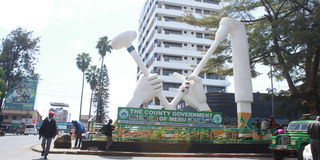
The Nyayo monument in Meru town on June 23, 2026.
Photo credit: David Muchui | Nation Media Group
Before 2010, Meru was in many ways a village town. Locals joke that during rainy seasons, banana plants could have thrived on its muddy streets, a reflection of roads that were largely unpaved and neglected.
As late as 2018, traders at Gakoromone open-air market still displayed vegetables on muddy ground with customers insisting that cabbages, carrots and sukuma wiki be washed before purchase.
“It was terrible,” recalls Mr Joshua Mungania, a long-time resident and businessman who also chairs the Meru Municipal Board and has witnessed Meru’s evolution from a rural trading centre into a growing municipality.
Successive county governments under Governors Peter Munya and Kiraitu Murungi spearheaded major urban renewal projects including cabro paving, street lighting and improved urban planning that reshaped the town’s image.
Meru’s history stretches back to May 13, 1911, when colonial administrator Edward Butler Horne declared a township within a one-mile radius of a British flag post near the Kathita River.
Colonial settlers later established an English-style hotel, the Pig and Whistle, which stood for decades before being demolished to pave way for Greenwood Mall, which is now a modern commercial hub.
For decades after independence, Meru’s growth remained slow. Between the 1970s and 1990s, development stagnated, with little expansion beyond its original commercial core.
That changed over the last 15 years when a property boom swept through the town. Modern malls, office blocks and branded outlets signalled Meru’s arrival as a serious urban centre.
Kenyatta highway in Meru in this photo taken on June 23, 2026.
Photo credit: David Muchui | Nation Media Group
Today, nearly all major banks operate in the town supported by a Central Bank of Kenya branch. According to Mr Mungania, the population has also grown significantly.
“Within 15 years, we have seen massive investments. The population has grown from under 150,000 to more than 250,000. This is phenomenal for a town once known mainly for miraa trade,” he said.
Data from the Kenya National Bureau of Statistics (KNBS) places Meru municipality’s population at 240,900 in 2021 with projections indicating that the five wards earmarked for city status Municipality, Nyaki West, Nyaki East, Ntima East and Ntima West have since crossed the 250,000 threshold required for elevation.
Beyond population, city status requirements include urban infrastructure standards such as road networks, street lighting, waste management, accessibility for persons with disabilities, CCTV coverage and proper traffic management systems.
Already, the county has developed a cabinet paper for submission to the County Assembly where MCAs are expected to deliberate on the roadmap. A public participation committee has also been formed, whose report will later be submitted to the Senate. The entire process is expected to take about a year, with city status targeted for early 2027.
“I assure residents that Meru stands to benefit immensely from city status, including increased investor confidence,” said the governor.
He added that major infrastructure projects such as the Sh100 billion Isiolo–Mandera road, which is part of the LAPSSET corridor, are expected to further transform the region. About 70 kilometres of the highway passes through Meru, already attracting investor interest.
Other flagship projects include the Sh1.2 billion Gakoromone market under construction and the planned upgrade of Meru Level Five Hospital to a Level Six referral facility at a cost of Sh1 billion.
The Nyayo monument in Meru town on June 23, 2026.
Photo credit: David Muchui | Nation Media Group
According to Mr Mungania, the town is steadily meeting infrastructure benchmarks. About 4,200 kilometres of roads have already been tarmacked within the proposed city area, against a target of 5,000 kilometres.
The Eastern and Western bypasses completed in 2019 have eased congestion while a planned 13-kilometre dual carriageway from Gikumene to Gitoro is expected to further improve mobility.
A Sh1.2 billion sewerage system serving the five wards is about 70 per cent complete and is expected to be commissioned by the end of the year. Water services, waste management and street lighting projects are also being expanded under Meru Water and Sewerage Company.
“Mewasco already covers about 70 per cent of the area, and we are expanding to reach full coverage,” Mungania said.
He added that the town can currently host more than 10,000 visitors at a time, a capacity demonstrated during national events such as drama festivals.
However, not everyone is convinced that the push for city status is purely developmental. Some residents argue that it is politically driven and may come with higher taxes and service rates.
“We know this is partly political. Service rates will rise like in Eldoret. I am not sure we are ready for that,” said Mr Jackson Kirimi, a trader at Gakoromone market.
However, supporters of the plan say higher costs will be matched by improved services.
“With city status comes better infrastructure, more investment and more jobs. We must look at the bigger picture,” Mungania said.
Former Nyaki East MCA Martin Mworia believes Meru is positioning itself as the economic hub of the Mt Kenya East region.
“With improved infrastructure, Meru will connect northern, eastern and central Kenya. It will become a preferred destination for investment and tourism,” he said.
At Makutano junction – Meru’s unofficial 24-hour economy zone – optimism is already visible. As the central business district winds down at night, Makutano lights up with restaurants, bars and entertainment spots.
“By 9pm, town is quiet, but Makutano wakes up. We are excited about city status because it will bring more visibility and business,” said Brian Kaberia, a local entrepreneur.