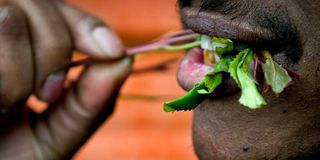
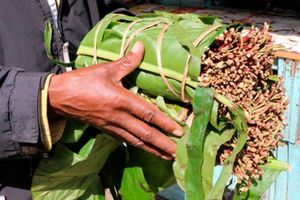
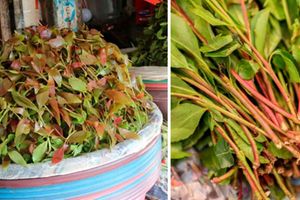
Meru University of Science and Technology has applied for a patent for a sachet that is said to replace the act of chewing miraa, offering the convenience of making a drink similar to tea.
Known as a khat infusion product, the sachet will infuse Meru's best-known export with flavours and stabilisers, delivering the stimulant to buyers in Kenya and beyond.
“The soluble infusion delivers [a] stimulation effect with minimal side effects,” the university says in its patent application to the Kenya Industrial Property Institute (Kipi).
“The infusion product … replaces the practice of chewing khat to achieve the required sufficient threshold. The infused product can be consumed in beverages, juice, food, medicine and water,” it adds.
Miraa on display on May 24, 2024.
Photo credit: File | Nation
The patent notice, contained in the latest Kipi journal, states that the inventor of the sachet is Prof Joshua Mbaabu Arimi, a food scientist with a master’s in post-harvest and food preservation engineering from Katholieke University Leuven in Belgium and a PhD in food engineering from the University College Dublin, Ireland.
The entrance of Meru University of Science and Technology (MUST) in this picture taken on December 7, 2020.
Photo credit: File | Nation Media Group
It notes that the sachet is created by adding substances to enhance the flavour, sweetness and stability of the khat. This mix, the university claims, can “reduce depression, fatigue, obesity, stomach ulcers, sleep and hunger”. The sachet will contain sterile packaging and a cotton thread extension.
Nation contacted the university, which says it has a “special drying method” for the crop, for a comment on the invention.
The sachet is one of the ways innovators have been pursuing as an alternative method of consuming and adding value to miraa. Some have made it into juice, wine, and even infused tea leaves. From online searches, there are at least two vendors already selling miraa sachets that are made in different ways.
One of the vendors, Marqan Herbal, sells a sachet for € 2.5 (Sh377). That means that buying seven to use one a week will set back the buyer at least Sh2,100.
Handasjuice.com, another vendor, sells miraa sachets called jaba tea bags for Sh500 a unit.
According to the Agriculture and Food Authority (AFA), the miraa sub-sector earns Kenya revenues of “about Sh13 billion annually”.
“Kenya’s main export destinations are Somalia, Israel and Democratic Republic of Congo. The sector reforms have led to increased earnings from the value chain,” the authority says.
The sachet is one of the ways innovators have been pursuing as an alternative method of consuming and adding value to miraa.
Photo credit: File | Nation Media Group
It adds that about 80 per cent of locally produced miraa is consumed locally, while 20 per cent is exported.
Miraa comes in different colours and levels of potency. According to AFA’s classification, the miraa grown in the Meru region falls into five grades: Kangeta, Kisa Grade 1, Kisa Grade 2 (Nyeusi), Kata, and Alele.
Meanwhile, in Embu, AFA says all the four grades of miraa cultivated there are commonly known as muguka. The grades from Embu are mchele, medium, digital, and CR.
Miraa was declared a scheduled crop in 2016, allowing government intervention in development, promotion and regulation of the crop — which has for long drawn controversy on whether it is a drug or not.