Iranian vessel MV Mashallah and the methamphetamine valued at Sh8.2 billion that was found in the ship will be destroyed, a court has ruled.
A Shanzu court ruled that the quantity and enormous monetary value attached to the consignment had created significant temptation for interference and raised grave and well-founded security concerns that could not be ignored.
The court also expressed concern about the safety of officers entrusted with the custody and preservation of the consignment, saying they were exposed to inducements capable of compromising not only the integrity of the exhibits, but also their personal welfare, probity and professional standing.
“This is not a speculative concern. The risk of corruption, theft, substitution, or disappearance of the consignment is real and proportionate to the value of the drugs in question,” the Chief Magistrate observed.
According to the court, leaving a consignment of such magnitude in storage when the law provides a clear mechanism for destruction while preserving the evidentiary record would invite the very harm the law seeks to prevent.
The court also observed that drug trafficking on the scale disclosed in the case extends beyond ordinary criminal law and intersects with transnational organised crime, maritime security and regional stability.
“Facilities holding such consignments become targets for criminal syndicates who have both the motivation and the resources to attempt a recovery of the drugs. The risk of a breach of security at the storage facility, with potentially catastrophic consequences, militates strongly in favour of destruction at the earliest opportunity consistent with the requirements of a fair trial,” the magistrate noted.
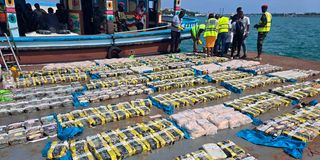
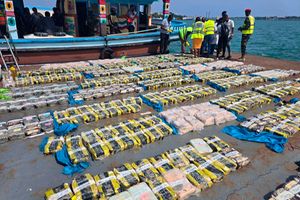
Some of the 1,024 kilogrammes of synthetic drugs seized from six Iranian crew members aboard a vessel. The haul, estimated to be worth Sh8.2 billion, was seized about 650 km off the shore of Mombasa.
Photo credit: Wachira Mwangi | Nation Media Group
The court ordered that the consignment be destroyed within 30 days from May 15. The narcotics, weighing 1,036.044 kilogrammes, are being stored at the Kenya Navy base in Mtongwe.
The court directed the Director-General of the National Environment Management Authority (Nema) to determine the mode of destruction of the drugs.
The drugs and their packaging will be weighed again in the presence of the court, prosecution, accused persons, their advocates, and representatives of the multi-agency team, before being destroyed.
The court further ordered that only authorised officers oversee the transportation of the consignment from the Kenya Navy storage facility to the place of destruction. The drugs are to be locked in secure transport vehicles, escorted by armed security officers and not left unattended until their final disposal.
Further, the destruction will be conducted in accordance with seizure analysis and disposal regulations, meaning each container or package of the seized substance must be inspected and an inventory prepared.
The narcotics are also to be verified and secured to ensure they are fully accounted for from the time they leave storage until their final physical destruction. A certificate of proof of complete destruction will be issued.
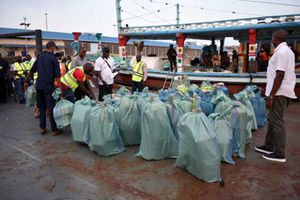
“The gunny bags be preserved and retained in the custody of the investigating officer, to be availed during the trial should the need arise,” the court ruled.
The reweighing, transport, destruction, retention and preservation of the gunny bags will also be documented through certificates, video recordings and photographic evidence.
While issuing the orders, the magistrate cited overwhelming public interest in the matter and the inherent dangers associated with the continued storage of such a massive and high value consignment of narcotic drugs.
“The court finds that the continued retention of the meth is neither necessary nor desirable,” the magistrate ruled.
The court also said that the opposition to the destruction, although properly grounded in the right to a fair trial, had failed to demonstrate any specific prejudice that would arise from destruction of the bulk consignment.
Iranian suspects found in possession of substances suspected to be methamphetamine valued at Sh8.2 billion at the Mombasa Port on October 25, 2025.
Photo credit: Pool
Jasem Darzaen Nia, Nadeem Jadgai, Imran Baloch, Hassan Baloch, Rahim Baksh and Imtiyaz Daryayi have denied trafficking the drugs between October 11 and 20, 2025, on the high seas at latitude 04 degrees 46.79 seconds south and longitude 041 degrees 27.42 seconds east, about 350 nautical miles east of the Port of Mombasa.
On April 26, the prosecution applied for orders authorising the destruction of the drugs, saying that samples had already been produced as exhibits, the entire consignment had been viewed by the court, and the sample drugs were properly retained for judicial process.
The accused objected to the destruction, arguing that the accuracy and integrity of the exhibits were central to proceedings before both the trial court and any appellate court.
“The prosecution has not demonstrated any difficulty or challenge relating to the preservation, storage, weight, or handling of the exhibits nor has it invited the court to ascertain the practicality of continued storage,” their advocate argued.
The defence added that the nature of the case entitled them to interrogate every detail of the prosecution’s case and that the multi-agency teams involved had sufficient capacity to preserve the exhibits under the court’s direction.
The prosecution said it was spending substantial resources to guard the consignment and added that the storage facility was not air conditioned.
“The integrity of the meth stands to be compromised, considering that the narcotic drugs had been recovered in October 2025, approximately seven months earlier,” the prosecution argued.
The prosecution further argued that the drugs were of substantial volume and could not continue being stored indefinitely.
The magistrate agreed with the prosecution, noting that where safety risks cannot be mitigated, destruction may be authorised provided that the integrity of the evidence remains intact through a transparent, witnessed and scientifically sound process.
According to the court, provisions allowing destruction and proper documentation of the process are particularly useful in cases involving large drug hauls such as the present one.
"The court sees no utility, legal or otherwise, in the continued physical retention of the bulk consignment," the court said.
Packages of substances weighing 1,035.986 kilograms suspected to be methamphetamine valued at Sh8.2 billion at the Mombasa Port on October 25, 2025.
Photo credit: Pool
The court observed that the drugs in question can neither be returned to any party, be sold, redistributed, nor applied to any lawful purpose and have no redemptive use, and their only lawful end is destruction.
This is not the first time Kenya has destroyed vessels and drug consignments intercepted at sea in a bid to curb narcotics trafficking. On August 14, 2015, the Kenya Navy destroyed a luxurious yacht found with 7.5 kilogrammes of heroin valued at Sh29 million at Delta 16 in the deep sea of the Indian Ocean.
The operation, which took four hours, involved setting ablaze the yacht, known as Baby Iris, which had been under police surveillance at the Port of Mombasa. The destruction was conducted under tight security in the open sea.
The vessel, registered in Britain, was intercepted by soldiers' patrol vessel at a boatyard in Mnarani, Kilifi County, on April 9, of the same year while attempting to sneak in the drugs. Police said the vessel had left Mombasa for Swaziland.
In a similar operation in 2014, Kenya destroyed liquid and solid heroin worth Sh1.3 billion together with a yacht intercepted on the high seas.
The ship, MV Al Noor, was destroyed together with the cargo as part of government efforts to demonstrate commitment to fighting drug trafficking.