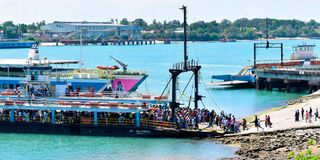
The newly introduced levies at the Likoni crossing channel in Mombasa, which increased ferry charges for motorists, have sparked uproar among transport operators and civil society organisations.
The revised charges, which took effect on May 22 2026, have in some cases nearly doubled the amount motorists are required to pay to use the crucial crossing channel linking Mombasa Island to Likoni, a key gateway to the South Coast.
Officials from Vocal Africa, Fast Action Business Community, Tuk Tuk Association, Boda Boda Association and Taxi Association have termed the sudden increase in ferry crossing charges punitive to the people of the Coast and unacceptable.
In a joint statement read on behalf of the affected groups, Vocal Africa Coast Coordinator Walid Sketty described the move as economic punishment to a region already struggling under immense pressure from the rising cost of living.
The group argued that the increase had come at the worst possible time, when Kenyans are grappling with high fuel prices, increased taxation and escalating costs of essential commodities. According to the group, transport operators, small-scale traders, and ordinary families are already stretched beyond their limits and cannot absorb any further costs.
Mr Sketty maintained that the increased levies would inevitably push up transport fares and commodity prices across the region, affecting boda boda riders, tuk tuk operators, taxi drivers, and small traders who rely on affordable movement between the island and the mainland.
Public transport operators faulted the manner in which the revised charges were introduced, insisting that there had been no meaningful public participation or consultation with stakeholders before implementation.
“Whenever development conversations happen elsewhere, citizens hear of empowerment projects, but at the Coast we are instead confronted with increased charges and additional burdens. We cannot continue treating the people of the Coast as second-class citizens through policies that only worsen their economic situation,” the activist said.
Mr Sketty warned that the affected organisations were already exploring legal avenues to challenge the new levies in court, saying the move violated the constitutional requirement for public participation.
Mombasa County Boda Boda Operators Association Chairman Halifa Mwatsahu noted that businesses in the Coast region were barely recovering from economic hardships and that the increase would have a ripple effect on the local economy by driving up operational expenses for transport and logistics operators.
He argued that the burden would eventually be passed on to ordinary citizens through higher fares and increased prices of goods and services.
The operators further described the revised charges as discriminatory and economically oppressive to Coast residents, who have for years endured unemployment, poor infrastructure and marginalisation.
“The government should be cushioning citizens during these difficult economic times instead of introducing punitive levies that deepen the suffering of the people,” Mr Mwatsahu said.
The operators and organisations are now demanding the immediate suspension and reversal of the new charges and the opening of a transparent engagement process with all stakeholders.
Under the revised tariff structure announced by the Kenya Ports Authority, motorists will now pay charges based on the type and size of vehicles using the crossing channel.
Small private cars measuring up to 4.5 metres will now be charged at a rate of Sh180 per metre, while slightly larger vehicles measuring between 4.6 and six metres will attract Sh225 per metre. Sport utility vehicles and crossover utility vehicles below six metres fall under the same category.
Pickup trucks and vans will attract higher charges ranging from Sh350 to Sh438 per metre depending on classification, while motorcycles and mkokoteni operators will each pay Sh75 per trip. Tuk tuks have been placed under a separate category and will now pay Sh100.
Passengers disembark from MV Safari Ferry at the Island side of the Likoni Channel Crossing on July 14, 2024.
Photo credit: File | Nation
Public service vehicles have also been affected by the new structure, with minibuses, shuttles and smaller buses attracting a charge of Sh900 per metre. Larger buses measuring between nine and 11 metres will pay Sh1,650 per metre.
Light commercial trucks will be charged between Sh438 and Sh500 per metre, while medium-sized trucks will pay between Sh750 and Sh1,125 depending on size. Heavier trucks face steeper charges ranging from Sh1,500 to Sh1,875 per metre, with extra-heavy vehicles measuring between 15 and over 17 metres attracting up to Sh2,125 per metre.
The authority has also introduced fresh rates for trailers and fuel transport vehicles. Empty trailers will now attract Sh7,000, while loaded trailers will be charged Sh7,950. Tankers have been pegged at Sh750 per metre, while fuel transport vehicles and petroleum-related trailers will attract charges ranging from Sh3,225 to Sh8,325 depending on their size and cargo.
Vehicles classified as abnormal loads will pay a flat rate of Sh15,950, while charges for vehicles not captured in the published schedule will be determined by the authority upon application.
Apart from the ferry crossing charges, the authority has also revised annual and daily port entry fees for motorists and other users accessing port facilities. Under the annual pass system, ordinary users will pay Sh1,250, while VIP passes have been set at Sh3,000. Motorbike and scooter operators will part with Sh300 annually, saloon car owners Sh750, while owners of pickups, SUVs and CUVs will pay Sh1,000.
Taxi operators have been placed under a Sh1,500 annual fee category, while vans, minibuses and canters will pay Sh2,000. Heavy commercial vehicles including lorries, cranes, tractors and forklifts will attract annual access charges of Sh3,000.
For daily access permits, individual users will pay Sh100, while motorcycles, scooters, saloon cars and station wagons will each attract a daily fee of Sh300. Pickups, vans and SUVs will pay Sh600 per day, while construction machinery and heavy commercial vehicles including bulldozers and lorries will be charged Sh1,000 daily.