The Mkanda Channel has served as a critical sea artery connecting Lamu West and East Sub-Counties since time immemorial but has now come under threat of siltation.
Just like the Strait of Hormuz, the only natural maritime waterway connecting the Persian Gulf to the open ocean via the Gulf of Oman and the Arabian Sea (Indian Ocean system), Mkanda Channel is crucial for Lamu County. Residents living in Lamu East and Lamu West depend on it to access either side of the county safely.
The Mkanda Channel: Siltation crisis chokes Lamu’s lifeline
Apart from linking the two sub-counties, residents from the vast Lamu East region rely on the corridor to access the rest of Kenya. Without it, they may be forced to depend on navigating the open sea routes which are usually avoided for being dangerous.
In recent years, Mkanda has been under serious threat, with many vessel operators admitting they face hurdles in their daily movements as the channel silts up.
Mr Abubakar Twalib, a fisherman and long-serving cargo shipper plying the Lamu West–Lamu East route, expressed concern over the rate at which the channel is becoming shallower due to siltation.
Mr Twalib notes that if the situation is not urgently addressed, the waterway will be impassable over time, particularly for large cargo carrier vessels.
In 1997, the United States Navy undertook to dredge the channel in order to deepen the route and allowing safer movement of vessels.
“Shortly after the dredging took place in the 1990s, we really enjoyed passing through without worry of hitting rocks and the seabed. In recent times, we’re experiencing challenges where sand, silt and clay have all settled and accumulated at the bottom of the waterway,” said Mr Twalib.
He added, “By gradually filling the channel bed, these sand, silt and clay continue reducing the water depth, hence restricting our maritime navigation and even disrupting vital aquatic ecosystems.”
Some of the remains of coral reef sediments left behind during the dredging of the Mkanda Channel in 1997 by the US Navy, in this photo taken on April 25, 2026.
Photo credit: Kalume Kazungu | Nation Media Group
Mr Simon Mulwa, an expert in maritime channel design and marine infrastructure, termed Mkanda Channel the life support of Lamu. Mr Mulwa, who is also a specialist in developing safe, sustainable and economically viable marine navigation networks, noted that the dredging process undertaken in 1997 at the route was a good course.
He, however, highlighted a major flaw in the project’s execution, noting that planners failed to provide for proper disposal of the dredged sediments.
According to Mr Mulwa, instead of the project executors ensuring the dredged sediments were ferried and disposed of far away from the channel, they ended up side casting them within the dredging site.
Over time, the move has resulted in an increased rate of siltation within the critical Lamu maritime link.
“By failing to plan for proper disposal of the dredged material, today it’s like the dredging effectively backfired. They side cast or throw the sediments on both sides of the channel. As time goes by, we’ve seen these dredged sediments initially side cast migrating back into the channel, making it shallower,” said Mr Mulwa.
Sediment stirring and settling
He also blamed the increased siltation on strong tidal waves and currents. Mr Mulwa says strong tides and waves always increase the rate of siltation through a process called sediment stirring and settling.
“Remember the dredged sediments were thrown side by side within the channel site. So when powerful tidal waves enter the channel, turbulent energy resuspends bottom sediments.
“As the water slows down, particularly during slack tides or in deepened areas, the sediment settles, rapidly reducing the channel’s depth over time like what we’re witnessing today,” said Mr Mulwa.
He called for a proper survey to be conducted, consultations from experts to be done, and a new phase of dredging to be reconsidered to save it from extinction.
At only 1.5 kilometres wide, Mkanda Channel is the most used route and ocean strip in the Lamu Indian Ocean waters. Despite its narrow nature and shorter distance compared to other channels across the archipelago, Mr Mulwa still views it as a powerful socio-economic determinant for Lamu County.
He noted that the channel has since time immemorial been facilitating the passage of medical emergencies, business and food supply chains, and building materials to either side of the archipelago.
“It’s this particular short stretch that dictates Lamu’s capacity for crisis resilience, daily sustenance, infrastructure development and overall community survival here, hence the need for it to be dredged to avert the continued siltation and decreased depth which endangers maritime movement and general operations,” said Mr Mulwa.
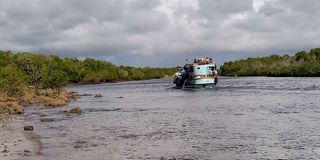
A cargo vessel passing through Mkanda Channel on April 25, 2026.
Photo credit: Kalume Kazungu | Nation Media Group
Mr Alex Jimbi, Lamu Chief Officer for Roads, Transport, Infrastructure and Public Works, cites the waterway as the most important inland sea route not only for Lamu but the entire Northern Coast of Kenya.
According to Mr Jimbi, Mkanda is widely used by fishermen, passengers, cargo shippers and even tourists.
“The channel provides an alternative to the open ocean during rough monsoon seasons. The channel also supports fishing, tourism and trade across the islands,” said Mr Jimbi.
He said dredging activities for the Lamu Port’s first three berths also contributed to the making it shallow.
He reiterated that plying the channel during low tides has often led to boats and dhows hitting coral reefs and rocks, resulting in increased marine accidents, injuries, deaths and loss of property.
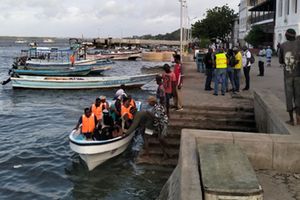
For instance, in December 2021, Lamu East MP Ruweida Obo, who was then the Lamu County Woman Representative, together with fourteen other people, notably her co-workers and local chiefs, sustained injuries after a boat they were travelling in hit a rock at the channel’s bottom.
The group had left Mtangawanda on Pate Island in Lamu East for Lamu Island in Lamu West for civic education forums when the accident occurred.
In June 2017, ten people died when a dhow carrying 25 passengers and their luggage capsized in the passage. The dhow was travelling from Lamu Island to Ndau Village in Lamu East when it capsized due to rough tides.
“Because of the shallow nature of Mkanda today, it’s impossible to cross when tides are at their lowest. Sea users are sometimes forced to delay their travels for six to eight hours just to wait for high tides,” said Mr Jimbi.
“It’s high time that the national government through the Kenya Ports Authority spearheads dredging activities since it’s their mandate,” he added.
Mr Mohamed Omar, a coxswain in Lamu East, says the unpredictable nature of the route in recent times, especially during low tides, has sometimes subjected them to risks. Mr Omar admits that during medical emergencies, they cannot dock their vessels at and wait over six hours for high tides to resume before crossing.
“If we do that, then our patients will die. That’s why we insist on deep dredging to be fast tracked. Sometimes we’re forced to resort to risky alternatives by plying the open seas, Ras Kitau and the Shella Channel before reaching King Fahd Referral Hospital for treatment. That route is extremely life threatening and dangerous,” said Mr Omar.
But even as the push for redredging gears on, Mr Athman Bakar, an environmentalist and founder of the Lamu Marine Forum, stressed the need for crucial mechanisms to be undertaken to stop recurrent siltation.
“We must therefore consider introducing techniques that will intercept sediment before reaching these navigation channels and subsequently alter water dynamics within the Indian Ocean. Solutions include building current deflection walls, deploying natural barriers like mangroves and oyster reefs, and setting up designated sediment traps to reduce dredging frequency and subsequent costs,” said Mr Bakar.