Ferry users at the Likoni crossing channel will have to endure congestion for an unprecedented period as the government remains uncertain in allocating funds for the resumption of ferry services in Mtongwe.
Transport and Infrastructure Cabinet Secretary Davis Chirchir told Parliament that the construction of the Mtongwe ramp was halted due to financial constraints and will resume once the Treasury allocates the necessary funds. As a result, residents who dependent on the service will have to continue using the Likoni crossing channel, which is more than 7 kilometres away.
“Ferry service cannot resume until construction of Mtongwe island ramp is done. The design phase of the ramp has been factored in the financial year 2025/26 for consideration,” he said.
According to a report submitted to the National Assembly on Tuesday through the Departmental Committee on Transport and Infrastructure, the ministry noted that the number of people using the channel daily has increased exponentially in recent years, as it remains the only link connecting the island city of Mombasa and the mainland side towards Kwale County.
Details show that from the 300,000 people who used the ferry services in 2011, a significant increase has been recorded, with up to 500,000 people now using the channel daily. The report by the CS was a result of a request by Likoni MP Mishi Mboko about what the government is doing to enable efficient travels by the ferry users.
As for vehicles, the number has reduced over time due to the opening of the Dongo Kundu Bypass, which has attracted vehicular traffic between the coastal counties of Kwale and Mombasa. The government stated that vehicle numbers at the channel have decreased by at least 41 per cent, from 6,000 to 3,500 since the bypass became operational.
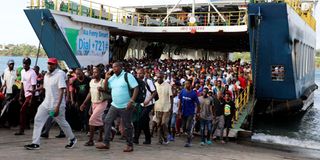
Passengers disembark from MV Safari Ferry at the Island side of the Likoni Channel Crossing in this picture taken on July 14, 2024.
Photo credit: Kevin Odit | Nation Media Group
Some residents depended on the Liwatoni Bridge to cross the channel, but the state decommissioned the Sh1.9 billion infrastructure in 2023. One of the major reasons the bridge was developed in 2020 was to ease access and manage congestion during the Covid-19 pandemic, a disease that killed hundreds of thousands of people globally.
Despite serving as a containment measure, the bridge also affected port activities, such as the movement of ships, which at times were forced to wait for long periods, especially during peak hours.
“Likoni channel is a shared channel for port activities and other maritime users. As port activities increase and the number of ships visiting the port of Mombasa increases, ferry activities are negatively affected. Being a restricted channel, priority is given to ships entering and leaving the port hence disruption of ferry services especially during peak hours,” Mr Chirchir added.
In his submissions to Parliament, CS Chirchir also noted that the government is planning to procure another ferry to address the increasing maritime traffic at the channel. Currently, four ferries operate at the channel, with the larger ones, such as MV Jambo and MV Safari, holding a capacity of 4,000 people at a time.
Procurement details show that Kenya Shipyards Limited has been contracted by the Kenya Ports Authority to build the new ferry. Details of the project indicate that the passenger ferry will be 80 meters long, with a car deck clearance of 4.5 metres and a seating capacity of approximately 2,000 passengers. The vessel, which will cost taxpayers Sh32 billion, is expected to be completed by April 2026.
According to the ministry, maintenance of the available ferries is undertaken weekly to ensure the effective operation of the vessels.
“Long-term maintenance involves dry docking of the ferries for underwater hull repairs. In the dry dock, comprehensive structural steel works, seawater system, and main machinery repairs are carried out,” he said.
The ministry says plans to facilitate an integrated marine transport system are underway before the end of the financial year, with a view to providing the best way for ferry services to be offered.