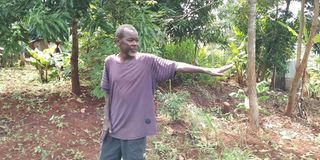
Joseph Njogu Wang'ombe at the family land in Rwanganga village in March 2026.

A family in Murang’a that is on the verge of losing its land to a shady scheme involving a sibling, tycoons and administrators has shone a spotlight on how cartels can take over estates without proper consent.
In 2023, then Murang’a County Commissioner Karuku Ngumo decried the emergence of cartels involving lawyers, administrators, brokers and tycoons that were forcibly taking over family land through dubious means.
“I am aware of the raging cry where vulnerable families are losing their land through manipulated succession processes, where greedy or illiterate family members are helped to forge documents appointing themselves estate administrators, with administrators aiding them through fake succession letters, thereby turning legal landowners into squatters,” he said.
Mr Ngumo said the scheme was being executed through debt agreements where family land was used as collateral, or through outright forgery of succession documents processed via stage-managed land boards with the complicity of government officials.
It is this progression of cartel activity that has seen the family of the late Wang’ombe Kabugua from Rwanganga village, comprising seven siblings, now battling to save its 1.5 acres of land from a scheme initiated by one of the two brothers.
According to Mr Ngugi Wang’ombe, the family land, reference LR/Kandani/1591, situated along the Gakarati–Kanguku road in Kigumo Constituency, has a market value of about Sh10 million.
“But my younger brother, who is a bachelor, has initiated the sale of the land at Sh1.6 million, despite the fact that we have never sat down as a family, either at home or in any office, to give consent. It means that land can be taken over by new owners without consent,” he said.

Joseph Njogu Wang'ombe at the family land in Rwanganga village in March 2026.
Mr Joseph Njogu, 47, who admitted to Nation that he is disposing of the land, said the decision was not malicious but a personal move that had gone awry.
“Look at me… I am poor and ageing rapidly due to neglect. My family members do not care about me and I live on the land alone,” he said.
He said he has no house to live in, and getting a meal depends on whether he secures casual labour.
“On a good day I can get Sh200. I take alcohol and also smoke cigarettes. I also have other physiological needs. I got tired of such a life and when I contemplated suicide in 2021, some friends told me I was foolish to think of self-harm when I was actually a rich man. That caught my interest,” he said.
Mr Njogu said his situation attracted new acquaintances who convinced him that owning land made him wealthy and that he could sell it to improve his life.
“I am not a bad man. I know I have siblings and they are all entitled to inherit from our late father. I approached them to let me have my share of land and allow me to sell it so I could improve my quality of life. They all refused,” he said.
He said he returned to his advisers, who had begun buying him alcohol and food, making him feel indebted.
“A man should not live like that… waking up to go to a bar to be bought alcohol and food, and later being sponsored to spend the night in a lodging with a partner,” he said.
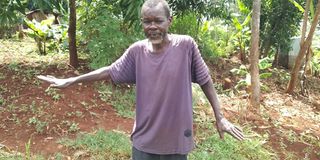
Joseph Njogu Wang'ombe at the family land in Rwanganga village in March 2026.
Mr Njogu said he later discovered that the lifestyle was being funded by two tycoons who promised to help him secure his share of the land and buy it.
“When I raised concerns that my siblings opposed the idea, I was told it did not matter. I was assured the process would only affect my share, leaving the rest intact for my siblings,” he said.
He said he was advised to inform his family that there were sponsors willing to finance the subdivision of the land so he could use his share.
Mr Ngugi Wang’ombe, who lives in Murang’a town, said he received calls from someone who introduced himself as a chief and even sent him Sh100 airtime, asking him to convene a family meeting to discuss subdivision.
“I told the caller that we had already consulted as a family and agreed that subdivision was not urgent. That was the last I heard from him. On December 8, 2025, I was alerted by anxious villagers that surveying was underway on our land. I rushed there,” he said.
He found developers fencing off portions measuring 20 by 40 feet and 40 feet square.
“They told me my brother had entered into agreements with them and they were securing their plots as they awaited formal transfer,” he said.
Further inquiries revealed that Mr Njogu had obtained a succession letter listing him as administrator and indicating he had three brothers entitled to the land.
“That was strange because our family has two brothers and five sisters. Our sisters have not waived their inheritance rights. How strangers became ‘brothers’ entitled to the land is a mystery,” he said.
He later received threats warning him to leave the land or risk arrest.
Advocate Timothy Kariuki said the proper process of acquiring family land requires consent from all beneficiaries and adherence to legal procedures.
“The land transfer process in Kenya follows a structured legal framework that protects both buyers and sellers. Due diligence, approvals and proper procedures ensure valid transfer,” he said.
He explained that the process includes conducting a land search, obtaining Land Control Board consent, drafting a sale agreement, paying stamp duty, and submitting transfer documents for registration.
“This consent is crucial in preventing illegal or forced transfers. In this case, it appears it was absent,” he said.
Mr Kariuki noted that fencing land before completion of the legal process indicates irregularities.
“It is only after issuance of a new title deed that a buyer can take possession. Any other process is fraudulent,” he said.
Mr Njogu now admits he may have been drawn into a process beyond his understanding.
“All I know is that I signed an agreement stating I owe Sh400,000 and that if I transfer the land I will get Sh1.2 million, less costs to be determined later. There is nothing I can do now,” he said.
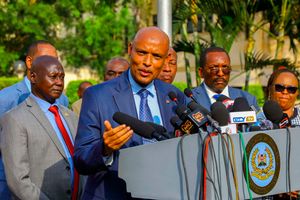
Murang’a County Commissioner Mohamed Bule advised that suspected fraud cases be reported to the Directorate of Criminal Investigations (DCI) and the Ethics and Anti-Corruption Commission (EACC).
“This is a country governed by the rule of law. Any suspected unlawful dealings must be reported to investigators,” he said.
Follow our WhatsApp channel for breaking news updates and more stories like this.