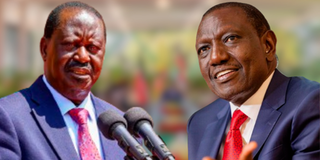
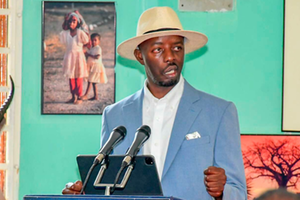
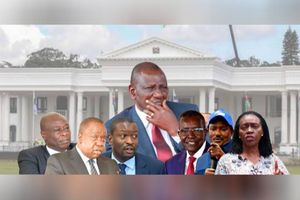
Orange Democratic Movement leader Raila Odinga (left) and President William Ruto.
When President William Ruto launched the National Conversation on Kenya’s Future Beyond Vision 2030 on Wednesday, he presented it as a fresh attempt to give the country a long-term destination, one that would belong not to the government of the day, but to generations of Kenyans yet to come.
But beneath the language of a new national development blueprint lies an intriguing political parallel.
The architecture of the conversation bears striking similarities to a grand national dialogue plan unveiled by former Prime Minister Raila Odinga months before his death.
Both initiatives place citizens at the centre. Both envisage a process that moves beyond Nairobi and political elites into the grassroots. Both seek to bring together young people, experts, counties, academia, business, civil society, religious leaders and other sections of society. And both ultimately seek to produce a broad national consensus on the direction Kenya should take.
The difference is in the destination.
Odinga’s proposed Intergenerational National Conclave was primarily conceived as a mechanism for confronting Kenya’s political and socio-economic crises and reforming the country’s governance culture.
Azimio La Umoja (One Kenya Coalition Party) coalition presidential candidate Raila Odinga addresses the crowd during a campaign rally in Kirigiti Stadium, Kiambu, Kenya on August 1, 2022, ahead of Kenya's general election. - On August 9, 2022, Kenyans will head to the polls in a contested tight battle between veteran opposition leader Raila Odinga and current Deputy President William Ruto as they traverse the country vying for electorate support.
Dr Ruto’s National Conversation, meanwhile, is being framed as a platform for determining what Kenya should become after Vision 2030.
Yet the two processes appear to share a fundamental philosophy: that Kenya’s future should not be designed exclusively by politicians sitting in boardrooms in Nairobi.
The President has proposed a multisectoral approach involving experts, young people, business, counties, academia, civil society, religious leaders and other stakeholders in defining the country’s next destination.
Kisumu Governor Prof Anyang’ Nyong’o, one of the experts who drew up a proposed vision plan, according to State House sources, has been tasked with leading the team and drawing a roadmap for the conversation.
The committee is expected to determine how the process will unfold, including whether consultations should begin at ward, sub-county or county level before culminating in a national gathering that produces the final blueprint.
That structure bears an uncanny resemblance to the roadmap Odinga had proposed before his death.
In an interview with NTV and the Daily Nation at his Karen residence on Saturday, July 19, 2025, Odinga laid out what he described as an Intergenerational National Conclave, anchored on Article 1 of the Constitution, which declares that sovereign power belongs to the people of Kenya.
His proposal was deliberately designed to begin at the bottom.
Citizens would meet at polling-station level before electing representatives to take their concerns to the ward, sub-county and county levels.
Those representatives would eventually converge at a national conclave involving about 3,000 delegates drawn from counties, Parliament, religious organisations, labour unions, academia, civil society and other groups.
“It would be the real people’s assembly,” Odinga said then, insisting that it should not become another political rally or elite conversation.
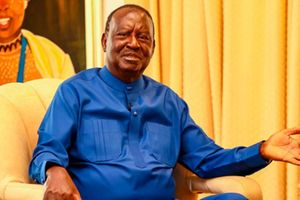
Former Prime Minister and ODM leader Raila Odinga during an interview at his home in Karen, Nairobi on July 19, 2025.
His argument was that ordinary Kenyans should be allowed to articulate their problems and determine their own priorities before politicians were invited into the process.
The proposal came a year after the Gen Z protests.
The proposed Ruto conversation appears to be travelling along a broadly similar road.
At the launch of the new national vision at the Kenyatta International Convention Centre (KICC) on Wednesday, the President repeatedly insisted that the exercise was not a government project but a people’s project.
“This is not a government project. It is a people’s project,” Dr Ruto declared.
He said the Government would provide the platform and resources but would not dictate what Kenyans ultimately decide.
The President's emphasis on ownership is significant.
Vision 2030, launched under retired President Mwai Kibaki in 2008, gave Kenya a broad development destination. It sought to transform the country into a globally competitive, newly industrialising middle-income economy.
But nearly two decades later, Kenya is approaching the end of that blueprint with a mixed scorecard.
Dr Ruto acknowledged that of the three pillars of Vision 2030, it was the economic pillar where Kenya had not performed as well as expected.
Observers say that the new conversation therefore presents an opportunity to ask uncomfortable questions: What worked? What failed? What should be retained? And what needs to change?
Prof Nyong’o, who was involved in the development of Vision 2030, has argued that Kenya cannot simply replace one five-year programme with another. He argues that the country needs a long-term destination capable of surviving political transitions.
That is where the political and philosophical overlap with Odinga’s conclave becomes particularly interesting.
The late ODM leader was not merely calling for another political dialogue, but wanted to establish a mechanism through which Kenyans could exercise their constitutional sovereignty directly.
“How do 55 million Kenyans exercise their sovereignty directly?” he asked. “That’s where dialogue comes in.”
Dr Ruto's language is different, but the principle is strikingly similar.
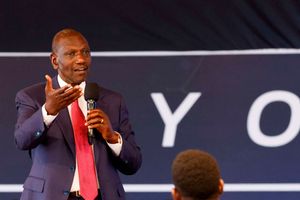
President William Ruto gestures as he speaks during the launch of the 'National Conversation Beyond 2030' at the KICC, Nairobi, Kenya, August 12, 2026.
His proposed national conversation is also premised on the idea that the country's future should be shaped by a broad cross-section of citizens rather than determined solely by those holding political office.
Indeed, the President was careful to distance himself from ownership of the process.
“I will be part of it as a Kenyan,” he said.
Odinga had gone even further.
He had argued that even he and President Ruto should not automatically sit at the centre of the conclave merely because they were political leaders.
“Even I may not be a participant unless I begin at the grassroots. President Ruto would also only attend as an individual,” he said.
For Odinga, the message was clear: the process had to be about Kenya rather than Raila or Ruto.
That sentiment now appears to be finding expression in the new vision conversation, with the strongest common denominator being the generational question.
At KICC, the President's initiative was not presented simply as an economic plan for today's Kenya. It was framed as an agenda for those who will inherit the country decades from now.
President William Ruto speaks at the Kenyatta International Convention Centre (KICC) during the launch of the National Conversation Beyond 2030 on Wednesday, August 12, 2026.
Seven-year-old Adrian Ombuni perhaps captured that idea better than any politician could.
His dream was simple: good schools, good hospitals, clean water, good roads and jobs for young people.
By 2060, Adrian will be 41.
That means the Kenya being discussed today will ultimately be the Kenya that his generation inhabits.
Odinga's proposal had also deliberately embedded an intergenerational character into the dialogue. At the lowest level, he wanted 40 or 50 delegates, half of them young people, particularly members of Generation Z.
This is perhaps the most compelling similarity between the two initiatives.
Both recognise that young Kenyans cannot simply be invited to listen to speeches about their future, but must have a seat at the table where that future is being designed.
But there is another important distinction.
Odinga's conclave emerged against the backdrop of political unrest, youth dissatisfaction and questions about governance, police brutality, unemployment and corruption.
His proposed dialogue was therefore fundamentally political and constitutional.
He argued that simply removing one president would not solve Kenya's structural problems.
“Ruto may go home but what changes?” he asked, arguing that Kenya needed to reform its governance culture rather than merely change individuals.
His proposed national conclave could eventually have generated recommendations for constitutional amendments and, depending on their nature, a referendum.
President William Ruto.
Dr Ruto's conversation is more deliberately developmental, even though he has proposed guardrails to the final document so that it can transcend regimes.
It seeks to answer what Kenya should look like beyond Vision 2030, while insulating long-term planning from the disruptions of elections and changes of government.
Deputy President Kithure Kindiki has warned against what he called policy disruption, arguing that new administrations too often abandon projects and policies initiated by their predecessors.
National Assembly Majority Leader Kimani Ichung'wah went further, proposing that the national vision be anchored in law so that a change of government does not automatically change the country's direction.
That could ultimately prove to be one of the defining tests of the Ruto initiative.
Can Kenya create a national vision that belongs to the country rather than the president who launches it?
The fate of previous national initiatives offers a cautionary tale.
Odinga and former President Uhuru Kenyatta's Building Bridges Initiative (BBI) experience demonstrated how quickly an ostensibly national reform project can become entangled in presidential succession politics.
Their own proposed conclave was deliberately designed to avoid that problem. They insisted it should not depend on government funding because government involvement could compromise its independence.
The Ruto administration, meanwhile, says it will provide the resources and platform but leave Kenyans to determine the outcome.
That difference could become crucial.
For the President, the challenge will be convincing sceptics that the national conversation is genuinely independent and not a sophisticated attempt to extend the political life of the current administration's agenda.
Already, critics have questioned why the process is being launched nearly three years before Vision 2030 formally reaches its horizon, and a year before the General Election.
Others have argued that the Government should first provide a comprehensive account of what happened to the existing blueprint before embarking on another grand national promise.
Opposition figures have also demanded a proper audit of Vision 2030 before Kenya embarks on its successor.
Observers say that these criticisms could make the grassroots component of the conversation even more important.
Raila's national conclave never got the opportunity to test whether his ambitious grassroots architecture could work.
His death three months later, on October 15, 2025, brought that particular political project to an abrupt end.
Dr Ruto's national conversation now offers a remarkably similar idea a new political and developmental stage.
Follow our WhatsApp channel for breaking news updates and more stories like this.