A DCI sting operation in Kasarani may have spared Kenyans from consuming potentially substandard maize flour after detectives uncovered a sophisticated racket repackaging counterfeit product as trusted brands.
Sleuths from the Directorate of Criminal Investigations (DCI) raided a godown (Tuesday) in the Canaan area, near Infinity Industrial Park in Kasarani, where they uncovered what they suspect was a sophisticated operation to repackage counterfeit maize flour and pass it off as products of trusted brands.
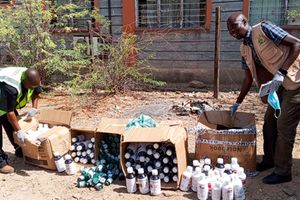
Six of seven suspects arrested in connection with a suspected counterfeit maize flour syndicate in Kasarani, Nairobi.
Photo credit: DCI
Seven suspects were arrested during the operation after detectives, acting on intelligence, stormed the premises and found what appeared to be a well-organised repackaging operation.
One of seven suspects arrested in connection with a suspected counterfeit maize flour syndicate in Kasarani, Nairobi.
Photo credit: DCI
The godown had allegedly been transformed into a covert factory, with stacks of empty packets bearing the branding of several genuine maize flour companies, packaging equipment and machinery used to prepare the products for distribution.
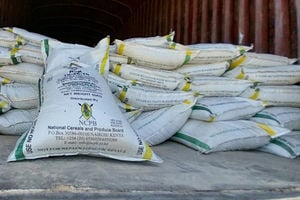
Among the items recovered were 3,682 packets of a popular maize flour brand valued at about Sh312,120, alongside hundreds of packets bearing the names of three other well-known flour brands.
The combined value of the suspected counterfeit products ran into hundreds of thousands of shillings.
The scale of the operation became clearer when detectives found a Hyundai lorry, registration number KBR 092K, being loaded with the illicit products.
Inside the godown were industrial processing and packaging machines, weighing equipment, bag-sealing tools and date and batch marking stamps allegedly used to imprint product information onto the packets.
Industrial processing and packaging machines, weighing equipment, bag-sealing tools and date and batch marking stamps allegedly used to imprint product information onto the packets nabbed by DCI.
Photo credit: Pool
The equipment suggested to investigators that the operation was designed to process, package and distribute the products on a much larger scale than a simple storage operation.
Among those arrested were Felix Kiprop, an employee of SARA Flour Brand, and Cynthia Nakoli, a salesperson attached to the same company.
Also taken into custody were loaders Joseph Kariuki and Victor Omondi Opiyo, driver Daniel Ngugi, Maria Ngui and Samuel Kimilu.
Speaking to the Nation, Kasarani sub-County Criminal Investigations Officer, Aloyce Mboya, confirmed the incident, saying the operation was successful and that a specialized unit based at the DCI headquarters led it.
“We were called in to assist the team and we were able to get seven suspects who were taken to the DCI headquarters for processing and once that is done, they will be presented to court,” SCCIO Mboya said.
The recovered products, packaging materials, machinery and other items have also been detained as exhibits.
A blunder by the suspects in cloning a trusted maize-flour brand also exposed their unscrupulous dealings. Detectives recovered discarded one-kilogram packaging that closely resembled the branding of one of the affected maize flour companies.
However, a company representative who arrived at the scene confirmed that though the packaging bore a striking similarity to his company's branding, there was one major difference.
The revelation has heightened investigators' suspicions that the packaging was deliberately designed to resemble a trusted brand and potentially deceive consumers.
The discovery has also raised questions about how many such packets may have already entered the market and whether unsuspecting consumers have been buying products believing established companies had manufactured them.
Representatives of the affected brands have committed to presenting themselves for verification as investigations continue.
The Anti-Counterfeit Authority has also been roped into the operation and will sample the recovered products for further analysis.
The testing is expected to help establish the nature and authenticity of the seized products as detectives piece together how the alleged operation worked and where its products may have been destined.
Investigators are now expected to pursue the supply chain behind the alleged racket, including how the packaging materials were obtained, where the products were distributed and whether other individuals or businesses were involved.
What was found in the Kasarani godown was not simply a pile of suspicious flour packets. It was a fully-fledged operation equipped with machines, packaging materials, weighing equipment and date-marking tools, all intended to make products of questionable origin appear genuine.
And had the police not acted on intelligence, some of those packets could have ended up on shop shelves and, ultimately, in Kenyans’ kitchens