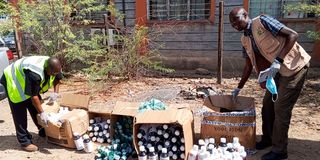
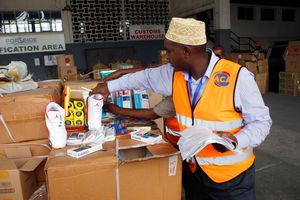
Fake pesticides. Fake fertilisers. Fake alcoholic beverages, academic papers, hardware products, clothes. And the list keeps growing, as government data shows how counterfeit products are thriving in the open market and increasingly launching an attack on public health, safety and funds, while choking manufacturers and distributors.
At the end of June 2024, the Anti-Counterfeit Authority (ACA) had seized counterfeit products worth Sh869.4 million.
The following financial year, the value of seized goods dropped to Sh223.7 million. But the drop was not a result of exorcising fakes from the open market.
No, the ACA had simply suffered budget cuts, which helped those in the counterfeiting business to make a killing – sometimes literally, as, some of the products now threaten the lives of unwitting Kenyans.
On March 26, police seized 196 bags of fake fertiliser and 396 kilogrammes of counterfeit maize seedlings in Kakamega County. Three individuals were arrested.
There were, at the time, many complaints of fake fertiliser in Kakamega, Nakuru and Kisii counties.
On May 28, the Pharmacy and Poisons Board (PPB) issued a public notice warning of a counterfeited [counterfeit] batch of Phesgo (Pertuzumab/Trastuzumab). The drug is used to block the spread of breast cancer.
Just four months earlier, the PPB had warned and issued a recall for counterfeit versions of IBRANCE, another drug used to treat breast cancer. In that instance, there was a global problem of counterfeit IBRANCE batches making their way to medical facilities.
And in April 2025, the PPB issued a recall notice for some batches of Augmentin (antibiotic) and Lumidol (paracetamol).
At the same time, the PPB warned of a wrongly packaged batch of S-Prazo Esomeprazole (acidity medicine). The PPB said that 500mg tablets of Levofloxacin (antibiotic) had been packed in S-Prazo Esomeprazole boxes.
Dr Bethwel Libeya, a pharmacist, warns that because healthcare requires strict licensing and standard compliance through the Pharmacy and Poisons Board, the invasion of unverified channels leaves patients entirely unprotected.
Dr Libeya points out that the unregulated distribution of these items strips them of their capacity to treat infections, as uncontrolled transit and storage cause chemical degradation.
A police officer stand guard outside a liquor store in Kitengela, Kajiado County where Sh5.28million worth of counterfeit liquor was seized on October 28 2025.
Photo credit: Stanley Ngotho | Nation Media Group
“Every genuine product has been registered to treat a specific disease, but a counterfeit does not have the ability to heal. It is like shooting in the dark,” Dr Libeya says.
On March 17, Nyeri Governor Mutahi Kahiga ordered the closure of all bars in Gatitu trading centre on the outskirts of Nyeri town after four people died after consuming suspected counterfeit alcohol.
A month later, a raid by a multi-agency team from the security sector impounded 12 crates of alcohol which were being transported in a Toyota Probox. The seized products were counterfeits of two popular beer brands. Only two of the 12 crates were genuine.
In August 2025, the National Authority for the Campaign Against Alcohol and Drug Abuse (Nacada) seized counterfeit alcohol worth Sh17.5 million at a wines and spirits outlet in Ruring’u, Nyeri County.
The outlet was owned by an individual who has been flagged and arrested on multiple occasions over the sale and distribution of counterfeit alcohol. We have not named the individual for legal reasons.
“Methanol is a dangerous source of poisoning. In a proper distillation process, methanol is separated, but illicit brew still contains traces of it. In the aspect of adulteration, they mix industrial alcohol to increase the strength of the beverage. It may smell similar, but it is quite dangerous,” Dr Libeya said.
“This poorly made alcohol is sold as trusted brands. It is not good for human consumption, especially the methanol and sometimes heavy metals, and when consumed can cause health problems like irreversible blindness and organ failure, and at times may be fatal,” she said.
Collins Mudogo, a 29-year-old businessman, explains that he has repeatedly encountered counterfeits but has never reported to the ACA. An ACA survey showed that over 80 per cent of consumers are aware of reporting channels but take no action when they encounter counterfeit alcohol.
ACA data shows that up to 89 per cent of pesticides could be counterfeits, while everyday necessities like non-alcoholic beverages have a 75.89 per cent counterfeit rate.
In November 2025, a 23-tonne consignment of counterfeit pesticides was seized at the Mombasa Port.
The Pest Control Products Board at the time indicated that there are approximately 70 cases in court involving supply and distribution of counterfeit pesticides. Fertilisers are at over 54 per cent counterfeit rate.
Other counterfeited consumer goods in the market include bread, biscuits, breakfast cereals and baby food.
The Ethics and Anti-Corruption Commission (EACC) has received 853 reports of falsification of academic certificates since January 2023 alone. Out of the figure, 691 cases have been under investigation, with 182 files completed with 27 convictions achieved against two acquittals and one withdrawal.
Appointments using fake papers
The anti-graft agency’s battle is against forged academic certificates which thousands of Kenyans have used to secure jobs in low-, middle- and high-level positions in government agencies.
In October 2022, a Public Service Commission verification exercise of academic and professional certificates for all public service employees uncovered over 2,000 forged certificates. The exercise led to the dismissal of 449 workers.
Of the 53,599 certificates and result slips submitted to the Kenya National Examinations Council (Knec), 1,280 were forged.
Kenya Medical Training College had 274 cases of forged academic papers, while Kisii Public Service Board had 171 cases.
Others were Homa Bay Public Service Board (144), Migori County government (93), Nairobi City Water and Sewerage Company (76) and Kenya Railways (60).
Additionally, in the 195 ministries, departments and agencies, out of 29,000 officers whose certificates were subjected to verification, 787 had secured appointments and promotions using fake papers.
ACA’s Dr King’a warns that counterfeiting is now largely done in private residences to evade law enforcement.
“They are doing it in the neighbourhoods where the police cannot get them. Sometimes they are being done in people’s homes or their own godowns where they are enclosed, or refilling of bottles,” he warns.
Anti-Counterfeit Authority (ACA) Executive Director Robi King’a during an interview at his office on June 10, 2026.
Photo credit: Francis Nderitu | Nation Media Group
The ACA boss referred to a study by the Alcoholic Beverages Association of Kenya (Abak), which found that up to 60 per cent of alcoholic beverages in the Kenyan market could be counterfeits.
According to the ABAK study, wine leads the counterfeit list at over 50 per cent, followed closely by beer at 47.44 per cent, while popular spirits like whisky and vodka face alarming counterfeit rates of 42.68 per cent and 36.95 per cent respectively.
This shift to domestic processing has triggered a severe medical crisis documented by the National Authority for the Campaign Against Alcohol and Drug Abuse, whose Strategic Plan 2023–2027 warns of a silent wave of slow deaths sweeping the country.
According to Nacada’s deputy director of corporate communication, Simon Mwangi, forensic laboratory revelations from the regulator show that these estate syndicates are skipping safe ethanol to brew lookalike spirits with industrial methanol, a toxic solvent capable of causing irreversible blindness and death in doses as small as 10 millilitres.
“We are finding alcohol by volume (ABV) levels that bear no relationship whatsoever to what is printed on the label, products sold as 40 per cent spirits testing at concentrations dangerously higher, or so diluted the buyer is paying premium prices for water,” said Mr Mwangi.
Nacada reveals that these syndicates manufacture their product for a mere fraction of legitimate costs by evading excise duties, licensing fees and safety testing, yet they sell the bottles at close to full market price to rake in extraordinary profit margins.
A police officer stand guard outside a liquor store in Kitengela, Kajiado County where Sh5.28million worth of counterfeit liquor was seized on October 28 2025.
Photo credit: Stanley Ngotho | Nation Media Group
To keep this lucrative trade hidden, the distribution network has migrated online. Syndicates are now exploiting a digital compliance gap, utilising encrypted communications, mobile money and unregulated WhatsApp groups to coordinate door-to-door deliveries.
“These are not production errors. These are deliberate choices made by people who understand exactly what they are selling—and who profit from it,” says Mr Mwangi.
To counter this shift into residential hideouts, the authority says it is pivoting towards an aggressive, intelligence-led multi-agency strategy in collaboration with the KRA and local security personnel.
“We are introducing a verification system where a simple scratch on the code will tell us exactly where the product was manufactured and used, alongside a mobile application that allows members of the public to scan the product on the shelf and instantly report back to us where these illicit goods are circulating,” says King’a.
When the Kenya Bureau of Standards (Kebs) conducted field tests in 2024, three in every five cement samples did not meet the country’s standards.
The test, carried out on 41 samples of various brands, established that 63.4 per cent of those tested met the required strength standard.
ACA’s Dr King’a said his team has received multiple threats from individuals in the black market trade.
“When you find these cases of cement, there are people who used to package cement around here; they were barons and my officers were afraid to go seize it because you are interfering with their lifeline which feeds them. They used to go and repackage or reduce the weights of bags. Instead of 50kg, they sell 40kg but pass it off as 50kg and use other people’s trademarks and brands. We have so many that have been seized at our storage, and this is dangerous. You get threats, yet you are there to protect the consumers,” Dr King’a added.