Every winning presidential campaign has a moment of euphoria — intense and atmospheric, languid and evocative — when prospective voters have a fleeting, almost treacherous happiness. At such times, the masses do not so much hear as tumble breathlessly into the excitement, suddenly unmoored and swept into the undercurrents of the promise of a better life.
In 1984, American President Ronald Reagan, who was seeking re-election, used a powerful slogan that captured American hearts: “It’s morning again in America.” The slogan, written and narrated by advertising legend Hal Riney, used morning as a powerful image — people going to work at sunrise, and the idea of economic recovery, national renewal, and optimism.
For American President Barack Obama, the shining moment came on January 8, 2008, in a New Hampshire speech when he said, “Yes, we can, to opportunity and prosperity... Together, we will begin the next great chapter in the American story, with three words that will ring from coast to coast, from sea to shining sea: Yes, we can.”
In 2022, then Deputy President William Ruto’s “hustler vs dynasties” mantra charged the nation as bodaboda (motorbike) riders, mama mbogas (vegetable sellers), farmers, and the hustlers of Gikomba Market were all swept up in the great project of becoming more empowered.
President Ruto is a creator of myths, with a mind that can reel off figures and names of roads in a dizzying sequence. In the 2022 campaigns, he ventured into the greatest political battle of his life, fighting off President Uhuru Kenyatta with one hand and former Prime Minister Raila Odinga with the other — and ran away with the coveted prize.
President Ruto understands that politics is a battle of narratives. A good narrative helps a great deal — and especially a feel-good one. The “hustlers vs dynasties” narrative was a feel-good one for ordinary people, and they embraced it almost wholesale.
With his new dream of making Kenya the “Singapore of Africa,” the president paints a bold vision of a country with order, opportunity, and even, perhaps, happiness; especially happiness.
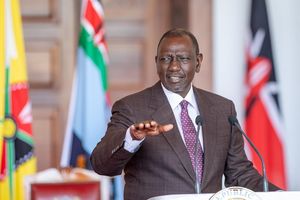
President William Ruto chairs a Cabinet meeting at State House, Nairobi.
Photo credit: PCS
Some Kenyans are skeptical, so the president has to provide details. Like many politicians, sometimes trying to understand President Ruto can feel like listening to one side of a complicated telephone conversation. He speaks quickly, moves confidently, and assumes a lot — history, policy, political memory, hustler nation, and Singapore metaphors — that he doesn’t always pause to unpack. He skips many details we wish he would spell out more fully.
However, President William Ruto’s “Singapore dream” resonates with the same imaginative power of transformation that ancient societies dreamt of.
Ancient Roman writers often imagined a utopian Golden Age of abundance. Ruto’s rhetoric, in a way, mirrors this Roman nostalgia, promising Kenya’s own Golden Age. Most voters will pause to listen, as this is appealing to their personal dream. The election is won when a politician’s dream aligns with voters’ personal dreams.
American literature offers the utopia of the “City upon a Hill,” an exalted and shining beacon for the world. The City upon a Hill later became the American Dream, an aspiration for prosperity, peace, and freedom. Ruto’s Singapore mirrors this, serving as Kenya’s own City upon a Hill — a beacon of hope for Africa.
President William Ruto inspects a guard of honour mounted by the Kenya Defence Forces along Parliament Road, Nairobi ahead of the Sate of the Nation address on November 20, 2025.
Photo credit: Dennis Onsongo | Nation Media Group
There are several reasons why political narratives like the Singapore dream work. The first reason is that they offer a clear symbol of success. A single place-name — Singapore — instantly evokes efficiency, order, prosperity, and global competitiveness. For a politician, a symbol as potent as Singapore does the heavy lifting in making communication easier.
The second reason is that political narratives distil complex issues like economic reforms into a simple narrative that condenses all into one memorable idea that people can rally around—and can even turn it into a meme or song.
The third reason is that political narratives invite citizens to dream together and to create a shared mental picture of what the nation could become.
This is essential for building political momentum and euphoria. And this, if not countered by a more powerful and opposing dream, could become unstoppable and easily win an election.
The fourth reason is that political narratives provide a benchmark for progress. People understand the promised change better when they can compare it to a real-world example like Singapore.
The fifth reason is that political narratives balance hope with realism. A good political narrative acknowledges challenges but insists that transformation is possible. It keeps hope alive without denying the struggle. Without that, a presidential campaign is boring and bound to be a losing one.
President Ruto has a job in selling his new Singapore dream to Kenyans. However, he has spelt it out and invited the opposition to counter with their own vision for a better Kenya. And with that, the battle lines for narratives for the 2027 election have been drawn.