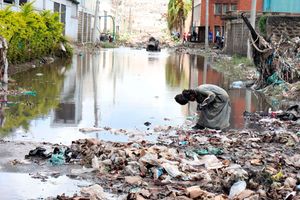
A few kilometres from Sai Road in Nairobi’s Industrial Area, a sprawling heap of waste sits beside the Nairobi River, spreading across what was once part of the water channel.
The mound of garbage which residents say has been growing for years through illegal dumping, now acts as an artificial barrier along the river’s path.
When heavy rains pounded the city last Friday, the consequences of that obstruction quickly became clear.
As stormwater rushed through the drainage systems and tributaries feeding the Nairobi River, it encountered resistance where the dumpsite had narrowed the channel.
With nowhere to flow downstream, the river slowly swelled, pushing its banks outward before spilling into nearby industrial premises.
Inside the warehouse of Printwell Industries Ltd, Managing Director Sharmila D’Cunha watched helplessly as the floodwaters spread across the factory floor swallowing machines that had taken years to acquire.
For more than two decades, the printing company had steadily grown its operations in the Industrial Area, employing dozens of workers and investing millions of shillings in specialised equipment.
Yet within minutes, much of that investment lay submerged in muddy water.
“In a span of seconds, everything was under water,” Ms D’Cunha said as she surveyed the damage days later. She said the flooding was not simply the result of heavy rain, but the culmination of years of warnings that went unheeded.
Printwell Industries Limited Managing Director Sharmila D'Cunha at the company premises on March 9, 2026, as the firm counts losses running into millions after last week’s heavy rains caused nearby rivers to burst their banks, sending floodwaters through the facility and submerging heavy printing machinery, paper stock, and printed books.
Photo credit: Bonface Bogita | Nation
“We have tried and I think we have lost the battle. This illegal dumping is really affecting all of us because when it rains, the water washes down the waste and all the drainage channels are blocked,” she said.
Efforts by businesses in the area to persuade both the national government and the Nairobi City County administration to clear the dumpsite have not borne fruit.
“We suspect there are powerful people within the establishment who are behind the dumpsite. It has become an exercise in futility,” she said.
For the employees who worked at the facility, the flooding has introduced a new uncertainty. Some of the machines that powered the company’s operations may never function again, raising fears that workers could lose their jobs if production fails to resume soon.
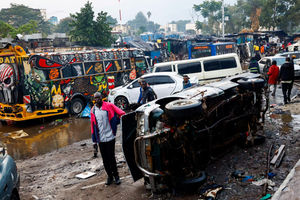
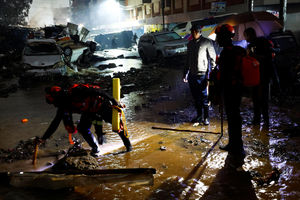
The devastation at Printwell is one of many stories emerging across Nairobi after the floods that have so far claimed the lives of at least 49 people and left a trail of destruction across homes, businesses and critical infrastructure.
As the city begins to recover, the disaster has exposed a long-standing problem that urban planners and environmentalists say has been steadily worsening beneath the surface.
Years of unchecked construction on riparian land, illegal dumping of waste along riverbanks and weak enforcement of environmental regulations have gradually transformed Nairobi’s waterways into narrow and fragile channels incapable of handling intense rainfall.
Nowhere is this more visible than in the Industrial Area where the Ngong River snakes through a dense network of factories and warehouses.
A spot check across the neighbourhood reveals a landscape where development has crept dangerously close to the water’s edge.
In several locations, perimeter walls belonging to factories extend directly into the river corridor narrowing the channel that was originally meant to carry storm water away from the city.
At Sai Road, one such wall stands across a drainage path that once connected storm water channels to the Nairobi River.
Several storm waterways have also been partially blocked by construction and debris, altering the natural flow of water during heavy rains.
Printwell Industries Limited's premises on March 9, 2026. The company counts losses running into the millions after last week’s heavy rains caused flooding that submerged heavy printing machinery, paper stock, and printed books.
Photo credit: Bonface Bogita | Nation
The situation raises uncomfortable questions about how Nairobi has managed its rivers over the years, particularly after a government campaign that promised to reclaim riparian land and restore the waterways.
In 2024, President William Ruto ordered the demolition of structures located along riverbanks and wetlands across the country, following widespread flooding that displaced thousands of families.
Bulldozers were deployed to informal settlements situated along river corridors, flattening houses that authorities said had been constructed illegally.
At the time, the demolitions were presented as a necessary step toward restoring the natural drainage systems that protect cities from flooding.
Yet a spot check across several neighbourhoods in Nairobi this week suggests that the crackdown may have been uneven.
While many informal settlements were cleared, several commercial developments appear to have escaped the demolition exercise.
In some areas, new structures have even been erected on land that had previously been identified as riparian.
One such example lies in Kileleshwa along the tributary of the Nairobi River that passes near the junction of Ring Road and Laikipia Road.
On the morning of August 7, 2018, a multiagency team composed of officers from the National Environmental Management Authority, the Nairobi City County government and the National Youth Service arrived at the location armed with excavators.
Among the buildings brought down were a petrol station, a restaurant and several residential properties whose developers had been accused of destroying the river’s natural ecosystem.
Barely seven years later, the same location now hosts a three-storey shopping centre and another petrol station.
Urban planners say such developments dramatically alter the landscape by replacing permeable soil with concrete surfaces that accelerate the flow of rainwater into rivers while simultaneously narrowing the channels that carry it away.
Further north in Parklands area, a walk along 1st Parklands Avenue from Mpaka Road to Limuru Road reveals a similar pattern.
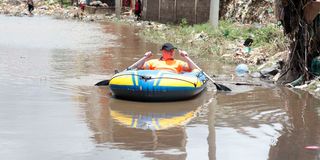
Ian Bernard, an employee at Printwell Industries Limited, uses a small inflatable boat to navigate the flooded Sai Road in Nairobi’s Industrial Area on March 9, 2026, after heavy rains left the street submerged, making movement difficult for residents and workers.
Photo credit: Bonface Bogita | Nation
A number of buildings have been constructed close to a tributary that feeds into the Nairobi River, leaving little space for the waterway to expand during heavy rains.
But the canal often struggles to contain the volume of water that flows through it during intense rainfall, forcing the excess water to spill into nearby streets.
Along Kirinyaga Road, the busy Grogan area presents another long standing challenge for city planners. Hundreds of mechanics operate garages and spare parts shops along the banks of the Nairobi River, forming one of the largest clusters of automotive businesses in the capital.
In 2020, Nairobi City County announced plans to relocate the mechanics to a new site along Thika Road so that the riverbank could be restored.
The growing concerns about unchecked development have also drawn attention to Nairobi’s building approval system.
Last month, the Commission on Administrative Justice recommended the prosecution and removal from office of five senior officials at City Hall over what it described as a deeply flawed system for approving building plans.
Those singled out in the findings included Built Environment and Urban Planning Executive Stephen Mwang, Urban Planning Chief Officer Patrick Analo, the Assistant Director for Development Control Frederick Ochanda, Simon Omondi, a Development Control Officer and Tom Achar, the Director of Planning, Compliance and Enforcement.
According to the investigation, systemic failures in the county’s planning and enforcement machinery have allowed developments to proceed in areas that should have remained protected.
Despite the findings implicating them in irregular approvals, the officials remain in office.
The Environmental Management and Coordination Act requires developers to conduct environmental impact assessments before constructing near water bodies. It also mandates a buffer zone ranging from six to thirty metres along riverbanks in order to protect ecosystems and reduce the risk of flooding.
Under the law, the National Environmental Management Authority (Nema) is responsible for enforcing these regulations through inspections, licensing and demolition orders where necessary.
However, critics say the agency’s enforcement capacity has struggled to keep pace with Nairobi’s rapid growth. Yesterday, repeated attempts to obtain comment from Nema Director General Mamo Mamo on the measures being taken to curb encroachment on riparian land did not receive a response.
President of the Institution of Surveyors of Kenya Eric Nyadimo said the city must strengthen development planning if it hopes to avoid recurring disasters.
“If you are going to put-up high-rise buildings, then you must reinforce the aspect of property management,” he said, noting that drainage systems and sewer networks must be designed to accommodate the growing density of urban development.
“This cannot be taken for granted because when infrastructure is ignored, the consequences eventually show themselves during extreme weather.”
Legal experts say the responsibility for addressing the problem does not rest solely with government agencies. Senior Counsel Nelson Havi argues that developers themselves must be part of the solution, particularly where their projects have contributed to environmental degradation.
“Strictly speaking, a majority of these buildings are illegal structures erected on rivers and swamps,” he said, adding that both developers and authorities share responsibility for remedying the damage that has already been done.