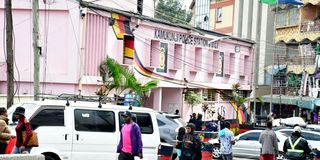
Kamukunji Police Station in Nairobi is set for its biggest transformation since it was established as the government prepares to make it the headquarters of the proposed Nairobi Metropolitan Police Unit (NMPU).
Located at the heart of one of the city’s busiest and most demanding policing zones, the station has been identified as the ideal command centre for coordinating security operations across the capital.
Every day, officers at Kamukunji contend with the challenges of policing an area where wholesale markets, transport hubs, banks, businesses and densely populated estates converge.
If the plan proceeds, the ageing station will be redeveloped into a modern security complex complete with operational offices, police housing and an Integrated Command and Communication Centre (IC4), enabling real-time surveillance, communication and emergency response across Nairobi.
The ministry said Kamukunji was selected because of its strategic location at the heart of Nairobi’s commercial activity and the complex security demands associated with it.
“Kamukunji is one of Nairobi’s clearest representations of the city’s role as Kenya’s commercial and financial centre while operating within a complex urban security environment,” the ministry said in a statement on Friday.
The multi-agency inspection team included representatives from the Kenya Defence Forces, the Kenya Police Service, the Administration Police Service, Nairobi City County Government and the State Department for Housing and Urban Development.
The assessment sought to determine whether the station was suitable to host what is expected to become the nerve centre of policing in Kenya’s capital.
Kamukunji sits at the crossroads of some of Nairobi’s busiest commercial districts. It borders the Central Business District and serves Gikomba Market, Muthurwa Market, Eastleigh and surrounding industrial and residential neighbourhoods.
Thousands of traders, commuters and motorists pass through the area every day.
The neighbourhood is also home to major financial institutions, government offices, transport corridors and wholesale businesses, making it one of Nairobi’s key economic engines.
But the same characteristics that make the area commercially vibrant also present significant policing challenges.
The movement of large crowds, heavy traffic, informal trading, public demonstrations and organised criminal activity requires constant coordination among multiple security agencies.
According to the Kenya Police Service, Kamukunji Police Station handles an average of about 170 reported incidents every day, making it one of the busiest police stations in the country.
The cases range from theft, robbery and assault to drug-related offences and other serious crimes.
The Interior Ministry says establishing the metropolitan headquarters at Kamukunji will enable commanders to monitor incidents across Nairobi in real time, deploy officers more rapidly and improve coordination among security agencies.
The announcement comes weeks after Interior Cabinet Secretary Kipchumba Murkomen said preparations to establish the Nairobi Metropolitan Police Unit had reached an advanced stage.
On July 1, Mr Murkomen said he had received a briefing from a technical team developing the operational framework for the specialised unit.
“The Nairobi Metropolitan Police Unit will be a model for future policing in Kenya. We must therefore get it right,” he said.
The meeting brought together Inspector-General Douglas Kanja, Director of Criminal Investigations Mohamed Amin, Deputy Inspectors-General Eliud Lagat and Gilbert Masengeli, and Nairobi County Head of Law Enforcement Eva Wangechi.
The specialised unit is expected to strengthen coordination among security agencies operating across the Nairobi Metropolitan Area.
Its responsibilities will include crime prevention, public order management, protection of critical infrastructure, intelligence-led policing and traffic management.
Government officials say the unit is designed to respond to the changing nature of security threats in a rapidly growing city whose daytime population swells to millions as people commute into the capital for work and business.
The government says the Nairobi Metropolitan Police Unit has been modelled on policing systems used in major cities around the world.
Officials have undertaken benchmarking visits to study metropolitan policing models in the United Kingdom, the United States, Italy and Japan.
The focus has been on how these cities use technology, integrated command centres, community policing and intelligence-led operations to manage complex urban security environments.
Those lessons are expected to shape both the structure of the new unit and the design of its headquarters.
Once completed, the facility will provide real-time surveillance, communication and operational coordination, enabling security agencies to respond more quickly to emergencies and major incidents.
The project forms part of wider reforms within the National Police Service aimed at modernising policing, strengthening community partnerships and improving coordination among security agencies.