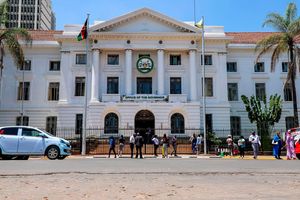
The High Court has dismissed Nairobi County Government's attempt to block payment of Sh498.7 million to a lawyer for legal services rendered 18 years ago, spotlighting persistent disputes between City Hall and advocates over unpaid fees from the defunct city council era.
Mr Samson Masaba, trading as Munikah & Co. Advocates, has secured a reprieve after the High Court dismissed an application by the county government to quash the advocate’s bill for the services procured in 2006.
“The applicant has failed to demonstrate any error of principle that would warrant this court’s interference. The allegation that the respondent is seeking to be paid twice for the same work is factually incorrect and not borne out of the record,” said Justice Helene Namisi.
The heart of the dispute was that the advocate had initially been awarded Sh60.7 million as payment for representing the city council in a dispute related to land rates.
According to the county government, the lawyer should not have billed the City Council an extra Sh498.7 million for the services rendered after the case developed.
City-based lawyer Donald Kipkorir to receive Sh1.3 billion from Nairobi county government.
Photo credit: Pool
The court’s ruling comes at a time the city county government is involved in another dispute with lawyer Donald Kipkorir over payment of Sh1.3 billion for his legal services to the defunct county council in April 2012 in a court dispute involving military land ownership.
This dispute mirrors another 2017 case where the city county government was ordered to pay lawyer Prof Tom Ojienda Sh264 million arising from five cases he represented the devolved unit in 2014.
In Mr Masaba’s case, the amount has been subject to previous court proceedings, with one of the rulings issued in June 2022 indicating that the sum had increased to Sh800 million.
The court papers show that the advocate was hired by the defunct City Council of Nairobi in 2003 to file a suit on its behalf for recovery of rates against the Commissioner of Lands. For this, he was awarded Sh60.7 million in January 2007.
But he was rehired in July 2007 after the Attorney General sued the City Council claiming Sh13 billion. The AG’s counterclaim was in reaction to the 2003 main suit, and the city council issued fresh instructions to the lawyer to defend it.
The lawyer successfully represented his client, and the counterclaim was ultimately dismissed with costs, which were taxed at Sh498.7 million in August 2012 by the court.
The bill remained unsettled, and on February 16, 2024 filed an application at the High Court seeking to set aside the advocate’s remuneration award, arguing that it was erroneous to pay the advocate twice.
It contended that the counterclaim does not constitute a separate suit for which a distinct bill of costs can be raised. Another argument was that the filing of the second bill of costs was irregular and an attempt to unjustly enrich the advocate at the expense of public funds.
However, in response, the advocate maintained that the second bill was justified as it arose from a separate and distinct set of instructions to defend a counterclaim that was filed long after the initial claim had been settled.
He argued that a counterclaim, for all intents and purposes, is an independent suit against the plaintiff.
It was his case that an advocate is entitled to charge separate instruction fees for prosecuting a claim and defending a counterclaim.
The City Hall building in Nairobi as pictured on April 19, 2021.
Photo credit: File | Nation Media Group
Justice Namisi ruled in his favour, expounding that the first bill was for prosecuting the main suit while the second was for defending the counterclaim.
“These were two distinct sets of instructions and two distinct scopes of work. The allegation of a scheme to defraud public funds is a serious one and ought not to be made lightly. On the evidence before me, it is unsubstantiated,” said the judge.
She observed that defending the counterclaim was not a continuation of the old mandate, but the commencement of a new one.
“The work involved in analysing, responding to, and ultimately defeating a claim of such magnitude is separate, distinct, and substantial. The respondent was, therefore, fully entitled to file a separate bill of costs for this distinct work,” stated the judge.
The judgment sets a precedent for distinguishing legal fees in counterclaims, potentially affecting future disputes over public sector payments.
Justice Namisi's distinction between 'continuation' and 'new mandate' sets a benchmark for similar cases involving government entities.