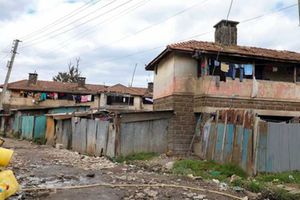
In this weekly series on living in Nairobi, Sammy Kimatu and Elvis Ondieki venture into the Mukuru informal settlements. Bordering the city’s industrial zones, their origins track back to the new post-independence Kenya where Nairobi’s population was rising, but the average industry worker’s pay wasn’t
In the beginning, there were quarries. After the quarries came the depressions, which are called “mukuru” in the Kikuyu dialect.
On those former quarries rose informal settlements, especially in post-independence Kenya, and they got various names.
In one area, there was a drinking joint called “Kwa Njenga” (Njenga’s place) that was run by Njenga Mwenda Kariuki, who died in 2021. Somehow, Njenga’s family once told the Nation , this place came to be known as Mukuru kwa Njenga.
In another area, there was a space originally owned by Jack Reuben, a Briton. Some accounts say he used to farm there and had staff quarters, and these grew into a settlement that is today Mukuru kwa Reuben.
While other records indicate the name as “Reuben”, some say the correct spelling is “Ruben”. However, in official records, it is named Mukuru kwa Reuben.
More and more “mukuru” sprung up in an area where quarrying used to happen. One of the areas, it is said, was fenced using the thorny Kei apple plants. Kei apples are commonly called “kayaba”, and so it became Mukuru Kayaba.
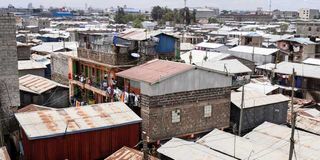
A trader sells cereals at his structure on October 10, 2025, at Naiobi's Mukuru-Kayaba slum in South B, Starehe Sub-county.
Photo credit: Sammy Kimatu| Nation Media Group
That was not the last Mukuru. Sinai, Paradise, Jamaica, Kingstone, Mariguini, Fuata Nyayo, Sokoni, Maasai, Hazina, Matress, Commercial, Tetrapak, Reli, Shimo la Tewa, Kenya Wine and Kaberira are among the other settlements with the “Mukuru” prefix.
In 2017, Technical University of Kenya (TUK) lecturer Melissa Wanjiru-Mwita conducted a study on the naming of three informal settlements in Nairobi.
She did it alongside Kosuke Matsubara of the University of Tsukuba in Japan. They released their findings in an academic paper titled Slum Toponymy in Nairobi, Kenya: A Case Study Analysis of Kibera, Mathare and Mukuru.
Writing in The Conversation in 2021, Dr Wanjiru explained how the Mukuru names came about.
“These names make reference to the lifestyle of residents as well as the living conditions. Jamaica and Kingstone point to the Rastafarian lifestyle adopted by some young people,” she stated.
“One is named Sinai after a mountain in Israel because it’s on relatively high ground. Another is called Moto Moto (meaning fire or hot in Kiswahili), because of the settlement’s fire hazards. In fact, one of the worst fire tragedies in Kenya in the recent past was the 2011 Sinai fire caused by a fuel spillage. It led to the death of 120 people and 100 more were injured,” she added.
Dr Wanjiru, a lecturer in the TUK Department of Architecture, Design and Planning, further noted that “Mukuru is a particularly hazardous settlement to live in”.
“It has an oil pipeline, high voltage electricity transmission lines and the highly polluted Nairobi River running through it. The settlement has 21 villages, or neighbourhoods,” she stated.
The Mukurus sprawl over three constituencies in Nairobi. Mukuru Kayaba, for instance, is in South B in Starehe Constituency.
Mukuru kwa Njenga and Reuben, on the other hand, are in Embakasi South. Some sections also touch Makadara Constituency.
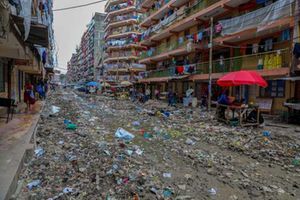
A Bodaboda rider maneuvers through a muddy road in Mukuru kwa Njenga slums on January 12, 2024.
Photo credit: Francis Nderitu| Nation Media Group
While boasting about the handover of the Mukuru affordable housing project that has 1,080 units in May, the Affordable Housing Board inadvertently painted the picture of daily living there.
“They are now transitioning from substandard living conditions to decent, dignified homes equipped with clean water, enhanced security, uninterrupted gas, reliable electricity, and other essential amenities that were once a daily struggle in their former environment,” the board said on its website.
One of the most pressing problems for Mukuru residents is garbage, and this issue came to the national limelight in July 2024 when the Kware dumping site in Mukuru kwa Njenga grabbed the headlines.
At least nine mutilated bodies stashed in gunny bags were found there, and some residents described the quarry as a common dumping ground for murder victims. One likened it to living near a mortuary.
Embakasi South Deputy County Commissioner Eric Mulevu told the Nation that government lorries will start picking the garbage and take it to the Dandora dumping site.
To have a feel of life in the Mukurus, the Nation spoke with two men who have lived in Kwa Njenga and Kwa Ruben for at least two decades each.
These are the main Mukurus, with wards named after them. Based on data from the Independent Electoral and Boundaries Commission, Kwa Njenga Ward had 28,554 registered voters in 2022; while Kwa Reuben ward had 33,591.
Eric Ambuche, 50, Kwa Njenga mobiliser
“I have been in Kwa Njenga since 2000. I came here from Kibera. I run a community-based organisation called Slums Outreach Programme, which focuses on education.
If I were to describe the typical Mukuru resident, I would say that many are employees in the neighbouring Industrial Area, but they earn peanuts.
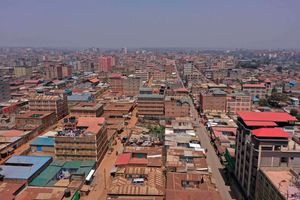
An aerial view of a section of Nairobi’s Mukuru kwa Reuben informal settlement in Embakasi South.
Photo credit: Sammy Kimatu| Nation Media Group
Most of them earn a little, and most of them are into small businesses. People live for the day; that is from hand to mouth. If you stock half a kilo of sugar at a shop, you’ll hardly sell. The highest you can stock is a quarter.
At Kwa Njenga, there is not much order infrastructure-wise. You will find one pit latrine serving at least 10 households. There are issues with sewerage and drainage, and there are no children’s playing fields. Schools also don’t have playing fields, and they don’t even have places to hoist the flag.
In terms of electricity, we use the single-wire ‘mulika mwizi’ system. Water comes from vendors, and filling a 20-litre jerrycan will cost Sh10 or sometimes Sh5. There are cartels that don’t want tap water to come here.
When it rains heavily, Kwa Njenga is a nightmare to residents. Most structures are erected on waterways. So, with the recent heavy rain, people slept on top of tables.
There is also a bigger challenge of buildings cropping up without approvals. It is a product of corruption at City Hall. Suddenly, a building goes up. It goes up to 12 floors and it doesn’t even have a lift. If things are not checked, Mukuru will become another Pipeline.
Speaking of dwellings, the threat of demolition still looms large. (There is the 2023 ruling that allowed Orbit Chemicals to repossess land in Mukuru kwa Njenga and evict locals). The Orbit property covers like two-thirds of the Kwa Njenga sub-location. Our plea is that people should be compensated before being evicted—if it ever happens.
There were demolitions that happened in October 2021, and I am among those who went to court saying people were evicted in an inhumane way and so they should be compensated. The case is still in court.
In terms of crime, the rate is high. In fact, gangs are in control as I speak to you (on October 8). They take away land from people and erect structures. If you want to put up any structure, they will come to the site.
Just today, they stopped a project that was going on to create some feeder roads in an area called Wape Wape. Someone wanted to install cabro blocks on the road, but the goons went there and said, ‘Tunataka keki yetu’. So, it has stalled.
At a recent Jukwaa la Usalama, we said we were worried about that issue. We have tried to explain to the administration to see how it can help us.
Equally, illicit brews are very prevalent. Out of 10 houses, you will find two selling illicit brews. Chang’aa is sold rampantly. We have been wondering how come Nacada [National Authority for the Campaign against Alcohol and Drug Abuse] gets a large budget yet its impact is not being felt.
There is also an issue of garbage, and it is a big problem. There is an area called Zone 48, which has a mountain of waste.”
Bernard Kyalo Nzika, 43, Kwa Reuben businessman
“I run a butchery in the area, and I have been in business since 1996. I came to Ruben in 1990 and found a few wooden and a few mabati houses. Now we have storeyed mabati and stone buildings.
Benard Kyalo during an interview on October 10, 2025, at Nairobi's Mukuru, Reuben slum in Embakasi South Sub-County.
Photo credit: Sammy Kimatu| Nation Media Group
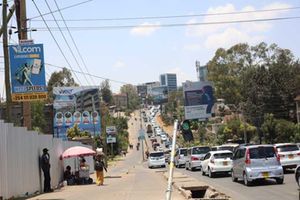
I won’t say I haven’t seen good things because there is a tarmac road constructed during Uhuru [Kenyatta’s] time. So, I can’t say I have seen nothing [positive].
The biggest problem in Ruben is electricity. There is no electricity. What we have are the wires that are used alongside the roofing and walling iron sheets.
These eventually cause fires, and when fires happen, some people cite candles or drunk people lighting matches. But all that is hogwash. There is no good supply of electricity. There used to be, but it died at some point.
In terms of security, this is not a good place. A person has to take care of themselves. It is because there are people who want to earn from other people’s sweat. Others wait for residents to go to work and then break into houses to steal valuables. If you leave a phone, you won’t get it when you return. The same case applies to woofers. Even good shoes will be stolen at night.
Benard Kyalo during an interview on October 10, 2025 at Nairobi's Mukuru, Reuben slum in Embakasi South Sub county.
Photo credit: Sammy Kimatu| Nation Media Group
However, why should you be walking about at 11pm? Won’t you meet them [robbers]? It is not safe. Once you see it is 9pm, 9.30pm,10pm, start going to your house. Even at 10pm, if you meet the youth and you have a good phone, they will steal it. It is not a very safe place, and the police won’t protect everyone. Also, when they [robbers] are arrested, they part with some amount and they are released.
Luckily, I’ve not been robbed, but I hear people complain of shops and houses being broken into.
My butchery business is not at its best level because people are struggling. Since a kilo of beef reached Sh700, it is hard to see someone buying a kilo. The quarter that used to go for Sh100 now costs Sh200. And that is not an amount you can easily get when you want flour, vegetables and other commodities. Meat is not a necessity.
People are struggling. If someone eats one cob of boiled maize for lunch, they have completed their midday meal. If you eat two bananas, you count it as lunch.
If you want to start a business here, many ventures would struggle. But mali mali [a form of barter trade] works well, in my opinion. Also, egg business works well. I’ve seen a young man who came without much money but who nowadays gets stocks in lorries.
Even a shop combined with M-Pesa isn’t the worst. You know, business is all about your strategy. You don’t just copy someone else.
In terms of land ownership, I’ve always heard that where I run my business is someone else’s land. And there was a time a Mhindi [person of Indian descent] came with a bulldozer and police. But locals were up in arms and told the Mhindi that he couldn’t pull their houses down. We asked him to show us where to go if he demolishes our houses. He retreated.
So, I keep hearing that we are living on people’s property. Every so often, I see a notice put up. It may say we have a month. But I tell people, ‘We’ve heard threats of demolition for years. I’m not moving.’ So, I just stay till the notice elapses.
One thing I tell myself is: I didn’t come here with anything. If these are people’s properties and the owners come, I will leave the space and go elsewhere. Or I can go to my rural home. I won’t fight over someone’s land.
If it’s someone’s property, and everyone else is being evicted, not just me, I will leave. However, I’ve stayed for a while. I usually see officials come and place a red ‘X’ but I never see them coming [back to follow up]. In any case, I’m almost going to my rural home in Makueni because the years have passed.
I’ve been hearing threats of demolitions, and notices being placed. At some point, groups of villagers emerged to defend residents’ rights. Each of us paid Sh2,000, but my hunch tells me someone pocketed the money.
They claimed to be going for lawyers and all. At that time, there were eviction notices. But a lawyer said no one has the right to demolish people’s properties without giving them an alternative.
Number two, you can’t demolish someone’s property without compensating them. It appears that the people who put the notices were talked to and they didn’t make good their threat. That’s the last notice I saw. So, I continue staying.
Even with the uncertainty over who owns the land, there are landlords who collect rent for the structures. We don’t know when the Mhindi will come, but you must pay rent. When he comes, we will make way, but his papers have to be okay. That’s because we’ve stayed here for a while. They say if you stay at a place for [12] years, it becomes yours [through the doctrine of adverse possession]. So, he will come here and find us here. He will have to explain the ownership.
Here, we even want to build a mortuary so that we bury our dead here. We will have our own Lang’ata [cemetery].
So, on rent, isn’t it the case that you have to pay for someone’s house? You don’t know where they got money for construction. You won’t say you can’t pay. Even if they add Sh500 in the rent, you move with it, or you get kicked out.”