In this weekly series on living in Nairobi, Jackson Ngari steps into Githurai where twin estates sit shoulder-to-shoulder yet belong to different counties. Long branded a hotbed of vice, residents say they are determined to change the narrative
Githurai 44 and Githurai 45 are often spoken of in the same breath, tagged as unsafe, riddled with petty crime, phone snatching, and slick hustles.
You hear of the black shoes that turn green at night; of soda that is just coloured water; of opportunistic traders preying on hope. But look closer today and another story emerges.
Both estates have seen gated markets, stepped-up patrols, and new infrastructure that suggest their once-stained reputations are slowly putting on a new coat.
The Thika Superhighway splits them in two. On the Kiambu side sits Githurai 45, also called Githurai-Kimbo, which is in Ruiru sub-county. Across the road is Githurai 44 that belongs to Nairobi’s Kasarani sub-county.
They got to be denoted by numbers due to the public transport route system created by the defunct Nairobi City Council and the Kenya Bus Service.
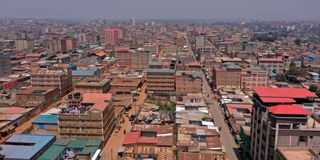
When viewed on satellite imagery, the contrast is sharp: Githurai 45 looks denser, its mabati-roofed houses tightly packed with narrow alleys and fewer open patches. Githurai 44, though still crowded, shows slightly wider grids, bigger structures, and more visible undeveloped parcels.
Mr Deonysias Mwangi, the MCA for Githurai who has been in the news over his resignation threat, described Githurai 44 as a place that isn’t a slum but which hosts many poor people.
“Ninety per cent are very needy. When I am giving out relief food, you will find a landlord coming for it because they built houses a long time ago, but they don’t have money,” he said. “It has needy people but, unfortunately, it is not categorised as a slum. It’s because it doesn’t have a slum but big plots.”
Describing the distinction between the estates, Mr Mwangi explained: “Githurai 44 and 45 are divided by a roundabout which we colloquially call Migingo Island because it’s a no-man’s island. Most people work on the Githurai 45 side but live in Githurai 44, or vice versa. The economy here [at the roundabout market] never sleeps. The market runs almost 24 hours, hotels operate all night, and streets are busy even at 3am.”
Githurai 44/45 Roundabout on Wednesday, September 26, 2025.
Photo credit: Dennis Onsongo| Nation Media Group
Mr Mwangi noted the ongoing need for better infrastructure: “One of our biggest challenges is public utility land. We need more space for schools, markets, and social services.”
He moved here in the early 1980s, when, as he recalls, “You could count the mabati shops along the road.” Now, at 51, he calls himself “a son of this place”, his life intertwined with its pavements and politics.
“This place has always been about hustle,” he said, leaning against a timber stall at the busy Soko ya Mawe open-air market.
Mr Kithuka said growth of rental flats has created new income streams for landlords and small-scale contractors. But he worries that the area has been left behind development-wise. “Our roads are poor,” he said. “The drainage is blocked, water is not consistent, and the market is so overcrowded people are forced to sell along the road.”
He pointed to the nearby Githurai 44 Primary School grounds, where a patchy football pitch sat under the afternoon sun. “Governor [Johnson] Sakaja promised to overhaul this pitch,” he said. “He even came here and said he’d make it a modern field. Up to now, nothing has been done.”
A key community hub where local talent trains, youth gather, and sports bring people together at the heart of Githurai 44, the Githurai Sports Centre.
Photo credit: Dennis Onsongo| Nation Media Group
Still, Mr Kithuka insists Githurai is improving. “People used to fear this place,” he said. “They said it was full of crime and thugs. But I want to assure Kenyans that Githurai has changed. There are good people, there are good things. Githurai is a good place.”
Security, he admitted, remains “a bit of a challenge”, but he credited local leaders for trying. “I’m thankful to our MCA because he works with the chief and the police,” Mr Kithuka said. “I think security will be good with time.”
His optimism is cautious, shaped by decades of promises and disappointments, yet rooted in a stubborn belief in the estate’s future.
If Mr Kithuka speaks as a son of Githurai 44, Ms Jane Wanjiru speaks as its watchful matriarch. At 52, the Nyumba Kumi official has lived here for four decades, seeing the place change from wild bush to a concrete maze. Her grocery stall sits along a narrow lane and it doubles as her “office” when domestic disputes spill out from the residential areas nearby.
“Whenever a problem arises, I report to the chief,” she said.
Her eyes crinkled at the memory of the old Githurai. “All these structures you see were not here,” she said. “It was just bushes.
One of her enduring memories are the times when a serial killer used to butcher people, so much so that the then president, Daniel arap Moi, asked about this notorious “Gathurai”. Those days are far gone, she says.
She is firm about the boundary that splits the two Githurais. “It was due to the matatu routes that we ended up with Githurai 44 and 45.”
A section of Githurai 44, along the Thika Superhighway, on the edge of Nairobi and Kiambu County, is captured in this photo taken on Thursday, September 25, 2025.
Photo credit: Dennis Onsongo| Nation Media Group
Yet for all the progress, Ms Wanjiru said security remains fragile. “You can’t afford to leave a door unlocked,” she said. “Chokoras (street children) will swarm in. If they find clothes soaking in a basin, they will pour them down and leave with the basin.”
That is why she closes her stall at around 8pm. “We don’t follow the 24-hour economy message here. We close early.”
By 4am, she added, the estate stirs to life. “People are up, going to the market. At Githurai 45, they start even earlier, around 2am, especially the banana traders.”
Despite her concerns, she said, Githurai offers opportunity to anyone determined enough.
“No business won’t work here,” she said. “It’s just a matter of luck and prayer. You wake up and ask God to open the door for you.”
Her biggest plea is for youth empowerment. “If they get employment, it will be great. Young men are only after freebies because they don’t have money. Sometimes they drink to forget their poverty.”
Ms Wanjiru also worries about the education environment, especially because bars are operating too close to schools.
A section of Githurai 45 as seen in this photo taken on Wednesday, September 26, 2025. Githurai 45 is a bustling urban neighborhood located on the northeastern edge of Nairobi, along the busy Thika Superhighway.
Photo credit: Dennis Onsongo| Nation Media Group
Water supply, she noted, has improved. “We have water from Tuesday to Thursday,” she said. “There was a time we didn’t have water at all, but the MCA ensured that was fixed.”
She worries, however, about the mushrooming of churches. “They are like a business now,” she said. “You make one step and you encounter a church, another step, another church. Children can’t study because of the noise.”
Still, she sees a calmer Githurai today. “Now we have a DC and his juniors [posted there]. Githurai has calmed down,” she said. “Even the rampant alcohol abuse, huwezi ona.”
For newcomers, she has a word of caution. “As a visitor, don’t go too deep into the interior when choosing a house to rent,” she warned. “Stick to the houses near the road until you know people. Otherwise, you will be taught. Lazima utafundishwa.”
She paused, then smiled. “But with time, you’ll love this place.”
Some of the most visible changes in the area are happening on the dusty playing field of Githurai 44, a pitch that the MCA says has produced greats in national football. On this pitch, 32-year-old Evance Odenyo has spent years trying to keep the area’s youth out of trouble.
A children’s teacher and coordinator of the Mathare Youth Sports Association, Mr Odenyo has lived here for more than 15 years and now oversees football development programmes across Githurai and Roysambu.
“I take care of all the games here in town,” he said. “My job is to ensure that sports development is looked after.”
A section of Githurai 45 as seen in this photo taken on Wednesday, September 26, 2025. Githurai 45 is a bustling urban neighborhood located on the northeastern edge of Nairobi, along the busy Thika Superhighway.
Photo credit: Dennis Onsongo| Nation Media Group
“There are no big companies here. It’s mostly small businesses,” he said. “This is a place where people start their lives.”
Mr Odenyo says the cost of living has risen, but Githurai – whether 44 or 45 – remains relatively affordable. Garbage collection is erratic — even as community clean-up groups such as the Green Army have helped phase out illegal dumping sites that once festered near the football grounds.
“There used to be a big dumpsite behind the pitch. It had a very bad stench,” he recalled. “Now that it’s gone, the environment is better, cleaner.”
A section of Githurai 44, along the Thika Superhighway, on the edge of Nairobi and Kiambu County, captured in this photo taken on Thursday, September 25, 2025.
Photo credit: Dennis Onsongo| Nation Media Group
He credits devolution for giving ward representatives and governors more responsibility and visibility on the ground, though he wants more done.
“They’ve done a lot, not the level we want yet, but I can give them a little credit. It’s not what it was five years ago,” said Mr Odenyo.
Security, once Githurai’s biggest challenge, has also improved. But Mr Odenyo warns that joblessness and drug abuse continue to endanger youth.
“Those are the perceptions that have been there,” he said of the area’s crime reputation. “These days it has gotten better… There is a decline, but drug abuse is still here. It consumes a lot of young people.”
“It would be great if other stakeholders would put hands together, even the police,” he said, adding that security presence remains thin for the area’s dense population.
Yet, despite the gaps, Mr Odenyo maintains that Githurai 44 is far from the danger zone that many think it is.
“Actually, it’s the safest place within Nairobi,” he said. “It’s a place where people are united…I encourage people to come to Githurai.”
His hopes for the future are simple; more public schools, a bigger health centre, and safe playgrounds for children.
Even eSports, he adds, has started opening new doors for young people.
“It has helped us a lot… Currently we have a national team of three,” said Mr Odenyo.
Pastor Rhoda Mwihaki has lived in Githurai 44 for nearly 20 years. There, she runs a church called Kingdom’s Sanctuary Fellowship. When she is not preaching, she’s usually at the nearby Soko ya Mawe market, designing and sewing clothes.
“I am a pastor here in Githurai 44,” she says. “And I also work as a designer. I make clothes for children, for mothers, for boys, even wedding dresses when someone asks.”
Ms Mwihaki first arrived in Githurai 44 from Eastleigh 17 years ago, long before the Thika Superhighway carved its sleek path through the once-quiet outskirts. She remembers when Githurai 44 was slower, less crowded, and safer.
“Back then, we used to walk from the stage home without fear,” she recalls. “It wasn’t very busy. Now, it’s different. The highway brought change, both good and bad; it’s very busy, and crime has really increased.”
Even as she celebrates Githurai 44’s transformation into a lively commercial hub, she says there are problematic areas. “The drainage and sewerage are a big problem,” she says. “Sometimes, when it rains, sewage even enters our church.”
She opened her church in February after years of serving under other bishops. “By the grace of God, I have seen His faithfulness. He cannot abandon you,” she says.
To her, Githurai 44 is chaotic yet full of promise: “There are many people, and there’s a lot of business. It’s a good place.”
Regarding the neighbouring Githurai 45, many residents know it to be more than just a busy Nairobi estate; it is a gateway to city life.
A section of Githurai 45 as seen in this photo taken on Wednesday, September 26, 2025. Githurai 45 is a bustling urban neighborhood located on the northeastern edge of Nairobi, along the busy Thika Superhighway.
Photo credit: Dennis Onsongo| Nation Media Group
Mr Leonard Ngatia, who has lived there for years, describes it as the kind of place where someone arriving from the countryside can find their footing.
“Githurai 45 is the safest place where you can start your life,” he says. “If you are a first-timer or you’ve just moved from the rural [areas], it’s a good place to settle because life here is affordable. Housing is cheaper, food is easy to access from the market, and generally it is safe for everyone.”
Mr Ngatia insists that while outsiders often confuse the area with its neighbour across the highway, Githurai 44, the two places differ greatly.
“Githurai 45 is a bit safe compared to the other side,” he explains. “In Githurai, 44 you frequently hear stories about insecurity, but I’ve lived here for years without a single encounter with robbers, either during the day or night.”
Still, Githurai 45 is not without its challenges. Congestion is the most pressing.
A section of Githurai 45 as seen in this photo taken on Wednesday, September 26, 2025. Githurai 45 is a bustling urban neighborhood located on the northeastern edge of Nairobi, along the busy Thika Superhighway.
Photo credit: Dennis Onsongo| Nation Media Group
“During rush hour, the population overwhelms the place,” Mr Ngatia says. “There’s heavy traffic, crowds spilling onto the streets, and sometimes even a shortage of matatus to ferry people to town.”
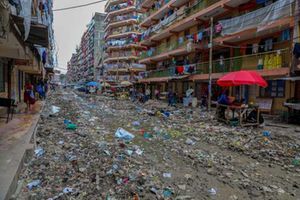
He adds that garbage collection is another concern. “On many streets, you’ll find heaps of uncollected waste. If that could change, Githurai would be an even better place to live.”
Despite these shortcomings, Mr Ngatia remains attached to his neighbourhood.
“You can access housing and all the basic needs at affordable prices. That’s what makes it home for me,” he says, beaming.
The Githurais at a glance
Githurai is one settlement split by the Thika Superhighway: Githurai 44 (Nairobi County, Roysambu ward) and Githurai 45 (Kiambu County, Ruiru/Githurai sub-county). >Location
Githurai 44: Sits inside Roysambu sub-county / Kasarani area of Nairobi City County. Adjacent to Zimmerman, Kahawa West and Mirema. Githurai 45: Lies across Thika Road in Ruiru (Kiambu County), often called Githurai Kimbo. It functions as the Kiambu-side market/transport hub for the wider Githurai area. >Size and footprint
KNBS lists Githurai sub-locations within the 2019 census. Local summaries place the combined Githurai population at 265,863.
Mixed housing: formal low-rise flats, maisonettes and extensive informal/plot subdivisions.
Highly informal, mixed economy: small retail shops, open markets, matatus, boda boda, food vendors, and light manufacturing/SMEs. >Development and infrastructure
Public services: new/expanded health facility (Githurai 44 Level 3 hospital) and other small clinics and schools.