In this weekly series on living in Nairobi, Elvis Ondieki and Sammy Kimatu head to the eastern side of the city where they encounter an estate rich in history but threadbare in liveability and amenities; where tenants in makeshift extensions pay more in rent than those who live in stone houses.
In Nairobi’s Kaloleni Estate, which is next to City Stadium on Jogoo Road, those living in the main houses pay between Sh1,980 and Sh2,200 a month to the county government to maintain their tenancy.
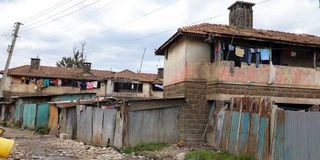
However, those residing in makeshift iron sheet structures attached to the stone-walled and tile-roofed main houses pay up to Sh5,000 as rent to private individuals.
“The extensions are more expensive than the city council houses,” says Levi Wanjala, a 59-year-old who was born and raised in the estate and is now a village elder there.
To understand why tenants pay about Sh2,000 to live in such a prime area requires a grasp of the history of Kaloleni.
The first thing that Kaloleni Estate Residents Association (Kera) Chairman Ezra Omondi Olack would want anyone to know is that the houses were given to people who fought in the Second World War alongside the British.
He says as descendants of former fighters, they should, in fact, not be paying anything.
“It was a reward for the veterans,” says Mr Olack. “My grandfather died in the war. He never came back.”
However, there are families dwelling there who did not have a relative fighting.
“Residents of this place are mostly those who were aligned with the whites. Those who were pro-whites before independence inhabited a large area of Nairobi: Kaloleni, Ziwani, Pangani, Ngara,” says Mr Wanjala.
“I don’t have any other home apart from here,” he says. “When we die, we [will be buried in] Lang’ata.”
He adds that people such as him have accepted the concept of burial in a public cemetery or being cremated when they die.
“Who said that everybody who lives in Nairobi must have come from a rural village?” poses Mr Olack. “We have been profiled when getting national IDs as you must state a [countryside] location.”
Currently, Kaloleni sits in its place like a neglected octogenarian. After all, 2026 will mark 80 years since construction of the houses there began.
A section of Kaloleni in Nairobi County, located approximately 3 kilometers southeast of Nairobi's Central Business District (CBD).
Photo credit: Dennis Onsongo| Nation Media Group
There were days, still stuck in Mr Wanjala’s boyhood memories, when Kaloleni was lush and lively. He remembers times when you would look at the estate from a vantage point and not see a roof, as trees were thriving all over.
“It was leafy like today’s Muthaiga. You couldn’t see roofs,” says Mr Wanjala.
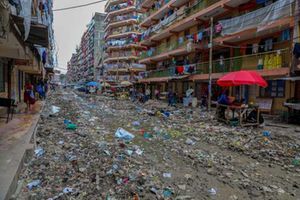
That is long gone. In its place is an area steeped in malaise and which looks like a tool its owner doesn’t know what to do with it and has left it to the elements. Most residents have not had running water for years, garbage lies on roads as if that is its anointed place and stagnant water dots the landscape like an immovable curse.
Garbage strewn at the entrance of Kaloleni in Nairobi County, located approximately 3 kilometers southeast of Nairobi's Central Business District (CBD).
Photo credit: Dennis Onsongo| Nation Media Group
The old Kaloleni has strong ties to Kenya’s history, especially in the country’s late colonial period and early post-colonial eras.
“It’s an estate full of history and heritage,” says Mr Olack.
In 2014, the estate’s cityscape was gazetted as a national monument by the then Culture Cabinet Secretary Hassan Wario.
A Kenya Gazette notice issued on September 25, 2014, and published in the gazette’s issue of January 23, 205, said Mr Wario considered Kaloleni’s cityscape to be of historical interest and so it needed to be protected as per the National Museums and Heritage Act.
The Britannica Encyclopaedia defines cityscape as the area where a city is and the way it looks. It means that through the gazette notice, the appearance of Kaloleni was frozen in time.
“Streetscape means anything adjacent to that street. For a road, it refers to any tree or any house or anything adjacent to it,” Mr Olack says. “So, all streets in Kaloleni are national monuments.”
A section of Kaloleni in Nairobi County, located approximately 3 kilometers southeast of Nairobi’s Central Business District (CBD).
Photo credit: Dennis Onsongo| Nation Media Group
In the same gazette issue, the Kaloleni Social Hall was also declared a national monument.
“All that building known as Kaloleni Social Hall and the surrounding compound, measuring approximately two acres … situated, in Kaloleni sub-location in Makadara Division in Nairobi County… to be a national monument within the meaning of the Act,” read the notice.
Besides its links to the Second World War veterans, it also became a key gathering place for leaders agitating for independence in Kenya and beyond.
An iconic May 1963 photo captured Jomo Kenyatta, Tom Mboya and Mwai Kibaki were celebrating outside the Kaloleni Social Hall.
Their Kenya Africa National Union (Kanu) party had just won a majority of the seats in the House of Representatives, meaning it could go ahead and form the first government in post-colonial Kenya.
Mr Philip Koima, Makadara Deputy County Commissioner, says Kaloleni was part of the colonial government’s plan to house the black population.
“They had segregation of the population into blacks, Asians, and whites. So, the blacks were placed in Eastlands while the Asians were put around the area of Parklands and also South B,” he says, adding that areas such as Karen were reserved for the whites.
That is why, he says, the black elite in the colonial period lived in areas such as Jericho and Kaloleni.
For instance, Mr Milton Obote (1925-2005), who was the President of Uganda for 10 years, was once a resident of Kaloleni and was the head of the residents’ association.
Trade unionist Tom Mboya was also once a Kaloleni resident, as was Barack Obama Senior, the father or America’s 44th president. Mr Olack says Kaloleni once played host to numerous leading figures in African politics.
“People like Julius Nyerere, Kwame Nkrumah, people like Joshua Nkomo, people like Mengistu [Haile Mariam] used to come here. There were so many leaders who came here. They came to talk about independence,” he says.
Mr Wanjala says that the construction of Kaloleni began in 1946 but had been mooted much earlier. Italian prisoners of war captured during the Second World War were used to construct the houses, using mostly imported materials.
Levi Wanjala, a village elder in Kaloleni Estate in Nairobi, during an interview on September 4, 2025.
Photo credit: Sammy Kimatu| Nation Media Group
When they were done, black survivors of the war were allocated houses there. Mr Olack says this was a way of honouring them.
“For those who managed to come back, they got houses,” he says.
“The war veterans resided in that place for many, many years,” notes Mr Koima. “They settled there and later it became the property of the county council.”
Some residents claim that the initial arrangement was that after a certain period, occupants would become permanent owners. However, there is no concrete evidence.
As it stands today, the houses are under the city county, which collects rent.
“It was not supposed to be rent; it was supposed to be service charge,” says Mr Olack, adding that this is one of the injustices residents have been subjected to.
As a young boy, Mr Wanjala loved life in Kaloleni.
“There were no sewerage clogging issues. Blockages after rain were unheard of. Also, the street lighting was just perfect,” he says.
“Roads were tarmacked and they had good pavements. There wasn’t anything to do with overgrowing grass or bushes. There were ditches that were well cemented to carry runoff water.”
A section of Kaloleni in Nairobi County, located approximately 3 kilometers southeast of Nairobi’s Central Business District (CBD).
Photo credit: Dennis Onsongo| Nation Media Group
Equally, he notes, the local authorities would clear grass and fumigate ditches to check against insects.
“This was a place where you could walk about comfortably. At the moment, if you walk, you will spot many stray dogs. Those days, they could be taken away. We also had by-laws. Those by-laws were in use, and they prohibited people from rearing animals. Whoever wanted to do so needed a permit,” says Mr Wanjala. “We used to have a very effective water system. We used to bathe using showers. When you flushed the toilet, everything worked as it should.”
“This estate has a huge population now of over 40,000 to 50,000 people,” says Mr Koima. “It has been turned almost into an informal settlement because of the old structures. We also have illegal structures now, made of corrugated iron sheets.”
According to Mr Wanjala, the structures – popularly known as extensions – started as an innocent effort to accommodate growing families.
“The original house owners started having families. And those families got families. This is the second or the third generation who are there now,” says Mr Wanjala.
After some time, residents thought of making a quick buck by renting out the extensions, and that ballooned into a crisis. Open spaces where a person could rest comfortably with a mattress disappeared, and in their place rose iron sheet structures.
Mr Wanjala says at some point, when the late Karisa Maitha was the Local Government minister, the extensions were brought down, but they later resurfaced.
As the population increased, so did the number and eyesores in the name of extensions. This stretched facilities such as sewerage and water.
In Mr Wanjala’s view, politicians should shoulder some blame for allowing the springing up of extensions.
“If the council bars construction, a politician will say, ‘These are my people, where are they going? Where are you relocating them to?’ The politician does that knowing that the more people there are, the better for them. So, politicians have also encouraged the vice,” he reasons.
Water vendors in Kaloleni Estate, Nairobi County, sell water at Sh5 per 20-litre jerrycan on Thursday, September 11, 2025, providing a crucial lifeline in a community grappling with persistent water shortages and supply crises.
Photo credit: Dennis Onsongo| Nation Media Group
“This is an area which… already should have been upgraded into modern buildings or estates, because actually it is within the centre of Nairobi city, near the CBD Nairobi region,” says Koima, noting that there is a plan to develop the Eastlands area.
“Jogoo Road is going to have an upgrade. In the next five to 10 years, you will see a huge change or transition and transformation within these Eastlands [estates],” the official adds.
Mr Olack, however, feels that the city county has abandoned Kaloleni deliberately to achieve other ends. He has two demands to make.
“One, our forefathers need to be compensated by the British. Two, we need to get back our houses [by owning them permanently],” he says.
As the local elder, Mr Wanjala notes that some of the problems he handles relate to tenants in the extensions and also cases where individuals “sell” land for others to put up mabati structures to rent out.
Mr Koima says among the security problems Kaloleni faces is the existence of Ochimbo area where “we have challenges of even illicit brews and also criminal gangs, which often emerge or even are active”.
Another major issue in Kaloleni is piped water. Save for boreholes sunk at the height of Covid-19, there is no other source of water in the estate. Vendors have capitalised on the situation, and you will not miss a cart packed with jerry cans awaiting buyers on a visit to Kaloleni.
“Water is brought in carts that come from Shauri Moyo in another sub-county – Kamukunji,” says Mr Wanjala.
He adds that the piped water system died when residents agreed to pay water bills alongside their rent. As a result, the county removed all the water meters.
“Water flowed for a short while, without meters, and the rent was increased to cater for that. Eventually, that water was cut off,” says Mr Wanjala. “They started with rationing, then finally it disappeared completely.”
Also, Kaloleni is the site of one of the worst accidents in the history of the Kenya Air Force. On April 16, 1992, a Buffalo aeroplane that had left the Moi Air Base developed mechanical complications and the pilot was cleared to return.
However, the pilot lost sight of the runway and crashed into houses in Kaloleni.
All the 42 people on board, plus the four crew, died. Six other people in the houses where the plane landed were also killed. A total of 52 people died in the morning incident.