It is 5 pm as a black Mercedes G-Class snakes down Oloitoktok Road, its tinted windows glistering under the evening sun. Behind it, a white Maybach and a G-Wagon inch forward, swallowed by traffic.
On a narrow path, a man in sleek jogging gear paces on with his earbuds in, oblivious to the growl from a construction site nearby.
Not far away, from the glass balcony of a 20-storey tower, a woman of Asian origin turns a page of her book, pausing now and then to glance at the traffic jam below.
Leleshwa is the Maasai name for the hardy plant, which has a distinct scent and can grow up to six metres, that once thrived here.
When the government put up housing in the area in the 1970s, many leleshwa plants had to go.
But beneath the polished façade, another story unfolds. A quiet calamity. One fought in courts, articulated in resident associations’ meetings, and splashed across billboards that have become impossible to ignore.
Some of the upcoming new buildings under construction and an advertising post in Kileleshwa Estate in Nairobi on September 17, 2025.
Photo credit: Evans Habil| Nation Media Group
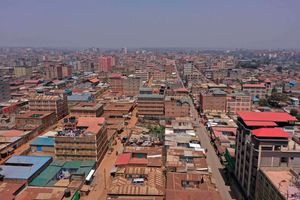
High-rise apartments jostle for space where single houses once stood. Its skyline, once broken only by leleshwa trees and the occasional bungalow roof, is now a jagged wall of concrete.
And recently, the area has witnessed a surge in glowing billboards with all manner of spectacles: fluorescent lights, suggestively dressed women, name it.
They advertise anything from residential flats to gadgets to massage parlours, promising heaven on earth.
In Kileleshwa, billboards stand side by side, some barely a hundred metres apart, turning the neighbourhood into an open-air showroom.
Major roads such as Waiyaki Way, Ring Road, Olenguruone Road, Oloitokitok Road, Mandera Road, Othaya Road and Nyeri Road are particularly affected, with billboards encroaching on setbacks, exceeding height limits of six metres for wall signs and violating spacing requirements (a minimum of 250 metres between structures).
For long-time resident Faith Njeru, the transformation of the estate feels like watching an old friend disappear. She has lived here for more than 40 years, long enough to remember the estate before the concrete and the billboard clutter.
During an interview at her house along Siaya Road, she pauses often, as though reaching for a memory that feels too distant now.
“Even Siaya Road was just murram,” she says. “There was no entrance. Just a walk path, all the way to Dennis Pritt. The only tarmac was Gatundu Road.”
In the late 1980s, the first cracks in Kileleshwa’s quiet began to show. New developments crept into the estate, replacing government plots with denser structures.
Construction workers in Kileleshwa Estate in Nairobi on September 17, 2025.
Photo credit: Evans Habil| Nation Media Group
The turning point came with Siaya Place, built by the late Philip Ndegwa, then the governor of the Central Bank of Kenya. For residents such as Ms Njeru, who had grown used to single houses surrounded by gardens, the sight was startling.
“We were shocked,” she recalls. “So many houses on one plot. It was unheard of. There were bylaws, rules to protect the estate. We wondered: how did they even get approval?”
It was a departure from the norm, but it would soon become the blueprint for Kileleshwa’s transformation. What was once a rare exception became the new norm.
By the 1990s, powerful developers, often government insiders, began reshaping the estate in their own image.
“We were not happy,” Ms Njeru admits. “We knew what would follow — jam, congestion, water problems. But these people were untouchable. What could we do?”
One of the old people who have lived in Kileleshwa estate,Faith Karimi Njeru is pictured at Kileleshwa Covenant Community Church in Nairobi on September 18,2025.
Photo credit: Evans Habil| Nation Media Group
“This used to be classic. It used to have dignity. Now, it’s billboards and flats everywhere.”
She recalls that one morning, she woke up to find a towering structure planted along Siaya Road, erected in the dead of night. Its sheer size blocks the sunlight from reaching her house, casting her home in permanent shadow.
At night, the harsh flicker of its lights floods her windows, turning rest into a struggle. “It is an eyesore,” she says bitterly. “You can’t escape it, day or night. They never asked us; they just put it up. And now we are the ones left to suffer.”
High-rise apartments in Kileleshwa, Nairobi.
Photo credit: File | Nation Media Group
Although apartment blocks began appearing in the 1990s, the growth then was measured, almost restrained: five or six floors at most, and still surrounded by pockets of green. But the past decade has brought a different kind of frenzy: towers climbing 15, even 20 storeys, sprouting wherever land can be found.
Single-dwelling estates that once defined Kileleshwa are slowly vanishing, their gardens and bungalows traded for concrete slabs. Resident Elvis Obaigwa notes that many owners have simply surrendered.
“Most people have given up their plots,” he says quietly. “They’ve paved the way for high-rise construction. What was once a neighbourhood is now a vertical city.”
An advertising post next to a mall in Kileleshwa Estate in Nairobi on September 17, 2025.
Photo credit: Evans Habil| Nation Media Group
Mr Obaigwa notes that in the past 10 years, Kileleshwa has also become a magnet for foreigners and short-term visitors, with many apartments now marketed as short-stay apartments or furnished rentals for expatriates.
Developers have been quick to cash in on this demand, capitalising on the suburb’s prime location — wedged between the central business district, Westlands, and Nairobi’s main commercial corridors.
Its lure also lies in the strong rental yields, steady demand from a growing middle class and expatriate community, and the promise of property values that keep climbing.
The limited land availability has only accelerated the rush, with developers embracing densification as the most profitable and, on paper, “sustainable” use of space. The result is a suburb whose identity is being rapidly rewritten.
For others, however, the story of Kileleshwa is not only about loss. Mr David Obiku, another long-time resident, says development in itself is not the villain. What matters, he says, is how it is managed.
He remembers the old Kileleshwa too: “single homes, single dweller homes in big compounds circa 1985, ’86” as he puts it. He is not opposed to change.
“Obviously, it is okay for development to happen,” Mr Obiku says. “But I think that development should be controlled. There ought to be laws that are followed.”
“Now, with all the apartments everywhere, space is limited and there are more vehicles,” he explains. “But to make matters worse, there are billboards everywhere now. Almost every few metres. Humongous. Some lighted up so bright they bother people in their own homes.”
Amid the chaos, area MCA Robert Alai insists he has been waging a one-man war with resident associations. He says he has stood at the frontline of resistance, pushing back against the tide of unchecked high-rise developments. The price has also been personal.
“I have borne the brunt of these developers,” he says. “They send goons when you question them. One time, I was attacked simply for demanding that a developer produce an approval letter and follow the zoning regulations.”
The construction site of a high-rise building along Kandara Road in Kileleshwa, Nairobi.
Photo credit: Ndubi Moturi Media Group
This means that any building in the area should have a maximum of four storeys. This has, however, been breached, with some of the already constructed apartments rising up to 20 floors.
Kileleshwa faces potential changes under a plan by Governor Johnson Sakaja's administration, seeking to raise building limits to 15 floors. Mr Alai says they will oppose the move since existing infrastructure cannot support the developments.
“The developments need to go hand-in-hand with the existing infrastructure. If you go to Kileleshwa now, there are no public utilities such as open spaces, fire stations, and water and electricity to support such developments. We need to be alive to the reality. Otherwise, it will be a disaster in the making,” he adds.
On the issue of billboards, Mr Alai points to a policy that is being openly flouted. Kileleshwa, he says, is designated as an “Area of Partial Control” under the Control Development Policy — yet the suburb has been turned into a dumping ground for advertisements.
“Kileleshwa cannot host all the billboards in Nairobi,” he says. “We need to move some of this advertising to other platforms: television, radio, print.”
He has petitioned the Nairobi County for an audit of all the billboards erected in the area, including approval letters and proof of payment of revenues.
He says the situation has spiralled out of control that even the county quietly admits it lacks the capacity to dismantle the offending structures.
Mr Patrick Analo, the county government’s Chief Officer for Urban Planning, says the county government is keen on ensuring compliance with the law in regard to the erection of billboards and high-rise developments.
“The problem we are having with these billboards is that most of them are erected at night when our enforcement teams are not around. We have, however, taken steps to address this and we are going to bring [down] all the illegal billboards in the area,” he adds.