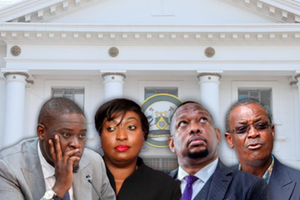
Plans to establish the Nairobi Metropolitan Police Unit (NMPU) , a flagship security initiative intended to transform policing in the capital city, have hit a snag following sharp disagreements over its structure, command, composition and funding, forcing top government officials to embark on an international benchmarking mission before a final framework can be adopted.
Interior Cabinet Secretary Kipchumba Murkomen and Nairobi Governor Johnson Sakaja are currently leading a delegation to New York City to study the New York Police Department (NYPD) model as the government seeks to resolve contentious issues that emerged during the development of the proposed unit.
The delegation, which includes Deputy Inspector General Eliud Lagat, Kenya’s Ambassador to the United States David Kerich, Head of the Nairobi County Inspectorate Eva Wairiuko and other government officials, is also expected to visit London, Rome and Tokyo as part of the benchmarking exercise.
Nairobi County Governor Johnson Sakaja, Interior Cabinet Secretary Kipchumba Murkomen, Deputy Inspector General of Police Eliud Lagat and Kenya’s Ambassador to the US David Kerich, among other senior Government officials, tour the New York Police Department.
Photo credit: Ministry of Interior
The trip follows the rejection of a draft technical report presented at State House on the proposed unit two weeks ago after President William Ruto reportedly expressed concerns that the model being proposed did not reflect the vision behind the formation.
According to sources familiar with the discussions, the report prepared under the National Police Service was deemed too similar to existing specialized police formations.
“The problem we had is that during the presentation about the unit, it looked like any other unit within the police force but that is not what is actually envisioned. So, the Head of State ordered them to go out and carry out benchmarking before coming up with the proposals,” said a source who attended the meeting.
Inside New York Police Department.
Photo credit: Ministry of Interior
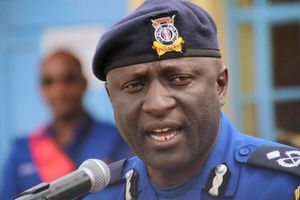
At the centre of the dispute is the question of who should control the unit and appoint its leadership. Inspector General Douglas Kanja is understood to favour a model in which the NMPU would be domiciled entirely within the National Police Service, similar to existing formations such as the Border Patrol Unit and the Anti-Stock Theft Unit.
Under this arrangement, the unit would largely comprise uniformed police officers drawn from existing formations within the National Police Service.
The IG is also said to hold the position that the head of the unit should be appointed through the National Police Service command structure and report within the existing police hierarchy.
Mr Sakaja is, however, pushing for a hybrid policing model similar to that of the New York Police Department, where both civilian and uniformed personnel work within the same command structure.
Under the proposal, the Nairobi Metropolitan Police Unit would be headed by a civilian Police Commissioner appointed by the county government, deputized by a senior officer drawn from the National Police Service, just like in the NYPD.
Nairobi County Governor Johnson Sakaja, Interior Cabinet Secretary Kipchumba Murkomen, Deputy Inspector General of Police Eliud Lagat and Kenya’s Ambassador to the US David Kerich, among other senior Government officials, tour the New York Police Department.
Photo credit: Ministry of Interior
The governor argues that such a model would enhance community policing and intelligence gathering while ensuring operational support from the uniformed service.
The proposal would also see the unit recruit personnel who live and work within Nairobi and possess a deeper understanding of the city's social, economic and security challenges.
According to sources, Sakaja believes officers who are familiar with the city's neighbourhoods, business districts and informal settlements would be better placed to detect criminal activities, respond to emerging threats and build trust with residents.
“The governor, on one side, wants some of the police officers not to be uniformed so that they can easily blend with the locals and help stem crime activities in the city without detection,” one of the sources who attended the meeting said.
He is also said to favour a decentralized structure in which the unit's operations are aligned to Nairobi's six boroughs, allowing security responses to be tailored to the unique challenges facing different parts of the city. Some of the recommendations contained in the draft technical report propose a centralized command structure anchored within the National Police Service.
The discussions have further been complicated by concerns over possible overlap between the new unit and the Nairobi City County Inspectorate, commonly known as Kanjo. Officials are yet to agree on where the mandate of county enforcement officers would end and where that of the NMPU would begin, raising fears of duplication of roles and jurisdictional conflicts.
Questions also remain over the recruitment criteria for officers who will serve in the elite formation, where specialized training will be conducted and which local or international agencies will be involved in capacity building. Mr Murkomen on Tuesday said the government is considering a memorandum of understanding with the NYPD for training and capacity building.
“Our meeting explored an MoU between the National Police Service and New York Police Department on the establishment of the Nairobi Metropolitan Police Unit, among other deliberations. We are seeking insights into intelligence-led and community-oriented policing, technology integration, specialised urban operations, emergency response coordination, and crime prevention strategies, among other areas of interest,” Mr Murkomen said.
President William Ruto on February 17, 2026, directed that a framework establishing the Nairobi Metropolitan Police Unit be developed within 60 days.
The deadline has since lapsed without an agreed blueprint. While President Ruto had initially ordered that the specialized force be operational in July this year, Mr Sakaja has said that the target may not be achievable given the extensive legal, administrative and operational structures that must first be put in place.
President William Ruto addresses mourners during the requiem mass for the late Ol Kalau MP David Kiaraho in Nyandarua County on April 8, 2026.
Photo credit: Boniface Mwangi | Nation Media Group
“We had discussions focused on strengthening collaboration and exploring areas of partnership between the National Police Service, the Nairobi City County Inspectorate and the NYPD, particularly in intelligence-led policing, community safety, technology integration, emergency response coordination, urban crime prevention and modern metropolitan policing,” he said
He added that Nairobi deserved “a world-class security system that matches its status as a regional economic and diplomatic hub.”
“As one of Africa’s fastest-growing metropolitan centres, Nairobi has in recent years faced evolving and increasingly complex security threats,” said the Interior Cabinet Secretary.
“In our benchmarking visit, we are seeking insights into intelligence-led and community-oriented policing, technology integration, specialised urban operations, emergency response coordination and crime prevention strategies.”
The findings from the international tour are expected to inform a fresh technical report that will ultimately determine the structure, command and operational framework of the Nairobi Metropolitan Police Unit.