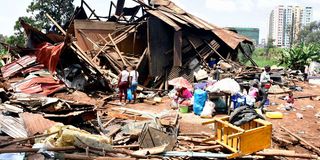
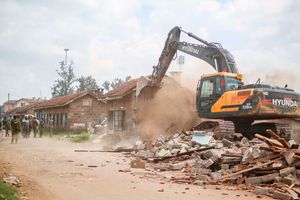
Families in Kwa Njoroge, Pangani, Nairobi, are counting their losses after a demolition left many homeless, with residents alleging that the operation was carried out without adequate notice.
The demolition saw angry youth storm the busy Thika Superhighway in the morning, using stones to barricade the road shortly before 9 am, disrupting the normal flow of traffic.
Police, however, quickly moved in and dispersed them.
More than 1,000 residents are said to have been affected by the demolition, which flattened homes and businesses in the informal settlement.
Some of the affected families, who say they have lived and worked in the area for more than 15 years, claimed they were forced out of their homes early in the morning with little time to salvage their belongings.
Caroline Karemi, one of the affected residents, said the demolition had left her family devastated and uncertain about where they would spend the night.
“This is the only place I have ever known as home. My children have grown up here and know no other place to call home,” she said.
According to Ms Karemi, the eviction disrupted lives that had been built over decades, leaving families without shelter, livelihoods or a clear relocation plan.
“We have lived here for more than 40 years and built our lives here over time. This sudden eviction has left us stranded without shelter or financial stability, and we have nowhere to relocate. The uncertainty has made our situation even more difficult,” she said.
Faith Loko, who said she has operated a business in the area for about 15 years, alleged that residents were not given any prior notice before the demolition.
“They came early this morning and told us no one was allowed to remain here. We were forced to leave immediately and ended up on the roadside with our belongings. I have nowhere to go, and I do not even know where my children and I will sleep tonight,” she said.
Ms Loko also questioned the handling of compensation, alleging that the process lacked transparency and fairness.
A number of families left stranded outside their homes at Kwa Njoroge Slum, located along Thika Road Superhighway on July 03, 2026.
Photo credit: Francis Nderitu | Nation
She claimed that some residents were offered Sh3,000 to facilitate relocation, but the money was not distributed through a clear and accountable process.
“Some people who were not entitled to the money ended up benefiting, while others who genuinely deserved assistance received nothing,” she alleged.
The evictions stem from a decades-long ownership dispute over the 44-acre parcel, formerly known as L.R. No. 209/193 and now Nairobi Block 37/63, where hundreds of families identifying themselves as descendants of colonial-era farm workers have long claimed ancestral occupation.
The residents, through Umoja City Self Help Group, sought ownership by adverse possession, while St. Benjamin Memorial Clinic Supplies Ltd also laid claim to the land through a disputed government allotment.
However, the Environment and Land Court dismissed both claims, holding that an earlier High Court judgment had already recognised the Trustees of the Sheikh Fazal Ilachi Noordin Charitable Trust as the lawful leaseholders, effectively leaving the trust's ownership intact.
City auctioneer Zachary Barasa, who was in charge of evicting the residents on behalf of the charitable trust, said each of them had been compensated Sh3,000.
“Out of humanity, we gave each of the residents Sh3,000 and urged them to move but they became rowdy and the eviction had been delayed for a long time,” Mr Barasa said.
Efforts by the Nation to obtain comment from Nairobi Regional Police Commander Issa Mohamud were unsuccessful.
Mr Mohamud promised to get back to us after a meeting he said he was attending, but had not done so by the time of going to press.
The Nation had sought clarification on the circumstances surrounding the demolition and the allegations raised by residents, including claims of inadequate notice, use of tear gas and the compensation process, but no official response had been received by press time.
Other residents claimed the demolition was carried out under heavy security, alleging that police used tear gas to disperse those who resisted and that officers entered houses before removing property.
“We were already outside when they arrived. They started throwing tear gas and forcefully entered our homes, removing everything inside,” another resident said.
The residents said the operation left many families without food, clothing, household items and other personal belongings, making it difficult for them to begin rebuilding their lives.
They also questioned the legality of the demolition, saying there was no clear communication on who owned the land or which government agency had authorised the exercise.
“We honestly do not know who is behind this exercise or under what authority it was carried out. Nobody explained who owns this land or the legal process that was being followed, and that has left us questioning whether due process was observed,” said Morris Mwendwa.
Residents further said they were left confused by the lack of information regarding the ownership of the land and the legal basis for the demolition, adding that no alternative settlement plan had been communicated to them.
The affected families have appealed to the government to intervene urgently, saying they have been left homeless with their children and have lost access to their homes, businesses and personal belongings.
They are now calling for humanitarian assistance, clarity on the ownership of the land and a transparent relocation plan to help them rebuild their lives.