A physical planner who secured approval for a change of user of the 18-storey building that later collapsed in Eastleigh, killing eight people, was allegedly recruited by a Nairobi City County employee and paid Sh121,000 for the use of his professional credentials for the process.
The revelation raised fresh questions about the alleged role of rogue officials in facilitating developments that put city residents' lives at risk.
Mr Nathan Mutunga Kiti on Tuesday told the Nairobi County Assembly Committee on Urban Planning, chaired by Baba Dogo MCA Geoffrey Majiwa, that he was approached through an alleged broker after the county planner had sought to have the change of user processed but lacked credentials to submit the request through the county's approval system.
Baba Dogo MCA Geoffrey Majiwa.
Mr Mutunga, a registered architect number 0274, said he went ahead and used his credentials to apply for the change of user through the county portal, after which the application was approved by the official through the change-of-user approval system at City Hall.
“I was called in to assist with the credentials. After doing the work as requested, I received the payment of Sh121,000 through M-Pesa (from the county official). That is all, and I never bothered to check the rest of the information,” Mr Mutunga told the committee.
He revealed that he never met the developer of the building but recalled that the broker had mentioned a person identified as Musyoki, who reportedly later died, as the project owner.
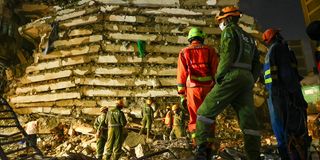
Rescue personnel sift through rubble at the site of the collapsed building in Eastleigh, Nairobi as excavators clear debris on October 30, 2026.
Photo credit: Bonface Bogita | Nation Media Group
The revelation offered a glimpse into the inner workings at City Hall, where a county official enlists private professionals to use their credentials to process a development application, only for the same official to approve the request, raising questions about the integrity of the county's planning approval system and the safeguards meant to prevent irregular developments.
The committee heard that the application for the Eastleigh building, made sometime in October 2024, sought to change the original use of the property from a single dwelling to commercial and multi-dwelling apartments, paving the way for a different form of development on the site.
Mr Mutunga alleged the broker approached him because he was a registered professional capable of submitting the application, despite the fact that he had no direct engagement with the property's developer.
He explained that his role was limited to processing the change-of-user application and that he did not consider it his responsibility to establish how the developer intended to implement the approved plans or whether the eventual construction complied with the original architectural and structural designs.
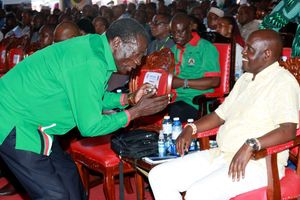
Governor Johnson Sakaja interacts with a youth during his tour at the scene of the collapsed building in Eastleigh.
Photo credit: Wilfred Nyangaresi | Nation
“I didn't follow up because that was outside my mandate. Once I'm done with the approvals, it is now the work of the developer, the contractor, the engineer and the architect to work on that,” he said.
However, committee members questioned how he could have accepted the assignment without establishing the identity and authority of the person commissioning the changes, particularly after learning that the individual presented as the developer was deceased.
"How did you accept to undertake the task knowing that your client that you mentioned was deceased?" committee member Anthony Kiragu asked.
In his defence, Mr Mutunga said there was an ongoing succession process and that letters of administration had been issued in respect of several properties belonging to the deceased developer. He, however, admitted that he did not know who was overseeing the Eastleigh project.
“That is something that I failed to do, and I am sorry I did not do due diligence,” he said.
Sakaja: Construction of Eastleigh building was going on without approval
The committee is now seeking to establish who commissioned the development, who had authority over the property and the officials who facilitated the change of user, as questions mount over the circumstances under which the building was allowed to rise to 18 floors.
The building came crashing down on October 23, 2026, while under construction, burying workers and other occupants beneath the rubble.
Some of its lower floors had reportedly been occupied even as construction was ongoing, raising further questions about compliance with building safety requirements and the county's enforcement of development regulations.
After two weeks of recovery operations, eight people were confirmed dead in the disaster, which has renewed scrutiny of City Hall's planning approvals, inspection procedures and enforcement of construction standards.
The revelations also raise questions about the extent to which private brokers and county employees may be working together to circumvent professional and administrative requirements governing development approvals in Nairobi.
The committee was also expected to hear from the building's developer and Nairobi County Executive Committee Member in charge of Urban Planning, Patrick Mbogo, but both failed to appear, citing their attendance at a meeting chaired by Governor Johnson Sakaja.
Nairobi County CECM – Built Environment and Urban Planning Patrick Mbogo.
Photo credit: Wilfred Nyangaresi | Nation Media Group
Their absence frustrated members, who said the committee was yet to establish who was ultimately responsible for the project, with the identity of the developer and the circumstances surrounding the construction remaining unclear.
"No one wants to take responsibility, and we may want to grill the owner, but from the information we are getting, no one wants to tell us who the developer is. But we will get down to it," Mr Majiwa said.
The committee is expected to summon the relevant officials on Wednesday to explain how the change-of-user application was submitted and approved, the role played by the county planner, and whether the building eventually constructed on the site conformed to the approved development plans.
The revelations come amid growing scrutiny of Nairobi County's enforcement of development regulations, particularly allegations that some developers have been able to circumvent planning controls through brokers and compromised officials.
Last week, it emerged that a number of officers in Nairobi County's Department of Built Environment and Urban Planning occupy key offices illegally, with some allegedly exercising statutory powers without valid appointments.
County Public Service Board Chairperson Thomas Kasowa disclosed that several senior officers, including directors and deputy directors, had continued serving in acting capacities beyond the six-month period permitted under public service regulations.
Mr Kasowa told MCAs that some officers were exercising powers without formal acting appointment letters from the County Public Service Board, warning that those without such authorisation could not legally claim to hold the positions.
The disclosures have raised questions about the integrity of decisions made within a department entrusted with approving building plans, regulating land use, monitoring construction and enforcing development standards across Nairobi.