For years, Nakuru stood tall as the heartbeat of Kenya’s nightlife, a city that partied hard.
From the legendary nightclubs of the early 2000s to the rowdy university-driven party culture that shaped an entire generation, Nakuru earned the nickname NaksVegas, referring to the famous Las Vegas party haven, for a reason.
It was vibrant, unapologetically loud, and irresistible to revellers from Nairobi, Eldoret and beyond.
But somewhere along the way, the lights dimmed, music softened and the once famous entertainment scene seemed to fall asleep, leaving many wondering what went wrong and whether the magic would ever return.
Nobody remembers the golden days better than PK, a veteran entertainment promoter who ran some of Nakuru’s hottest gigs in the mid-2000s.
PK attributes the nightlife boom to a perfect mix of factors, among them high student population, affordable alcohol, aggressive club marketing, and a young urban population hungry for adventure.
“Nakuru was untouchable between 2005 and 2015. On a Friday night, you would find people driving from Nairobi just to party here. We had clubs like Rafiki’s, Dimples, Club Signature, Coco Savannah, Oyster Shell, among others; places that were always full. We used to have street bashes. It was pure madness and people loved it,” he recalled.
But the very foundation that built NaksVegas also became its undoing, and soon it was on a slow decline. According to PK, with the growth of the entertainment scene came crime. Cases of muggings were on the rise, as there were too many gangs targeting club-goers. At some point, people did not feel safe at night.
As Nakuru grew, regulations tightened, bars closed earlier, noise restrictions increased, and some of the clubs were closed, killing the spark.
“The cost of running clubs skyrocketed from licences to rent to electricity. Many businesses either shut down or could no longer maintain the extravagant party culture that defined the NaksVegas identity. As time went by many promoters, DJs, and investors preferred Nairobi’s bigger market. And with that the once lively Nakuru’s entertainment slowly dried up,” said Mr PK.
Nakuru’s once vibrant nightlife looked deserted, clubs closed, promoters quit while revellers moved on.
Today, the story is different. Something electric is happening again. New clubs are opening, live events are back, DJs are booking out, influencers are flocking in and Nakuru’s nightlife is buzzing in a way it hasn’t in nearly a decade.
From modern clubs to creative event spaces, from the importing of popular DJs to the rise of TikTok party influencers, Nakuru is reclaiming its identity. Major concerts, food festivals, street art exhibitions, and cultural showcases are among the recent happenings defining the reawakening.
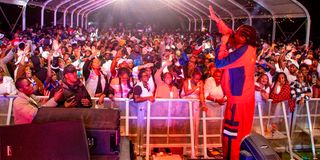
Genge artiste Jua Cali performs at Nakuru Golf Club during O’l Skool Bongo vs Kenya Edition on November 22, 2025.
Photo credit: Boniface Mwangi | Nation Media Group
The comeback is unmistakable, and the city is once again buzzing with the familiar beat of NaxVegas. Clubs like Space Next Door, Platinum 7D, Wave XO, Chillis and others are always packed on weekends.
Once more, Nakuru is no longer just a stopover on the way to Lake Naivasha or a transit town to another destination. It is reclaiming its spot as one of Kenya’s fastest-growing entertainment hubs, attracting artists, event promoters, and nightlife lovers.
Today, musicians, fashion designers, filmmakers, photographers, and digital creators are converging in the city, blending their crafts and finding new audiences. What was once considered a “small town scene” has evolved into a thriving creative industry.
If there was a turning point, it came with the introduction of big entertainment events that once seemed unimaginable outside Nairobi.
One of the most notable has been Oldies and Soul, a nostalgic music experience dedicated to 80s and 90s classics — an era fondly remembered as the golden age of music.
Since its debut, the event has taken Nakuru by storm, attracting diverse crowds with monthly shows ranging from intimate indoor sessions to outdoor festivals under the stars.
But Nakuru’s transformation isn’t just about concerts and nightlife; it is also about rediscovering cultural identity and unity through heritage events.
Over the past months, a wave of cultural festivals has taken root, celebrating Kenya’s rich traditions and diversity. Events such as Ndumo Festival, Ngemi, Kikuyu Festival, Abagusii Festival, and Kigoco Night have made Nakuru a stage for communities to tell their stories through music, dance, art, and cuisine.
For instance, on June 23, the first-ever Ndumo Festival brought Kikuyu culture to life at Buraha Zenoni Gardens in Barnabas.
The venue overflowed with colour, music, and energy from traditional decor in earthy tones to rhythmic kigooco sessions that had revellers dancing freely in the rain.
Performers such as Chris W, Wacuka Muchendu, Davy Kamoko, gospel artist Faith Nduhio, and Janney Sings blended classic and contemporary Kikuyu sounds, while DJs Nitram and Touch kept spirits high well into the night.
Barely two months later, the Kikuyu Festival made its debut at Kunste Grounds, featuring stars like Tonny Young, Joyce Wa Mama, Kariuki Kiarutara, Kamwana Wa Jane, Wanjiru Wa Waya, Wachuka Muchendu, and Philis Mbuthia — with MC Getooro and DJ Rada Safi steering the show.
The Kisii community was not left behind. On October 4, they were treated to the first Nakuru Abagusii Festival, which lit up the Crane Resort, celebrating Kisii heritage through live performances, traditional art, food, and fashion.
Bongo artiste Seif Shaban aka Matonya performs at Nakuru Golf Club during O’l Skool Bongo vs Kenya Edition on November 22, 2025.
Photo credit: Boniface Mwangi | Nation Media Group
Artists including Embarambamba, Smallz Lethal, Vicky Young, Danlee, and Sagero thrilled the crowd with energetic sets that celebrated cultural pride.
Beyond music and dance, the Nakuru Food Festival has become another highlight: a feast of flavour, music, and family fun that is pulling crowds from across the region.
Other events like Park and Chill have also been witnessed in the city, with two editions already held in Elementaita and Ngata Farm. There are also wine-tasting events, jazz nights, Caribbean music sessions, and Naks House — an Afro-fusion party.
Nakuru’s greatest advantage lies in its audience: eager, vibrant, and supportive. Unlike Nairobi’s oversaturated entertainment market, Nakuru fresh, enthusiastic crowds hungry for new experiences.
“We used to travel to Nairobi or Eldoret for big concerts. But now, events are being brought closer to us. Organisers are learning fast, and Nakuru is on the right track. We are loving it,” said Kelvin Kibet, a Nakuru resident.
On October 17, partygoers were treated to a Kalenjin Heritage Festival featuring big names like Vicky Brilliance, Patoto Pa Sweet Star, Yoyo Zing, Kipsang, Bruni Star, 2nd Junior, Micah Maritim, Hasira 44, Light Star, and others who showcased electric performances.
On November 22, locals gathered at the Nakuru Golf Club for The Reunion Ol’ Skool Bongo vs Kenya Edition, where both millennials and Gen Zs showed up ready to party, adhering to the all-white dress code.
Placards featuring portraits of iconic artists such as Redsan, Ray C, Wyre, Sanaipei, E-Sir, Lady Jaydee, Professor Jay, and Alikiba welcomed revellers at the entrance.
Avril, Tanzanian Bongo Flava artist Seif Shaban, popularly known as Matonya, Mr Nice, Juakali and Toxic Lyrycalli brought the house down with an electric performance.
Kenya artiste Avril performs at Nakuru Golf Club during O’l Skool Bongo vs Kenya Edition on November 22, 2025.
Photo credit: Boniface Mwangi | Nation Media Group
According to Sammy Gitto, one of the event organisers, the centrality of Nakuru has worked to its advantage, attracting revellers from other towns.
He said that the event attendance has evolved from people showing up only for Princeloo and other rugby tournaments, which were once the only popular events in Nakuru and its clubs to organisers coming up with a diverse variety.
Mr Gitto noted that with the help of diverse social media platforms, they have been able to advertise events effectively, compared to the time when only Facebook was available but was not much effective.
“Nakuru is becoming the hub of events. In the past, the threshold for charges was Sh500. If you charged more than that, people would not turn up, but we have seen that changing. People have embraced events. Nakuru is much safer now. Revellers feel comfortable staying out late. We have seen a resurgence, and we are working to support it but responsibly,” he said.
Ms Maggy Maina, a resident, notes that in the early 2000s, Nakuru’s nightlife felt simple and tightly knit. She says that the clubbing scene revolved around a handful of iconic spots, including small discos, dimly lit bars and music joints that mostly served the local crowd.
She says that entertainment leaned heavily on Kenyan classics, Congolese rhumba and whatever music local DJs had on their CDs. Security was minimal, dress codes were relaxed, and most nights out centred on familiar faces and affordable drinks.
As Nakuru grew into a busier city, the nightlife began to shift. By the mid-2010s, modern lounges, revamped clubs, and themed party nights started popping up.
DJs embraced a wider range of genres, while local artistes frequently headlined weekend events. Better lighting, upgraded sound systems, and improved security made the experience more polished.
She said that now, digital innovation drives the nightlife economy, with online reservations, cashless payments, and influencers shaping events. Club décor shifts with themed nights, and safety is more organised, with surveillance and strict entry checks.
“Social media is reshaping the culture as people dress for photos, tag their locations and follow club pages to know where the biggest crowd is headed. Nakuru’s clubbing landscape is almost unrecognisable from its early-2000s roots. Sleek lounges and lifestyle clubs dominate the city, attracting partygoers from across the country,” she noted.
The enthusiasm is spilling over into the local economy. Hotels and Airbnb hosts are reporting full bookings during event weekends, while restaurants, caterers, and transport operators benefit directly from the influx of visitors.
Ms Catherine Kariuki, an Airbnb host in Nakuru City, says such events boost their business.
On December 6, another Oldies and Soul event is set to take place, while on December 20, Ndumo Festival will be staged at Arthur Gardens, Lanet.