Despite two presidential orders and a law requiring rainwater harvesting, Kitengela town is facing a two-pronged challenge — preparing for possible El Niño rains while grappling with an acute water shortage.
According to a Ministry of Water and Sanitation survey, by 2019, the rapidly growing satellite town in Kajiado County had a population of 500,000 people requiring 30,000 cubic metres of water daily. The population has since shot up by almost double digits.
The survey indicated that private boreholes catered for only 5,000 cubic metres daily, with water vendors meeting the 25,000-cubic-metre deficit. In the last three years, most boreholes are said to have dried up due to climate change, which has lowered the water table.
The town’s water shortage has in the past caught the attention of both President William Ruto and his predecessor Uhuru Kenyatta, but the water project has always faced headwinds in the last seven years.
Under the then President’s directives, the County Government of Kajiado was to spend Sh20 million on eight kiosks, while the Nairobi Water and Sewerage Company (NWSC) was to reroute the main pipeline at Kyangombe, within Kitengela township, to serve the proposed eight kiosks.
On February 18, 2019, the Ministry of Water and Sanitation banned the sale of water by all private companies in the region, prompting the Export Processing Zones Authority (EPZA) to disconnect piped fresh water to residential homes within the EPZ estate, parts of Kitengela town and Milimani estate. In addition, it shut down public water-selling points along Namanga Highway and another near its main gate.
However, of the eight proposed kiosks, only five were set up, but only three operated for a short period under heavy water rationing.
At the onset, a 20-litre jerrycan was sold at Sh3, but later the price was increased to Sh5 before the project collapsed by the end of 2022.
Aerial view of Kitengela town.
Photo credit: Stanley Ngotho | Nation Media Group
A Nation spot check in the town, which was elevated to a municipality in 2022, on Wednesday indicated that the kiosks are abandoned and some have been vandalised.
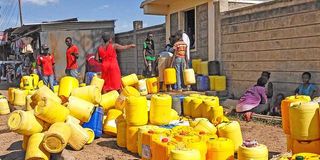
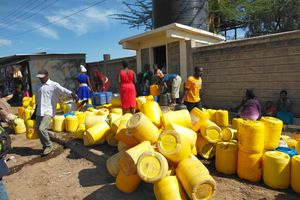
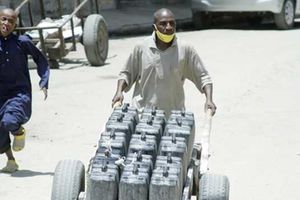
On a normal day, the picturesque town is characterised by hand- and donkey-pulled carts (mkokoteni), blue-painted water tankers competing with women carrying yellow jerrycans on their backs to their homes 13 years into devolution.
Mr James Musei, a resident, like other town dwellers, survives at the mercy of private water vendors who sell a litre of fresh water at Sh50, while a 20-litre jerrycan costs Sh20.
“Water remains a rare commodity in Kitengela town. Most of us survive on salty water. To us (residents), water is a political tool applicable during the election period,” said Musei.
Mary Atieno, a fish vendor, said the shortage of water has taken a toll on most businesses, with many traders relocating to neighbouring counties.
“Water is among the major facets in most businesses. Businesses are untenable when a trader is forced to spend most of the money on outsourcing for water,” said Atieno.
In 2025, during a development tour in Kajiado, President William Ruto promised Kitengela residents that his administration would ensure water reticulation. He reiterated his commitment in September when he visited the town during his three-day Kajiado County development tour.
Following President Ruto’s initial order in 2025, the Athi Water Works Development Agency (AWWDA) hit the ground laying infrastructure under the Nairobi Water and Sanitation Project (NWSP).
The 21-kilometre last-mile distribution network, which connected to the Northern Collector, was funded jointly by the Government of Kenya and the Agence Française de Dévelopement (AFD).
The water project, which was to serve 50,000 people in its first phase, was slated for completion in February 2026, but there has been no water distribution to date despite pipeline flushing in January. The water service provider, Nairobi Water and Sewerage Company (NWSC), was to handle bulk water supply, while the water utility was supposed to manage and connect water to consumers.
The Water, Environment, Climate Change and Natural Resources CEC told Nation that the county was expecting at least 2.5 million litres of water daily from Nairobi Water and Sewerage Company (NWSC).
However, she said NWSC had reported a commodity shortage, delaying the much-anticipated bulk supply.
“The water distribution was to be enhanced in homes connected to the pipeline and public water kiosks. We are in talks with NWSC, but so far it seems they lack capacity due to a possible water shortage,” said Ms Pere.
Nevertheless, for Kitengela residents, the dry and rainy seasons present the same predicament — water shortage — despite a rainwater harvesting law enacted five years ago by the Kajiado County Assembly.
The Bill, sponsored by then nominated MCA and current Kajiado North MP Onesmus Ngogoyo, sought to promote rainwater harvesting to reduce water supply gaps in the vast, dry county.
Kajiado North MP Onesmus Ngogoyo addresses the press. He wants the Kajiado County government to implement the Rainwater Harvesting Law.
Photo credit: Stanley Ngotho | Nation Media Group
Under the law, all buildings in both rural and urban areas in Kajiado County were required to have water-harvesting and storage infrastructure.
The new law also required those intending to build residential and commercial buildings to seek approval for water-harvesting facilities.
Completion certificates were to be issued to building owners who had complied, while the county government was bestowed with the responsibility of providing financial assistance to residents’ welfare associations, private schools, institutional buildings, hospitals and charitable institutions for the construction of rainwater-harvesting structures.
Existing buildings were to be given 18 months to comply from the time the Bill was enacted into law, while upcoming buildings were given a grace period of three months to comply. All those seeking building approvals would also be required to seek approval for water harvesting.
Defying the new directive was to attract a penalty of Sh100, 000 for commercial buildings and Sh50,000 for residential buildings, or six months’ imprisonment.
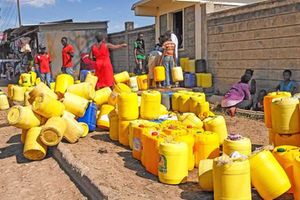
Kitengela residents queue for water at a public kiosk near Kitengela Police Station.
Photo credit: File| Nation Media Group
The legislator told Nation that the devolved unit’s failure to implement the law exposes the county’s soft underbelly on harvesting and storing rainwater ahead of the expected heavy rains.
“A law serves its purpose once implemented. Kajiado bore the major brunt of climate change that prompted animal deaths from drought. Other counties have water reservoirs in terms of mega dams. Kajiado County has the potential to be transformed into the regional food basket owing to the availability of fertile land. A mega reservoir is long overdue. Let the county implement the rainwater harvesting law,” said MP Ngogoyo.
John Metiyan, a livestock trader, said when it rains, it pours in both rural and satellite towns of Kajiado, leaving residents grappling with perennial water shortages.
“The much-anticipated El Niño rains will go to waste as we (locals) watch helplessly as usual. Until when?” wondered Metiyan.