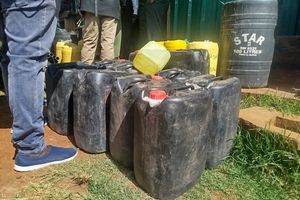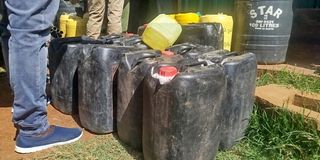
Exhibit of ethanol brought to Eldama Ravine Law Courts on February 16, 2026 following the arrest of some suspects.

Kisii, Nairobi and Kakamega counties top the list of regions where illicit alcohol seizures have been most significant, according to an exclusive breakdown obtained by the Nation, offering a rare, detailed look into the scale and geography of the underground trade.
The data shows Kisii leading the country with 353,178 litres seized, underscoring the deeply entrenched nature of traditional brewing in the region.
Nairobi follows with 309,408 litres, largely driven by the proliferation of counterfeit alcohol in an urban market where demand for cheaper alternatives remains high.
Kakamega, Nakuru and West Pokot also recorded substantial volumes, while Meru, Busia, Migori, Trans Nzoia and Nandi complete the list of the most affected counties.
This spread forms a broad belt stretching from western Kenya through parts of the Rift Valley into the capital, illustrating how production, distribution and consumption are tightly interconnected.
In these regions, enforcement agencies are not merely confronting isolated brewers but dismantling complex, adaptive networks capable of moving products across counties and evading crackdowns. Investigators say some networks rely on established transport corridors, informal distribution chains and digital communication channels to coordinate supply and avoid detection.
Data compiled by the Ministry of Interior and National Administration shows that 2,846,590 litres of illicit alcohol have been seized across the country since December 2025, with at least 973 suspects arrested in an ongoing multi-agency operation.
Also Read: Eldama Ravine - Where illegal brewers are arrested, freed on bond and resume killing locals
At a regional level, the Rift Valley emerges as the hardest hit, accounting for more than 870,000 litres of seizures. Nyanza follows with over 690,000 litres, while Western Kenya recorded about 600,000 litres, reinforcing the dominance of these regions in the illicit alcohol trade. Security officials note that these areas have a long history of informal brewing, which has gradually evolved into more organised and commercial operations.
At the other end are counties with relatively low seizure volumes. Garissa recorded just 60 litres, Wajir 108 litres and Nyandarua 515 litres, with Makueni, Tana River and Kajiado also posting modest figures. While lower consumption patterns—particularly in predominantly Muslim regions—may partly explain this, officials caution that the figures could also point to gaps in surveillance and enforcement.
Beyond geography, the data reveals a highly stratified illicit alcohol market. Kang’ara accounts for the largest share by far, with 1,877,473 litres seized. Cheap to produce and easy to ferment in bulk, it sustains a vast network of producers and distributors. Experts say its low production cost and minimal technical requirements make it highly resilient, allowing brewers to quickly resume operations even after crackdowns.
Chang’aa accounts for 276,842 litres. Though still significant, its lower volume suggests a shift in the market. Unlike kang’ara, chang’aa requires distillation, making it more complex to produce and easier to detect. It is also more potent and often carries higher health risks, especially when adulterated. Public health officials warn that despite reduced volumes, it remains one of the most dangerous brews due to the frequent use of toxic additives.
Traditional brews classified as “other traditional alcohol” account for 665,453 litres, reflecting the continued importance of culturally rooted drinks within the illicit market. In counties such as Meru, these brews blur the line between heritage and illegality, complicating enforcement efforts.
Authorities also seized 18,567 litres of illegal ethanol and 8,205 litres of counterfeit alcohol. Though smaller in volume, these categories point to a more industrialised and potentially more dangerous segment of the trade. Counterfeit alcohol, particularly prevalent in urban centres like Nairobi, is often packaged to resemble legitimate brands, making it difficult for consumers to distinguish genuine products from fake ones. The use of industrial ethanol further heightens the risks.
Interior Cabinet Secretary Kipchumba Murkomen said the crackdown marks a shift from sporadic enforcement to sustained, intelligence-led operations targeting entire criminal ecosystems.
“We are not just going after consumers or small-scale sellers; this operation is targeting the entire ecosystem, from manufacturers to distributors and financiers,” he said.
Interior Principal Secretary Raymond Omollo warned that organised criminal networks increasingly drive the trade.
“We are seeing syndicates that are highly organised, with supply chains that cut across counties and, in some cases, borders. This is no longer a cottage industry; it is organised crime,” he said.
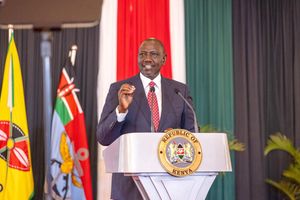
The crackdown followed a directive from President William Ruto, who declared illicit alcohol and drug abuse a national development and security emergency at the end of 2025.
Kenya’s struggle with illicit alcohol is longstanding, driven by economic realities. Legal alcohol remains out of reach for many due to high costs, while illicit brews offer a cheaper alternative. For producers, especially in rural areas, brewing provides a vital source of income.
Follow our WhatsApp channel for breaking news updates and more stories like this.