For more than a decade, the Galana-Kulalu project has embodied Kenya’s troubled ambition to turn semi-arid land into a food-producing hub.
Launched in 2013 as a one-million-acre food security scheme, it aimed to transform the vast ranch into a major agricultural frontier. For years, however, that vision remained largely unrealised.
Today, the landscape is changing. From the air, neat green circles of irrigated farmland replace stretches of dry scrubland, powered by solar-driven water pumps in an area without grid electricity.
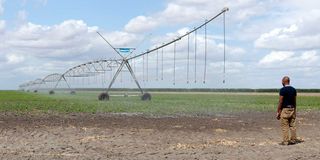
Centre-pivot irrigation systems water fields of maize, onions, cassava, soybeans and sisal, while trucks queue at grain stores as workers package produce for markets in Mombasa, Nairobi and beyond.
The 1.8-million-acre ranch, which straddles Kilifi and Tana River counties about 105 kilometres northwest of Malindi, for many years symbolised one of Kenya’s biggest agricultural disappointments. Government plans to transform the vast semi-arid land into the country’s food basket stalled because of funding constraints, management challenges and inadequate infrastructure.
Today, however, the narrative is shifting as a Public-Private Partnership (PPP) model breathes new life into the project.
Nyumba Agri is among the companies allocated sections of the larger Galana-Kulalu Food Security Project to help realise its vision, alongside Selu Limited and Al-Dhara Group.
The firms are working to transform 300,000 acres into one of East Africa’s largest irrigated farming schemes, despite delays in completing the irrigation dam intended to serve the wider project.
A visit by the Nation earlier this month found more than 50 acres of mature onions almost ready for harvest. Inside storage warehouses, hundreds of employees peeled, graded and packaged onions while bags of maize were stacked awaiting transport.
Nearby, tractors prepared fresh land as irrigation pivots watered newly planted fields.
At the government-owned section of the project, which is set to be leased to Selu Limited and Al-Dhara Group, the main water pumping station has been completed, opening another phase of expansion as more land is prepared for cultivation.
Nyumba Agri Farm Manager Jaco Coertze said the transformation demonstrates that climate is no longer the biggest obstacle to food production.
A centre-pivot irrigation system operates in maize fields at the Galana- Kulalu Food Security Project in Tana River and Kilifi Counties on July 6, 2026.
Photo credit: Kevin Odit | Nation Media Group
“We are proving that agriculture can thrive even in semi-arid areas when you combine technology, innovation and proper water management,” he said.
The farm harvested about 300 tonnes of maize during its initial pilot phase while testing different commercial seed varieties.
Production has since expanded significantly to include onions, cassava, soybeans and sisal.
The farm currently operates 23 giant centre-pivot irrigation systems, with the number expected to increase to 71 by September as more land is brought under irrigation.
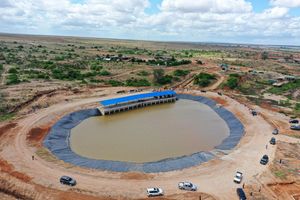
Behind the expansion is an extensive water infrastructure that supports year-round farming despite the harsh climate. The project operates 14 earth dams connected through gravity-fed canals. Three pumping stations are operational while another three are under construction.
Because there is no electricity in the area, the pumping systems rely on a combination of solar power and diesel generators, although solar energy now supplies a significant share of the project’s power needs.
“We use solar in most of our operations because it reduces costs and helps us protect the environment through clean energy,” Mr Coertze said.
Unlike many farming regions that suspend onion production during colder seasons, Galana-Kulalu supports year-round production because of its warm climate.
“At any given time, we have about 50 acres under onions. To minimise post-harvest losses during periods of market oversupply, Nyumba Agri has invested in value addition. When onion prices fall because of oversupply, we process them into onion flakes instead of allowing farmers to incur losses,” he added.
Cassava is also processed into crisps and other products sold in Mombasa, Nairobi and other markets, providing farmers with more stable returns while reducing wastage.
The company has also ventured into sisal production, establishing more than 1,000 acres, making it one of Kenya’s largest sisal farms.
Construction of a sisal processing factory within the ranch is underway, a move expected to create additional employment while increasing value addition.
The engineering behind the irrigation system is equally significant. Rather than relying entirely on diesel-powered pumps, water from the Galana River is diverted through a 278-metre weir before flowing naturally along an 18-kilometre trapezoidal canal into a network of reservoirs.
Gravity performs much of the work. The reservoirs, spread across the ranch, store millions of cubic metres of water, ensuring continuous irrigation even during prolonged dry seasons.
Production Manager Hein Kok said hydrological studies showed that irrigation would not deprive downstream communities or wildlife of water.
“Our crop water demand is only about one per cent of the river’s capacity, and currently we are using less than half of that. The remaining water continues flowing downstream,” he said.
The farm also captures rainwater and runoff in reservoirs while implementing soil conservation programmes to support long-term sustainability.
President William Ruto (centre) on May 16, 2025 during a tour of the Galana Kulalu irrigation project in Kilifi County.
Photo credit: Pool
Currently, more than 3,200 acres are under irrigation. Each centre-pivot irrigation system waters about 123 acres in a perfect circle while simultaneously delivering fertiliser through fertigation, a technology that dissolves nutrients in irrigation water and delivers them directly to plant roots.
The system reduces fertiliser wastage, improves nutrient absorption and lowers production costs compared with conventional broadcasting methods.
Agronomists also rotate maize, soybeans, onions and cassava to preserve soil fertility and naturally suppress pests and diseases.
Because Galana’s soils contain relatively little organic matter, laboratory soil analysis guides nutrient application while compost is continually incorporated to improve soil health.
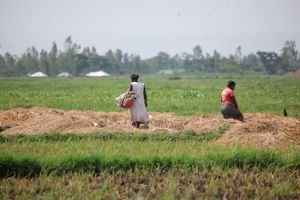
Beyond crop production, the project is reshaping livelihoods. More than 1,300 people, most drawn from neighbouring communities in Kilifi and Tana River counties, are employed as machine operators, irrigation technicians, engineers, drivers, agronomists and casual labourers.
As processing plants, storage facilities and transport services continue expanding, thousands more indirect jobs are expected to emerge across the agricultural value chain.
The government views the project as central to Kenya’s food security strategy. President William Ruto has repeatedly described Galana-Kulalu as one of Kenya’s flagship agricultural projects.
One of the irrigation machines stationed within the maize plantation covering thousands of acres at the Galana-Kulalu Food Security Project in Tana River and Kilifi counties on July 6, 2026.
Photo credit: Kevin Odit | Nation Media Group
“We are on course to making Kenya food secure. The transformative Galana-Kulalu Food Security Project is one of our many initiatives that will scale up our production,” the President said during a recent inspection.
The revival followed a 2023 presidential directive that shifted the project from a purely government undertaking to a Public-Private Partnership model combining public infrastructure with private sector expertise.
The government has invested in intake works, canals, reservoirs, roads, bridges and transmission lines that are expected eventually to replace costly diesel generation with grid electricity.
Construction of the Galana Bridge is expected to improve the movement of farm inputs and harvested produce, while the proposed Athi (Galana) Dam is expected to provide long-term water security for up to 300,000 irrigated acres.
Water, Sanitation and Irrigation Cabinet Secretary Eric Mugaa said the project represents a new chapter in Kenya’s agricultural transformation.
“The Galana-Kulalu project demonstrates the success of effective public-private partnerships in transforming Kenya’s irrigated agriculture. It will create thousands of jobs while strengthening national food security,” Mr Mugaa said.
The transformation is still unfolding, but evidence of change already stretches across the horizon. Whether Galana-Kulalu ultimately fulfils its long-promised potential will depend on the successful completion of planned infrastructure, sustained investment and the long-term performance of the public-private partnership model. For now, the project is showing tangible signs of progress across one of Kenya’s driest landscapes.