It’s the dead of night in Namanjalala village in Kwanza, Trans Nzoia County.
Locals wake to a subtle shiver beneath your feet, a cold, creeping sensation that quickly turns into terror.
Within minutes, floodwaters are waist-deep swallowing everything on their path with families scrambling in the darkness clutching children and whatever belongings they can grab.
For residents of Namanjalala, this is no nightmare but an all-too-familiar reality.
Heavy rains have once again sent the Chemusus and Sabwani rivers over their banks, submerging homes, destroying infrastructure and cutting off access routes.
Peter Simiyu, in his house damaged by floods at Namanjalala in Trans Nzoia County on March 24, 2026. Chemususu-Namanjalala stream burst its bank and flooded the villages following a heavy downpour on Sunday night.
Photo credit: Jared Nyataya | Nation Media Group
Villages in Sirende, Milimani and Lukhuna are under water, leaving families displaced and livelihoods in ruins.
According to the Kenya Red Cross Society (KRCS), at least 78 households have been displaced with 36 in Sirende, 28 in Milimani and 14 in Lukhuna.
And behind the numbers are stories of loss and tragedy. One young man perished from the cold as waters swept into his home at night. An eight-year-old girl was injured and rushed to Namanjalala Dispensary for treatment.
“Water reaches waist level inside the houses. We cannot sleep. People are living like animals as life has become unbearable,” says Robert Wanjala, a local resident, his voice heavy with despair.
This flood is the latest in a decades long cycle. For generations, residents have watched as long promised flood control measures such as dykes, drainage channels and dams remain incomplete or stalled.
“This is no longer just a disaster but it is a repeated story. People have been forced out of their homes. The area is no longer habitable, yet every time it happens, nothing changes,” says community leader Ben Wanjala Mulipuko.
Over the years, more than 300 homes in the area have been affected by floods displacing families and eroding livelihoods. A spot check by Nation revealed submerged houses, scattered belongings and families struggling to salvage what little they could from the muddy waters.
“The government is spending a lot of money on food, blankets and iron sheets. But if proper drainage channels and dams were constructed, this problem would be solved permanently,” he says.
The health risks are also mounting with three children under five have already been treated for diarrhoea while flooded latrines and wells heighten the risk of waterborne diseases.
“Latrines have been submerged and this means high chances of disease outbreaks. We are calling for government support to help affected families,” warns community health promoter Rael Onea.
The human cost goes beyond illness. Some households now host up to ten displaced families, and children cough through cold nights spent outdoors.
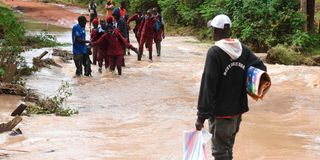
Members of the public help learner from St Michael’s Liyavo Primary and Junior Secondary School in Namanjalala, Trans Nzoia County, to cross a flooded Skubu bridge on March 24, 2026, following heavy rains.
Photo credit: Jared Nyataya | Nation Media Group
“We have nowhere to go. Our children are coughing and others have died because of the cold. Everything has been swept away,” laments Ms Amina Abdurrahman.
Even local shelters are overwhelmed. Pastor Metrin Wamalwa of Exodus Church says host families are struggling to accommodate the displaced. “We have taken in many people, but resources are stretched. We are appealing to the government to intervene and provide sustainable housing solutions,” he says.
The Kenya Red Cross Society has mobilised relief efforts, distributing blankets, kitchen sets, soap, sleeping mats and jerry cans to affected households. Yet urgent needs for shelter, food, water and sanitation remain.
“We are using a multi-agency approach to reach everyone in need,” says agency coordinator Ruth Minginwo.
The damage extends beyond homes with at least 10 acres of farmland have been destroyed while two feeder bridges have been swept away, cutting off parts of the area and disrupting schooling. Residents blame poor drainage systems, blocked waterways and stalled infrastructure projects.
Stalled projects such as the incomplete Manjalala dyke and blocked drainage channels from Chemusus to Sabwani are cited as major contributors. Calls have been made to revive old dams in Kaptega, Marinda, Kitubo, Soy and Kapsitwet.
“This is not a new problem. It has been here for years. If leaders worked together, it would have been solved by now,” says Mr Wanjala, his frustration shared by many.
Environmental experts warn that the crisis is a ticking time bomb fueled by climate change, poor land use and weak infrastructure planning.
“The government knows what needs to be done, but there has been a failure to act decisively. This cycle has gone on for over 50 years,” says environmental expert David Walala.
Even government interventions have fallen short. A project to construct dykes along the Sabwani River, launched in 2017, remains incomplete.
By the end of 2023, only 1.8 kilometres had been finished. In January 2025, Water Cabinet Secretary Erick Mugaa pledged Sh15 million to extend the dyke by 250 metres. Yet progress has stalled leaving residents exposed once again. Ironically, Sh29 million in emergency relief was announced in November 2025 as a stopgap measure that critics argue could have been invested in long-term flood prevention.
For residents like Opuya Kapindi, these floods are more than a seasonal calamity, an inherited burden.
“I have lived here for over 20 years and we have suffered for a long time. This river has brought us more pain than benefit,” he says, gazing at the swollen Sabwani.