More than a decade since devolution began, counties still face serious governance issues, which have prevented Kenyans from reaping the full benefits of the trillions of shillings flowing to devolved governments.
An analysis of data on money disbursed by the national government shows that the biggest problem is the insufficient spending on development projects. This is because many governors allocate large sums of money to recurrent activities such as salaries, travel and other non-essential items.
Over the 13 years from 2013/14 to 2025/26, for instance, the national government disbursed Sh4.5 trillion to the counties.
During the same period, the total development spending by the 47 counties was Sh1.28 trillion, accounting for around 28.5 per cent of funding from the national government.
This excludes the cash counties generated from their own sources, which would make the share allocated to development even far less from the 30 per cent minimum required under the public finance management (PFM) Act, 2012.
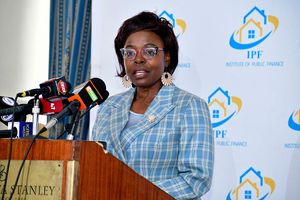
In the 2025/26 annual report on implementation of budget, the Controller of Budget (CoB) Margaret Nyakang’o observed that counties’ development spending of Sh126.69 billion was 25.5 per cent of their overall spending, falling short of the 30 per cent requirement.
“Further, the development expenditure of Sh126.69 billion represented 54.21 per cent of the approved development budget of Sh233.69 billion,” she stated .
The report observed that 42 counties spent below three-quarters of what they planned to put to projects, with only four spending above 75 per cent of their original plans.
Controller of Budget Dr Margaret Nyakang’o.
Photo credit: Wilfred Nyangaresi | Nation Media Group
“County treasuries should monitor the monthly absorption of the development budget and take immediate corrective action through lawful supplementary budgets when bottlenecks occur,” Dr Nyakang’o added.
This has been the trend since the onset of devolution and shows that while hundreds of billions continue to leave national coffers to counties, little is trickling down to citizens in the form of development projects and programmes.
The 25.5 per cent allocation to projects in the last fiscal year is a small improvement from the status during the first year of devolution when the counties’ Sh36.6 billion development spending was 21.6 per cent of the total expenditure in 2013/14.
Governors have been unable to put enough resources to projects due to recurrent expenditures that continue to gobble up hundreds of billions every year, majorly huge wage bills and allowances for travels.
In the last financial year, for instance, counties spent Sh236 billion on compensation to employees, which was 39.5 per cent of their revenues for the year.
The spending flouts a PFM requirement that wage bill spending should not exceed 35 per cent of counties’ revenues.
“The high wage bill constrains resources available for development and service delivery, given that compensation of employees is a recurrent expenditure and should be prioritised before discretionary development spending,” the COB observed.
Some counties such as Homa Bay (56.21 per cent), Nyeri (52.14 per cent) and Taita-Taveta (49.23 per cent) had particularly high rates of wage bill to revenues, indicating the extent to which their budgets are constrained.
Governors during the Biennial Devolution Conference at Eldoret Sports Club in Uasin Gishu County on August 17, 2023.
Photo credit: Jared Nyataya I Nation Media Group
“The counties should conduct payroll audits, control recruitment, rationalise staff, enforce approved establishment limits, and migrate manual payroll data to the approved human resource information systems,” Dr Nyakang’o recommended.
Several audits have also flagged possible cases of ghost workers in county payrolls, raising concerns over possible wastage of resources that could be channelled to projects.
In a report released in January, Auditor-General Nancy Gathungu said that she was unable to trace more than a quarter of staff sampled across 26 counties. The public auditor sampled 2,354 workers whose details were drawn from payrolls to verify their existence, but 596, who earned Sh978 million over a three-year period, could not be traced.
“The special audit requested 44 employees from the county executive to present themselves for physical verification. However, 23 employees did not come for the exercise, despite multiple attempts to reach out to them,” Ms Nancy Gathungu said in her report on Machakos.