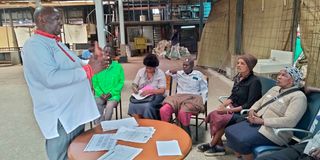
James Muturi, a former banker who is now involved in counselling, at ICM Kitale, Trans Nzoia County.

James Muturi, a counsellor, does not have an office for his work. When we met him recently, he was counselling survivors of gender-based violence (GBV) in a small space in Kitale town, Trans Nzoia County, offered to him by a friend.
He listened closely as they spoke of painful experiences, then gently guided them towards understanding their emotions and finding a way forward. Some were speaking of feelings they may have suppressed for years.
This is how Muturi, 67, has worked for the past 10 years. He has no permanent base. He meets survivors wherever he can and follows referrals wherever they lead him. He does not charge them. He says that the number of cases is overwhelming and that he sometimes reaches out to well-wishers for support with things like transport costs.
A former banker, Muturi founded the Positive Thinkers Programme. He holds a diploma in counselling psychology from ICM Kitale. He is keen on helping victims to heal and return to their normal lives.
He says that many victims continue to suffer in silence due to stigma, fear, and the cost of seeking help. He warns that inadequate support for counselling services leaves many Kenyans, especially GBV survivors, struggling with emotional trauma because they cannot access professional psychological care.
“Some victims of gender-based violence are deeply traumatised and need someone to listen to them and help them find a way forward,” he said.
He said counselling plays a critical role in helping survivors cope, particularly those who have endured prolonged abuse and struggled to regain a sense of normality.
“Counselling can help a victim regain hope and understand that what happened to them does not define their future,” Mr Muturi said.
Anastacia Kimani is one of those he has counselled. Anastacia, who is in her 40s, recalled experiencing GBV in her marriage and missing out on business opportunities while working in South Sudan years ago.
She said that she had suffered from depression for years before she recovered. She endured the distress for years before seeking help from Muturi, which enabled her to confront her personal challenges and regain stability.
“Without counselling, I would not have been able to bounce back. I can now run my business and advise others,” she said.
The businesswoman emphasised that depression should not be dismissed. “It’s not something that can be faked,” she said.
She urged survivors to seek emotional support rather than suffer in silence, explaining that counselling can help them confront trauma, regain confidence, and find hope for a better future.
But Muturi said that requests for counselling had overwhelmed him, with demand far exceeding his capacity to help.
However, there is now a place where survivors in Trans Nzoia can go for help. Last week, the county government opened a Sh20 million centre to provide temporary accommodation and support to victims of GBV, in a move aimed at strengthening protection for vulnerable women and children.
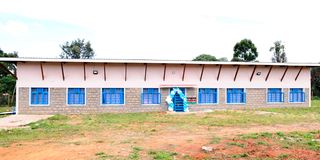
The new Safe Centre in Kwanza Sub County, Trans Nzoia County on November 17, 2026.
For survivors in need of support and people like Muturi, this development is a welcome relief.
The 50-room facility at Kwanza Centre was opened by Governor George Natembeya on November 17 and will serve survivors from all five sub-counties.
It has been set up in partnership with Shining Hope for Communities (SHOFCO) and will be co-managed by the county’s gender department and other partners, including the police.
Survivors will receive accommodation, counselling, nursing care, meals, and psychosocial support, and there will be professional counsellors, medical personnel, and security officers on hand.
The centre will also work to keep victims safe from perpetrators and refer them to the justice system and for medication.
Victims will be guided through the process of seeking justice. Depending on their specific situation and needs, they will only be reconnected with their families once it is fully confirmed that they are safe.
The bedrooms have bunk beds, mosquito nets and clean bedding, as well as lockable storage for privacy and security.
There is also a dining hall, a kitchen, a counselling unit, and a play area for young survivors, children accompanying their mothers, and teenage mothers.
During the opening ceremony, Mr Natembeya said that the facility forms part of the county’s efforts to protect vulnerable populations and address the social and economic circumstances that expose people to abuse.
He noted that financial dependence, limited economic opportunities, and a lack of alternative accommodation often prevent victims from leaving abusive relationships. The centre will also offer empowerment programmes to help survivors regain their independence and rebuild their lives.

Trans Nzoia Governor George Natembeya (second left) poses with a signed MoU together with SHOFCO CEO Kennedy Odede after commissioning of the Safe Centre at Kwanza, Trans Nzoia County on November 17, 2026.
“While we have this centre to help victims of GBV, I want to caution against this retrogressive vice. Regrettably, such practices are still rampant in this day and age, and it is something that we must collectively fight,” Mr Natembeya said.
According to statistics from the County Gender Department cited in 2026, Trans Nzoia recorded 1,016 cases of sexual and gender-based violence in 2025, compared to 991 in 2024. Of the cases recorded in 2025, 704 had been concluded through the courts.
Last year, a report revealed that GBV and femicide cost Kenya up to Sh41 billion annually in economic losses. The Presidential Working Group on GBV and Femicide said this figure represents the economic impact on the country.
The Technical Working Group, led by former Deputy Chief Justice Nancy Baraza, informed stakeholders in Trans Nzoia that GBV and other gender-based abuses, including femicide and child abuse, have serious consequences for the economy and wider society.
“This is because some of the victims are left with permanent physical or mental health issues, which makes them unproductive members of society,” said Dr Baraza on 12 May 2025.
Shofco CEO Kennedy Odede commended the county administration for supporting the initiative.
“Addressing gender-based violence requires more than responding to individual cases. It calls for partnerships that restore dignity, protect survivors and create opportunities for vulnerable people to rebuild their lives,” Odede said.
Boniface Wanyoike, programmes officer at Kitale Justice and Peace Centre, said the facility will help victims who sometimes suffer abuse at the hands of family members and have nowhere to seek refuge.
“This is a noble idea that is timely to ensure victims get a safe place as they heal, get treatment or fight for justice in courts,” Wanyoike said
Follow our WhatsApp channel for breaking news updates and more stories like this.