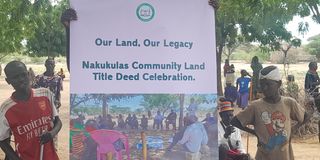
Residents of Nakulalas village in Turkana East Constituency on May 1, 2025 celebrate the awarding of a community land title deed.

Residents of Nakukulas village in Turkana East Constituency have witnessed another historic milestone after receiving the first community land title deed in the South Lokichar Basin under the Community Land Act 2016.
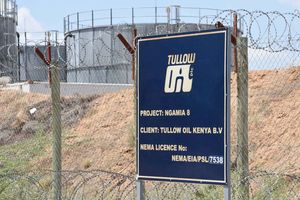
The village is where Tullow Oil plc made a significant oil discovery at the Ngamia-1 exploration well in 2012.
On May 1, residents gathered in Nakukulas village to celebrate the presentation of the title deed issued on February 27, 2025 by Turkana County Land Adjudication Officer Vincent Agevi.
The Nakukulas Community Assembly, a trustee for the community, is the registered owner and custodian of the vast piece of land.
Nakukulas Community Assembly Secretary-General Alfred Esinyen said the community's land title deed covers 42,070.55 hectares.
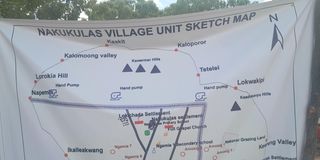
A map capturing areas covered by the Nakukulas community title deed in Turkana East Constituency.
The land will be managed by the Nakukulas Community Land Management Committee, which consists of 15 officials.
Present at the ceremony were Turkana East MP Nicholas Ngikor and Lokori/Kochodin MCA Willy Napuyo.
On June 3, 2018, then President Uhuru Kenyatta was in the village to launch the Early Oil Pilot Scheme (EOPS) to test the logistics of oil production, transportation and marketing before the expected full-scale oil exploration.
However, oil production has not been as high as previously predicted and there have been several challenges, including the realisation that any export route would require the construction of hundreds of miles of heated pipeline to the Port of Mombasa.
For the locals, however, even the first oil wells did not bring much benefit to the community, largely because there was no legal basis for a claim to a share of the resources. Now, with a title deed to the community's land, residents are hoping for better news.
Mr John Ekai, a Turkana resident and founder of the Turkana Empowerment Advocacy Group, said residents in the South Lokichar Basin had been unable to secure direct benefits from oil production because they lacked legal documents to claim their land rights.
"Crude oil discovery aroused great interest in ancestral land that was only communally owned by locals who are majorly nomadic pastoralists. The huge chunk of land, characterised by indigenous trees and pasture, paved the way for the establishment of development projects such as roads and social amenities, drilling of wells, camps and roads. Residents who had no proof of ownership of land held in trust by the county government lacked bargaining power for compensation," he said.
The initial agreement, he said, was that compensation for land would go to the county government as the custodian of the land.
Mr Erika said the acquisition of the title deed near oil fields would secure the livelihoods of the indigenous communities.
Turkana East MP Nicholas Ngikor said the title deed had come at the right time as there was hope for the resumption of oil activities.
He said the scaling down of oil exploration has affected the community as companies have shut down and workers in the oil fields have lost their jobs.
However, there is light at the end of the tunnel after Tullow Oil signed an agreement in April to sell its assets in Kenya to Gulf Energy Limited for at least Sh15.6 billion.
"I want to tell the world that where we are celebrating the title deed is where oil was discovered. It comes at the right time when we are planning for the commercial phase," Mr Ngikor said.
The MP added that he hoped the locals would not come into conflict with the new investor, as they know the size of their land and can now negotiate directly for benefits.
Alfred Esinyen, a resident of Nakukulas village, said they were happy that the land registration process, which started in 2017, had been completed.
"We appreciate support from the county government's department of land ... We appreciate all the leaders for political good will," he said.
Ms Dorcas Akusi said the development would avert conflicts with investors because the community now knows the boundaries and size of its land. "It will prevent grabbers who may want to take advantage of illiteracy to own our land forcefully. We can easily plan our villages to attract more private investors," she said.
But a Turkana Council of Elders official, James Lochakula, warned that the title deed could lead to internal conflict if the community doesn't get support to establish a legal framework to govern the land.
"We need to have a lawyer to guide the community through support from NG-CDF so that in case of emerging legal issues, we can easily be represented because title deeds are new things to us. It will take many years to realise the full benefits," he said.
Mr Lochakula said that just as in pastoralist communities, where new investors are introduced into an indigenous community, the authorities should protect them from land grabbers.
Lokori/Kochodin ward representative Willy Napuyo said there were other areas where locals needed their land registered and title deeds issued.
He said title deeds would make it easier to tackle cases of communal land grabbing, where rich individuals forcefully transfer land for personal gain.