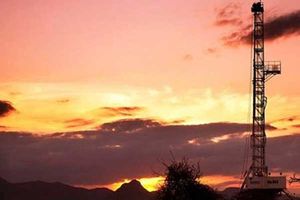
Kenya’s long-awaited journey to becoming an oil-producing nation has entered a decisive new phase after Gulf Energy received a Sh2.59 billion onshore drilling rig at the Port of Mombasa, bringing the country’s December 2026 first-oil target into sharper focus.
The integrated rig, acquired in February from Great Wall Drilling Company (GWDC) in the United Arab Emirates on a long-term lease arrangement, arrived on Friday aboard the general cargo vessel MV Transit Sedanka from Duqm Port in Oman.
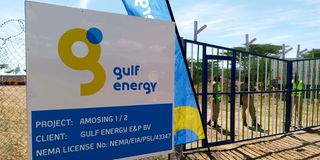
Its arrival marks a significant step towards drilling in the South Lokichar Basin, where Gulf Energy plans to develop the first phase of the USD6 billion crude oil project.
Gulf Energy E&P BV SEZ chief executive Paul Limoh said the rig was being offloaded by the Kenya Ports Authority (KPA) before being transported by road to Turkana County.
MV Transit Sedanka, a general cargo ship carrying the integrated onshore rig valued at more than Sh2.59 billion at the Port of Mombasa on September 25, 2026.
Photo credit: Pool
The company has set November 1 as the planned spud date, the point at which drilling begins, as it races to deliver first oil in December 2026.
“All workstreams at Gulf Energy E&P BV SEZ are running to a tight project management schedule, and the project remains on course for First Oil production in December 2026,” Mr Limoh said.
He thanked KPA officials for what he described as professional services, adding that the offloading operation was proceeding smoothly.
The 1,500-horsepower GW70 onshore rig will undergo procedural commissioning and acceptance checks before drilling starts.
In the UAE, the GWDC rig has been used on projects for the Abu Dhabi National Oil Company (ADNOC), where it has maintained what the company describes as a strong, efficient and safe operating record.
Gulf Energy plans to produce 20,000 barrels of crude oil per day during the first phase of the South Lokichar development before increasing output to 50,000 barrels per day in the second phase.
The project is expected to strengthen Kenya’s position as an emerging oil producer in East Africa, while creating a new stream of economic activity around the South Lokichar fields and the transportation of crude.
For the first phase, Gulf Energy has contracted Baker Hughes, a global oilfield services and equipment provider, to deliver Integrated Well Services.
It has also engaged SLB, an energy technology and services company, to provide the Early Production Facility (EPF).
The arrival of the rig follows preparations in the UAE, where officials from the State Department for Petroleum, the Energy and Petroleum Regulatory Authority (EPRA) and the Turkana County Government travelled to Abu Dhabi to inspect and familiarise themselves with the equipment before its shipment to Kenya.
At the time, Gulf Energy chairman Francis Njogu said securing the rig represented a major investment as competition for modern drilling equipment remained high and mobilisation timelines were increasingly stretched.
“At Gulf Energy, it’s all systems go, in the journey to deliver first oil by December 1st this year,” he said.
“Securing a modern onshore drilling rig marks a significant investment for the company, coming at a time when global demand for such equipment remains high, and mobilisation timelines are increasingly stretched.”
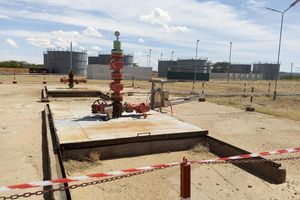
Residents of Turkana South at Ngamia 3 oil rig.
Photo credit: File | Nation Media Group
Turkana County Secretary Richard Ekai described the inspection visit as both enlightening and productive, saying it provided the team with insight into the rig’s capabilities and operational preparedness.
The team also examined GWDC’s corporate and environmental credentials, including commitments around skills transfer.
A detailed technical assessment of the rig’s operational systems and safety mechanisms was carried out, with recommendations issued to fine-tune its readiness and support seamless operations once it is mobilised to Turkana.
Beyond the drilling programme, the South Lokichar project is being closely watched for the revenues and wider economic opportunities it could generate.
The Government of Kenya projects that the South Lokichar Basin oil fields could generate more than USD2.9 billion (about Sh371 billion) in lifetime earnings for the country, depending on global oil prices and production volumes over the life of the project.
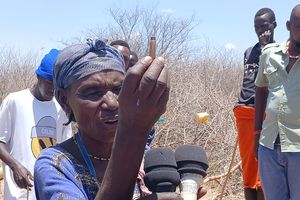
For communities in the oil-producing region, however, the promise of the project is increasingly being measured not only in barrels and billions, but also in jobs, businesses and access to the emerging crude-oil transport economy.
Communities in Turkana and West Pokot counties are expected to benefit from the transportation of crude once production begins.
Gulf Energy plans to work with individuals who will help lead and govern the transport programme, alongside registered community-based organisations (CBOs) representing communities in the two counties.
Under the proposed arrangement, trucks will be shared on a 90:10 basis between Turkana and West Pokot, respectively.
Community members will come together through registered CBOs, which will receive Gulf Energy endorsement before applying for financing to acquire one or more trucks.
The trucks will then form part of the crude-oil transport fleet, moving oil to Mombasa.
Transport revenues are expected to enable the CBOs to repay the financing while retaining a margin, creating a mechanism through which communities can participate directly in the economic opportunities arising from the Turkana oil project.
For Kenya, the arrival of the rig therefore represents more than the movement of heavy equipment through the Port of Mombasa.
It is the latest physical milestone in a project that has been years in the making and, with drilling scheduled to begin in November, the countdown to Kenya’s targeted first oil in December 2026 is now moving from plans on paper to activity on the ground.