Lodwar town in Turkana County is flooded with counterfeit and banned pesticides, exposing unsuspecting residents to toxic products sold under new names and with altered contents.
The products are not being sold in licensed agrovet shops but are stocked in busy hardware and building supplies outlets.
An impromptu crackdown by Pest Control Products Board (PCPB) officials at major hardware stores revealed the existence of banned products that were deregistered in 2022.
“It is a normal business in Lodwar, where we confirmed dangerous products being openly sold to unsuspecting residents. Some products were deregistered because they are very dangerous to humans and the environment,” officials said.
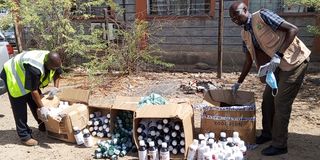
During the crackdown, the officials, led by North Rift Regional Manager Anthony Wechuli, arrested five dealers with the help of National Police Service officers. Products with names such as Tullomite and Gladiator were impounded.
“Over 75 per cent of the branded Gladiator termiticide bottles were fake, containing only paraffin and a dye, with zero active ingredient. Following our sustained raids in major agricultural towns in North Rift, we have established that the dealers have opted for remote areas like Turkana,” Mr Wechuli said.
He said the five dealers arrested are to be charged with violating the Pest Control Products Act, which requires all products to be registered, properly packaged and labelled.
“The sale of illegal, unlicensed and counterfeit products poses risks to human health, safety and the environment. We want to encourage locals to buy products only from approved and licensed agrovet dealers where we certify the products they are selling,” Mr Wechuli said.
Counterfeit and banned pesticides impounded during an impromptu crackdown by officials from the Pest Control Products Board at hardware stores in Lodwar, Turkana Central Sub-county, on February 19, 2026.
Photo credit: Sammy Lutta | Nation Media Group
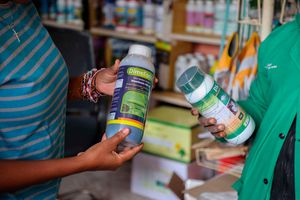
Locals were advised to be on the lookout for the PCPB (Pest Control Products Board) registration number and a conspicuous feature on the product label. Only two languages — English and the equivalent Kiswahili translation — should appear on an approved product.
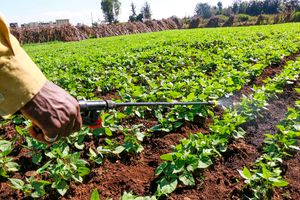
The board said it will step up crackdowns in other towns within Turkana, where locals are also practising irrigated farming to unravel the activities of unscrupulous dealers.
“We are on the heels of unscrupulous dealers by moving everywhere within the North Rift region as assurance that the board wants to ensure that all Kenyans are protected and that only approved outlets are operating. Our mission is to ensure that Kenyans are sold efficacious products that do not harm their health,” Mr Wechuli said.
Mr John Lekiling, a resident of Lodwar town, said he has been buying the fake pesticides at between Sh1, 300 and Sh1, 500 to treat timber against termites, but he has never eradicated the pests for more than a year.
“The Pest Control Products Board’s first-ever crackdown on counterfeit and banned products is an eye-opener to residents of Turkana who have fallen victim whenever buying timber and are immediately convinced by dealers about the availability of reliable pesticides,” Mr Lekiling said.
He called on the board to publicly reveal the names of certified pesticide dealers and the approved products for use within Turkana as part of measures to protect unsuspecting consumers.
Separately, uunscrupulous sellers and farmers have been put on notice over the continued misuse of the illegal pesticide Gladiator 4TC.
The board notified the public that Gladiator 4TC, a termite control product, was withdrawn from the Kenyan market in 2021 by the product registrant and is therefore not authorized for sale or use.
Despite this timely move, the board has noted that products bearing the same name are still circulating in the market.
Pest Control Products Board North Rift Regional Manager Anthony Wechuli addressing journalists in Lodwar on February 19, 2026 where he declared Lodwar a new hotspot for counterfeit and banned pesticides.
Photo credit: Sammy Lutta | Nation Media Group
Mr Lawrence Kalawa, the boatrd’s General Manager of the Compliance and Enforcement Department, said counterfeiters have been taking advantage of unsuspecting end users. He highlighted that the product is intended for termite control, which is critical in the building and construction industry to protect timber.
In addition, it is used to safeguard other cellulose-based materials from damage that can compromise the integrity and safety of buildings.
“The hazardous product being circulated in the market poses a health risk to handlers and jeopardises the structural integrity of structures due to poor efficacy,” he said.
As part of its compliance and enforcement mandate, PCPB conducted market surveillance and obtained samples, which were analysed at the Board’s laboratory.
The analysis confirmed that the product currently sold under the name Gladiator 4TC is counterfeit, does not match the original formulation, and contains kerosene and other undeclared substances, making it illegal and unsafe.