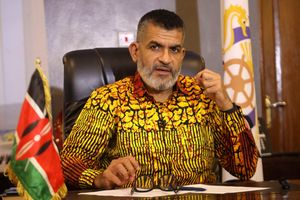
At 80, Mohamed Dagale Osman has the kind of memory that spans eras. He remembers when Wajir was just four main streets lined with trees, when the British called it a frontier outpost, and when the bucket toilet system was introduced as a "temporary" solution.
Seven decades later, Osman watches the same ritual his grandfather witnessed: men moving silently through the darkness, collecting plastic buckets filled with human waste from house to house.
"When I was a young man, this town was very small," he says, his weathered hands gesturing toward streets that now buzz with shops, mobile money kiosks, and internet cafes. "But even then, the sanitation system was poor. I was told that long ago, Wajir was like a sea—people used shallow wells and used bucket toilets to avoid contaminating the water."
What was supposed to be temporary has become permanent. What was designed for a small colonial outpost now serves a bustling town of nearly 200,000 people. And Mohamed Dagale Osman has watched it all, becoming the unlikely chronicler of Kenya's most persistent infrastructure failure - poor sanitation.
Wajir's bucket toilet bind
The road to meet Osman and understand Wajir's sanitation paradox began with a long drive from Nairobi. We left the capital around midday on a Tuesday, following smooth tarmac through Mwingi and Nguni in Kitui County, past scattered settlements and dry landscapes. The drive to Garissa covered hundreds of kilometres in just seven hours—deceptively easy.
But the next morning revealed the true challenge of reaching Kenya's northeastern frontier. By 7 am, we were back on the road, and after Modogashe, the tarmac abruptly ended. What followed were hours of dusty, bumpy roads stretching past small villages and security checkpoints, until we finally drove into Wajir at 1 a.m., exhausted and covered in fine desert dust.
Wajir town immediately confounds expectations. This is no sleepy settlement—tuktuks honk through crowded streets, traders hawk everything from mobile phone credit to imported dates, and the central market buzzes from dawn to dusk.
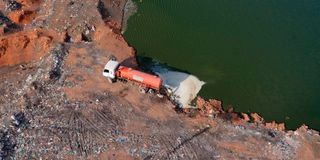
Tractor unloads refuse into open pit, highlighting urgent need for sustainable sewerage system in Wajir.
Photo credit: Robert Gichira | Nation
This is northeastern Kenya's administrative and economic heart, home to an estimated 150,000 to 200,000 people according to Kenya's last census in 2009—a number that local officials insist has grown dramatically since.
Yet for all its expansion and economic vitality, Wajir remains trapped by the same challenge Osman has witnessed for seven decades: how do you manage human waste when geography and history conspire against you?
A town built on impossible geography
Osman understands Wajir's geographic curse better than most. The county's flat landscape creates a technical nightmare for sanitation. The water table sits unusually high—you can dig just three metres in some areas and find water. It's a blessing for a semi-arid region, but a curse for waste management.
"Long ago, Wajir was like a sea," Osman repeats, referencing local knowledge passed down through generations. "Any sewage dumped in shallow pits quickly contaminates the very water sources residents depend on for survival."
With no sewer system possible, approximately 75-80 percent of households still rely on plastic buckets as toilets—a figure that has remained virtually unchanged throughout Osman's lifetime, despite the devolution of services to counties twelve years ago.
The bucket system operates with the same precision Osman remembers from his youth. Each evening after sunset, teams of men known locally as 'Chura' move silently through the town's neighbourhoods. Working in small groups, they collect filled buckets from compounds and empty them into tractors stationed at strategic points throughout the town.
Once collected, the waste follows the same simple path it has for decades: tractors drive five kilometres to Wajir's only designated dumpsite, where raw sewage is dumped into open pits and left exposed to the sun, wind, and rain. No treatment, no processing, no safety measures.
"As the town began to expand, people started digging sewage trenches, but almost 80% still use the bucket system," Osman says, his voice carrying the weight of accumulated frustration. "This has led to diseases like kala-azar and typhoid that keep coming back."
Tractor unloads refuse into open pit, highlighting urgent need for sustainable sewerage system in Wajir.
Photo credit: Robert Gichira | Nation
Beyond infrastructure, Osman has become a witness to climate change's impact on an already fragile system. His memories span Wajir's transformation from a region with predictable rainfall to one caught between devastating droughts and destructive floods.
"We used to have two rainy seasons, but now they've disappeared. Drought has gripped Wajir, and people rely on shallow wells, which are increasingly affected," he explains.
When rains do come, they arrive with devastating force that Osman says is different from the gentle, seasonal patterns of his youth. Floodwaters wash human waste from unsealed pits into homes, roads, and water sources, triggering seasonal outbreaks of cholera, dysentery, and other waterborne diseases.
"When it rains, there's no proper drainage. Wastewater gets into clean water wells," Osman continues. "That's our biggest problem—the lack of toilets and clean water."
Over the decades, he has watched the same cycle repeat: growth without infrastructure, hope without delivery, promises without results.
Osman's long perspective makes him sceptical of most proposed solutions. He has watched too many initiatives fail to believe easily in the next one.
Abdi Billow, a resident and Chairperson of the One-Stop Development Agency, shares some of that scepticism while acknowledging the scale of the challenge.
"The poor ones are still using the bucket latrines, and the poorest of the poor are still using open defecation," Billow explains. "If you go to some villages today, some families have no toilets. What do they do? They either use the neighbourhood or they defecate openly."
Billow recalls how a 2010 initiative under the Ministry of Northern Kenya attempted to build a conventional sewage system but was abandoned due to poor planning and the onset of devolution, which shifted responsibility to county governments unprepared for such technical challenges.
Later efforts to introduce EcoSan (ecological sanitation) latrines faced different obstacles that revealed the complex cultural dimensions of Wajir's sanitation challenge.
"EcoSan toilets convert waste into dry compost. But for many Somali communities, the idea of human waste being used as manure was unacceptable. That project failed too," Billow explains.
The resistance reflected deeper concerns about dignity, cleanliness, and religious practice in a predominantly Muslim community where ritual purity holds special significance.
Another promise, another wait
Today, the Wajir County Government claims to have learnt from past failures. In partnership with the World Bank, they're constructing what they say will be the region's first faecal sludge treatment plant—a system designed specifically for Wajir's unique challenges.
Roble Ahmed, Managing Director of Wajir Water and Sewerage Company (WAJIWASCO), believes this approach finally matches technology to local conditions and will serve the town for the next 20 years.
"The flat, sandy topography made conventional sewage impossible. So we opted for a sludge treatment plant," Ahmed explains. "Waste will be collected using trucks and processed 5 kilometres from town. Solids and liquids will be separated, treated, and reused even as briquettes or fertiliser."
The treatment plant is expected to be built at the town's main dumpsite, where visible excavation shows large pits being prepared. However, there's no clear indication of when it will be fully operational.
Osman has heard such promises before. His weathered expression suggests the polite scepticism of someone who has watched too many initiatives begin with fanfare and end in abandonment.
The human cost of Wajir's sanitation failure weighs heavily on his mind. According to the World Health Organisation, poor sanitation is responsible for 1.5 million deaths globally each year, mostly from preventable diarrheal diseases. In Kenya, 70% of rural communities still lack access to proper toilets, but in Wajir, where even shallow wells face contamination, the risks multiply exponentially.
Mahmoud Hassan, Wajir County's Director of Public Health, acknowledges the challenge while defending current efforts. His department conducts regular water quality checks and distributes chlorine tablets while running sensitisation programs about hygiene and disease prevention.
"People are opting to have what we call septic tanks, and if not properly moderated, may lead to what we call mixing of the faecal matter into the shallow wells," Hassan explains. "The county government of Wajir has been putting a lot of emphasis on this, especially in areas where we don't have proper toilets. We have a program called open defecation free system, mostly done in our villages."
The county reports progress: several villages certified as open-defecation-free, modest improvements in urban household sanitation. But with three-quarters of residents still depending on bucket toilets, Wajir remains trapped between growth and basic infrastructure.
For Osman, these incremental improvements feel insufficient against the backdrop of decades of watching the same problems persist and multiply with the town's growth.
At nightfall, we watched the evening ritual unfold—men moving in the darkness, collecting buckets, moving like clockwork, their hands in medical gloves, following the rhythm. They wore masks, but not the kind you'd expect for this kind of work. They wore medical masks. It was smelly and, quite honestly, disgusting to watch. It's difficult work, they say, but someone's got to do it.