For decades, residents of Kalokol town on the shores of Lake Turkana, the world’s largest desert lake, have lived with a painful contradiction: surrounded by water yet struggling daily to find safe water to drink.
With no reliable piped water system in the lakeside fishing town, thousands of residents depend on the Napasinyang seasonal river, and its sandy riverbed dotted with dozens of hand-dug scoop holes where locals fetch groundwater daily for domestic use.
Every morning, women and children wake before sunrise to trek for kilometres to the river in a desperate search for the scarce commodity. The persistent shortage has turned water vending into a lucrative business controlled by suppliers linked to fish traders, hotels and construction companies.
A resident, Ms Aregae Alimlim, says the town’s water crisis has repeatedly been reduced to a political campaign tool by leaders for more than five decades without lasting solutions.
“Our plight is known to all local leaders, but every election cycle promises are made and nothing changes. We have cartels in the town controlling the distribution of water from the seasonal river. Several attempts, including drilling boreholes, have been made to address the situation, but pipes have been vandalised,” she said.
According to Ms Alimlim, women and children bear the heaviest burden, often walking long distances to the Napasinyang riverbed, where shallow wells are controlled by men seeking quick cash from traders and residents.
“Although it is a seasonal river, it is the only stream near our town that drains into Lake Turkana whenever it rains in different parts of the county. But frequent flash floods and contamination of the wells have exposed us to increased waterborne diseases and sometimes cholera outbreaks,” she said.
During rainy seasons, many households lack adequate water storage facilities and are forced to rely directly on lake water, which has contributed to widespread fluorosis cases in the area.
Residents have repeatedly appealed to the county government since the onset of devolution to address the crisis, but with little success on the ground. But they are yet to benefit from plans by the county government and the North Rift Water Works Authority to solve Kalokol’s long-standing water problems, which include extending a pipeline from Eliye Centre.
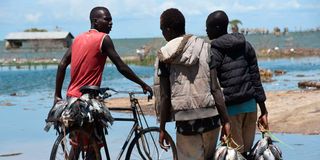
A fisherman loads fish on a bicycle at Kalokol area of Lake Turkana in Turkana County.
Photo credit: Jared Nyataya | Nation Media Group
“We only enjoyed water from the pipeline for one month. Though the water was salty, it showed that Kalokol’s water woes can be solved. Later, a section of the pipeline was reportedly destroyed and it has never been repaired,” Ms Alimlim said.
Another resident, Mr Peter Esuron, questioned why Kalokol, a thriving fishing hub and one of Turkana County’s biggest revenue earners, still lacks a reliable piped water supply.
“Most hotels in the town depend on water vendors for their supply. Lack of piped water is also slowing economic growth in a town that has huge tourism potential because of its proximity to archaeological sites and Central Island National Park,” he said.
He urged county authorities to dismantle cartels allegedly frustrating efforts to provide adequate clean water to the lakeside town.
Mr Esuron said children as young as school-going age are forced to wake up as early as 6.30 am and walk up to eight kilometres daily to fetch water before reporting to school.
“Addressing the water crisis will also help tackle child labour and improve school attendance,” he said.
Residents are now pinning their hopes on two major water projects funded jointly by the national and county governments.
The latest intervention by the county government is the Kalokol Water Supply Project Phase II, which was awarded to a contractor last month and is expected to supply the town with water from the Loyoro-Kalokol catchment.
County Director of Water Paul Lotum said the project will involve laying a pipeline from Loyoro to Kalokol, constructing an additional 100 cubic metre elevated steel tank, one water kiosk, and connections to key institutions, including Loyoro Primary School, a local dispensary, and a community water point.
The works aim to enhance reliable access to safe water for both domestic and institutional use. This project demonstrates our commitment to ensuring every household and institution has access to safe and reliable water,” said Mr Lotum.
Abandoned temporary shops in Kalokol town that were submerged by the rising waters of Lake Turkana.
Photo credit: Sammy Lutta | Nation
He urged the contractor to adhere to quality standards and timelines, saying timely completion would significantly improve livelihoods in the area.
County Executive for Water Willyjustus Akwalata said the county government and the Central Rift Valley Water Works Development Agency were also jointly implementing the Eliye-Kalokol Water Project to improve water access in the two centres and surrounding villages.
The Equalisation Fund project, which will be implemented in phases, includes development of Eliye Springs as the main water source for Eliye village, construction of a 225,000-litre steel tank, a 42-kilometre pipeline, six water kiosks, five cattle troughs, and rehabilitation of a steel tank in Kalokol.
“Due to poor access to safe drinking water along the lake shores, there was a need to drill additional boreholes to improve distribution. Through this project, we plan to develop separate water sources for Eliye and Kalokol, while villages located between the two centres will benefit from the connecting pipeline,” said Mr Akwalata.
The county official said successful implementation of the projects would depend heavily on community involvement to minimise disruption during construction and protect the infrastructure from vandalism.