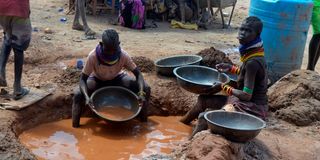
Deep beneath Turkana’s rocky terrain, hundreds of artisanal miners risk their lives in narrow, unstable shafts, hand-drilling and chiselling quartz-bearing veins in search of gold.
The hazardous work offers a source of livelihood in a region where economic opportunities are limited. But as mining activity intensifies, a battle is unfolding above ground over who controls the goldfields, who gets to mine and who stands to benefit from Turkana’s underground wealth.
At Lomeguro, Kalomwae and Naduat, allegations of manipulation of mining licences and attempts to bring in private investors have triggered a political dispute, with leaders trading accusations over the future of mineral rich sites that have traditionally supported local communities.
The dispute has raised fears among miners and residents that growing commercial interest could push them out of areas they have relied on for their livelihoods.
As Turkana’s gold attracts greater attention from commercial interests, a central question is emerging of whether the communities already digging for it share in the wealth it generates.
The controversy has drawn in the Turkana County Assembly, where MCA's are demanding answers from the county executive on the status of mining activities and the role of private investors.
At Lomeguro, where mining activity has increased, Loima MP Protus Akuja claimed that some gubernatorial aspirants were seeking to hand over the site to a private investor.
Dr Akuja alleged that a secret deal was being orchestrated to dispose of the mineral-rich site without the consent of residents, local leaders or the County Assembly.
“A secret deal is being orchestrated to dispose of the mineral-rich Lomeguro site without consent from locals, leaders and the County Assembly. I have credible information about the individuals and I will expose them if they do not abandon the plan to fence the site and displace the people. We have leaders who I will name. I will take a petition to the assembly seeking cancellation of prospecting licence,” Dr Akuja said.
But Turkana North MP Ekwom Nabuin, whose constituency includes Lomeguro, strongly rejected the allegations, describing them as unfounded and reckless.
Women work at a gold mine Naduat, Turkana West, where artisanal mining provides a livelihood for local communities.
Photo credit: File | Nation Media Group
Addressing residents, Mr Nabuin assured them that they would not be displaced, insisting that he had a responsibility as the area MP to be involved in decisions concerning the mining site.
“This is your land, you will live here, and no one will displace you. I heard propaganda that you will be forced out. As area MP, I must be involved in everything around here. I assure you that you will live here as long as I am your leader,” Mr Nabuin said.
The dispute has since moved beyond political exchanges, with the County Assembly demanding answers from the county executive about developments in the mining areas.
During a sitting, ward representatives questioned Natural Resources, Mining, Energy and Climate Change executive Anthony Apalia about the status of mining activities and the licensing of investors in the county.
Lobei/Kotaruk MCA Anarclet Lemuya said he had recently witnessed an altercation between the two MPs, both of whom are aspiring for the gubernatorial seat, over allegations that a gold mining site was being auctioned to an investor.
“I would want to hear from the county department of mining what they know about it because it is the responsibility of the county government to protect the land of Turkana people and their resources,” Mr Lemuya said.
Dr Apalia, however, distanced his department from the political claims, saying the allegations had not been brought to his office through official channels.
“As a ministry, we are not able to establish the truth in those statements, but that has never passed through our office,” he said, describing the claims as public pronouncements by politicians seeking to advance their political interests.
The dispute has also raised broader questions about the extent of Turkana’s mineral wealth and the status of exploration and extraction activities across the county.
Lapur Ward MCA Michael Ewoi said Turkana was endowed with significant petroleum resources in the South Lokichar Basin, as well as deposits of gold, gypsum, gemstones and other minerals that are either under exploration or being extracted.
He asked the county executive to provide a comprehensive inventory of known mineral resources and disclose the exploration, licensing and development status of each deposit.
“In South Lokichar Basin, the national government is currently undertaking activities aimed at advancing oil production and export. I now want the executive to provide a comprehensive inventory of known mineral resources in Turkana as well as indicate the current exploration, licensing and development status of each mineral occurrence,” Mr Ewoi said.
Women work at a gold mine Naduat, Turkana West, where artisanal mining provides a livelihood for local communities.
Photo credit: File | Nation Media Group
Dr Apalia said the county government had developed an extractive sector readiness strategy to guide the management of petroleum and mineral resources.
He said the Turkana County Extractive Sector Policy, which provides a framework for the county’s engagement in petroleum and mineral development, was awaiting approval by the County Assembly. The policy covers local content, revenue management, environmental safeguards and community development.
The county executive also cited the Community Land Act, 2016, saying the devolved government works with community land management committees to secure the free, prior and informed consent of residents before investors can operate on community land.
Dr Apalia said Nakalale Ward in Turkana North remained the county’s principal artisanal mining area, alongside other mineral-rich areas, including Sasame, Lochoremoit, Kalomwae and Kapua.
However, while the county government has a role in facilitating community engagement, the licensing of mineral extraction is primarily handled by the national government under the Mining Act.
“On licensing of mineral extractives, we all know that under the Mining Act, the procedure squarely falls under the national government and the county only facilitates the process of sharing benefits and community consent. That is why we issue a letter of no objection after a community accepts that the investor will be around with them. That is why we sometimes don't have much information about some mining companies,” Dr Apalia said.
For some MCAs, however, the dispute goes beyond the technical question of who issues mining licences.
Katilu MCA William Etubon accused some local leaders of using what he described as a “divide and rule” approach to win the support of sections of communities for private investors seeking to take over mining sites, particularly around Aroo Sub-County.
Mr Etubon called on the county government to investigate the licensing of mineral extractors around River Turkwel. He alleged that local miners were being pushed out of Kalomwae, which he claimed was being occupied by mining companies linked to senior national government officials.
For artisanal miners working in the narrow shafts, the political dispute has direct implications for their livelihoods. Gold mining provides an alternative source of income in an area where economic opportunities are limited.
The entry of private investors could bring capital, technology and new employment opportunities. However, local communities want clarity on what would happen to miners already working at the sites and how the benefits from the resources would be shared.
The county government says it is developing a framework covering local content, revenue management, environmental safeguards and community development, while leaders are demanding greater transparency on mining licences and the status of prospective investors.