Education stakeholders in Turkana County are pushing for legislation to guarantee consistent government funding for the school feeding programme, saying unreliable food supplies are negatively affecting enrolment, retention and transition among children in pastoralist communities.
Teachers, parents and MPs want the programme anchored in law, saying unreliable meals are fueling school dropouts and disrupting learning in arid and semi-arid lands (ASALs) as pastoral families migrate in search of water and pasture.
The concerned stakeholders want proposed education reforms to guarantee timely government funding and food deliveries, alongside mandatory low-cost boarding schools to keep children in class when families migrate in search of water and pasture. The push comes amid concerns over delays following the government takeover of the programme from humanitarian agencies.
In Kenya’s arid north, a school meal can be the difference between a child staying in class and following their family hundreds of kilometres in search of water and pasture. That reality is at the centre of a growing push by education stakeholders who say the school feeding programme is critical to keeping children in school in ASAL areas.
Local leaders, teachers, parents and representatives of teachers' unions, including the Kenya National Union of Teachers (Knut) Turkana branch and the Kenya Union of Post Primary Education Teachers (Kuppet), say the absence of comprehensive national legislation specifically governing school feeding has left the programme vulnerable to funding shortfalls and delays.
They argue that putting the programme on a firm legal footing would help ensure children in drought-prone pastoralist communities continue attending school even when their families migrate in search of water and pasture.
According to Mr Peter Lokitoe, the Junior Secondary School Secretary and Kuppet Turkana Branch Secretary, lack of food in schools is affecting learners' transition to upper classes and junior secondary schools.
"The school feeding programme is facing unnecessary delays in distribution due to lack of a clear operational plan, subjecting vulnerable learners to disrupted meals and hunger. This is a major factor contributing to preventable high rates of school dropouts, resulting in low numbers in JSS institutions," he said.
The concerns come as the National Government continues to oversee the programme following a transition from the World Food Programme (WFP).
Before the National Council for Nomadic Education in Kenya (NACONEK) took over the school feeding programme in primary schools in 2024, the Ministry of Education had taken over the programme from WFP, which had provided food to learners since the 1980s, after the launch of the National School Meals and Nutrition Strategy for 2017 - 2022.
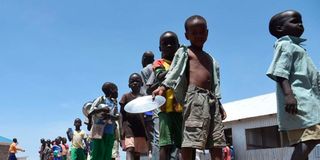
School feeding programme in a school in Turkana County.
Photo credit: File | Nation Media Group
Teachers have raised concerns about the sustainability of the programme under the national government, saying that when WFP was running it, funds were released on time to facilitate the procurement of food.
Chairperson of the National Assembly Departmental Committee on Education Mr Julius Melly (Tinderet), said the programme, which is aimed at improving student nutrition and enrolment, must be safeguarded through legislation.
Speaking in Turkana County during the second week of the committee's public participation exercise on the proposed Education Reform Bills this week, Mr Melly backed calls by education stakeholders for the school feeding programme, particularly in ASAL counties, to be anchored in law.
"While in Turkana during the second week of our public participation exercise on the proposed Education Reform Bills, we support calls by education stakeholders to ensure that the school feeding programme, especially for ASAL counties, should be within the law. We want parents to be assured that their children will be able to get food in schools when they migrate in search of water and pasture for their livestock," Mr Melly said.
He also backed calls by Loima MP Protus Akuja for the mandatory establishment of low-cost boarding schools in ASAL counties.
Such schools, the leaders said, would allow children to remain in school when their parents migrate with livestock in search of pasture and water, while ensuring they have access to food and accommodation.
Dr Akuja said low-cost boarding schools in Turkana would also benefit children living along the Kenya-Uganda border, where some families cross into Uganda with their livestock during migration.
"Without such schools, their children won't learn because they are following their parents everywhere they go until it rains and they come back. We should have mandatory low-cost boarding schools in such areas so that if their parents migrate, their children remain behind and are supported by the schools with both accommodation and food and when it rains, parents will find them safe in schools," he explained.
Dr Akuja said delays in government food supplies could leave children who drop out of school near gold mines vulnerable to being drawn into risky gold-mining activities.
"Once we have low-cost boarding schools and a legally recognised school feeding programme, our children will remain in school and they learn and pass their examinations without disruptions," he said.
Turkana Central MP Emathe Namuar said pastoral communities in Kenya want their children to attend school but have for decades been disadvantaged and marginalised.
He said the new legislation being developed should ensure children in marginalised areas have uninterrupted learning opportunities as they progress to senior school and university.
Mr Namuar said the school feeding programme should be treated as a critical part of efforts to attract children to school and retain them.
"Compulsory education for children should also be accompanied by infrastructure, as a quarter of my Constituency don't have a school, forcing children to only learn how to take care of the livestock,” he added.
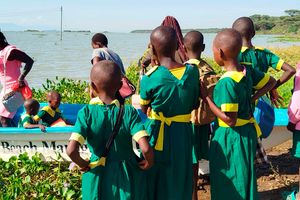
School feeding programme in a school in Turkana County.
Photo credit: File | Nation Media Group
He stated that parents needed confidence that food promised by the Ministry of Education through NACONEK would reach schools promptly.
Mr Namuar said timely food deliveries would help convince parents to enrol their children in nearby schools, knowing they would receive meals whether the area was experiencing drought or not.
For parents, the impact of disruptions to school feeding is already being felt.
Mr Christopher Ekuwom, a parent from Oropoi, said Turkana had been among the beneficiaries of a school feeding programme run by Mary's Meals Kenya, which provided daily meals to public schools as part of efforts to attract children to school.
He said the programme supported about 184,000 pre-primary and Early Childhood Development Education (ECDE) children with daily meals before it was halted in November last year.
"When the programme that was supporting about 184,000 pre-primary and Early Childhood Development Education (ECDE) children with daily meals was halted in November last year, distribution delays were imminent, forcing me to migrate with my children in search of water and pasture," Mr Ekuwom said.
The stakeholders are now calling for the proposed education reforms to provide a clear and enforceable framework for school feeding, particularly in ASAL counties where drought, pastoral migration and limited school infrastructure can directly affect children's access to education.