When scientists announced the discovery of vast underground water reserves beneath Turkana in 2013, pastoralists living along Kenya’s border with South Sudan hoped it would ease one of their biggest challenges of access to water.
For herders such as James Ekidor, the prospect was straightforward that reliable water closer to home would reduce the need to move hundreds of livestock in search of pasture and watering points, sometimes into unfamiliar and insecure areas.
The migrations have also exposed herders and their animals to attacks and livestock theft as they cross the Kenya-South Sudan border in search of water and pasture.
More than a decade later, however, Ekidor and other residents are still waiting for the resource to make a meaningful difference to their lives.
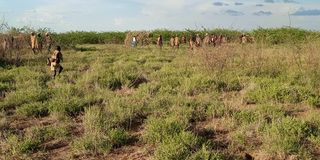
A group of herders on August 29, 2026 at a section of Lotikipi plains in Nanam Location, Lokichogio Sub County with pasture but lack water.
Photo credit: Sammy Lutta | Nation Media Group
They continue to rely on insecure water points along the border where drought and livestock theft remain a threat.
“Even with more than two years of peaceful coexistence between Turkana and Toposa pastoral communities, we are yet to get support for a mega water project at the border like Kobebe Dam in Uganda that is relied on by pastoralists from Kenya and South Sudan when the border resources are replenished,” Mr Ekidor said.
The situation has left the Lotikipi Basin Aquifer as one of Kenya’s biggest development opportunities yet to be fully exploited.
The aquifer covers about 4,164 square kilometres. An original technical assessment estimated its storage at about 207 billion cubic metres while a wider assessment of deep groundwater reserves in northern-central Turkana put total storage at about 250 billion cubic metres.
The Lotikipi aquifer was estimated to receive about 1.2 billion cubic metres in annual replenishment. The wider groundwater inventory put renewable groundwater resources in northern-central Turkana at about 3.447 billion cubic metres a year.
For a region where communities have long lived with severe water scarcity, the figures offered something that had seemed almost impossible - the possibility of water security.
But the promise quickly ran into a problem. The water was found to have high salinity, raising questions over whether it could be used directly for human consumption.
The initial pumping of the Lotikipi aquifer was subsequently halted because of the high groundwater salinity, while researchers and policymakers began looking at whether desalination could make the resource economically viable.
For residents, the discovery that had generated so much excitement began to look like another failed hope.
The contradiction is difficult to explain to communities living in the Lotikipi plains. They have water beneath them, but they still have to walk or drive long distances in search of it.
They have an enormous potential resource, but pastoralists continue to depend on traditional water points.
And when drought strips the plains of pasture and water, herders are pushed towards border areas where they risk losing their animals to theft or attacks.
Turkana Senator James Lomenen has questioned why the huge underground resource remains largely untapped. He argues that the water was naturally replenished through underground streams and could provide a long-term answer to the region’s water crisis.
“Immediately after rains in Kenya, our people who have survived insecurity and drought in another territory cross back and rely on traditional water sources that had been filled up with excess water going to the aquifer,” Mr Lomenen said.
His argument reflects the frustration among residents who have watched drought return repeatedly while the promise of the aquifer remains largely unrealised.
For a while, it appeared that desalination would provide the missing link between the underground resource and the thirsty communities above it.
By 2019, there were plans to bring in a Saudi-owned company, Almar Water, to establish a desalination plant.
In February 2022, the Kenyan government declared the project economically unviable because of the high cost of desalinating the water.
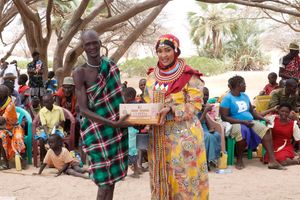
Juncao grass that Turkana local professionals on August 29, 2026 hoped that can transform livestock production if embraced for commercial fodder production.
Photo credit: Sammy Lutta | Nation Media Group
The Ministry of Water halted the project, with the electricity required for desalination alone estimated at about Sh50 million a month.
The decision effectively put the brakes on hopes that the aquifer would quickly become a source of drinking water and irrigation.
For Mr Chris Lomadanga, a resident of Lokitaung town in Turkana North, the disappointment was particularly painful. When the aquifer was discovered, Mr Lomadangabelieved he would finally stop making frequent migrations in search of water near the Kenyan borders with Ethiopia and South Sudan.
“We expected that the government and development partners would invest in drilling of boreholes around the aquifer so that water challenges pastoralists face are solved once and for all,” he said.
“What we have been subjected to are failed hopes,” he regretted.
When traditional water points dry up and pasture disappears, pastoralists have little choice but to move. The search can take them towards the borders with South Sudan, Uganda and Ethiopia - territories where insecurity and competition over water and pasture can turn migration into a dangerous undertaking.
Mr Ekidor says the possibility of reliable water within the Lotikipi plains could fundamentally change that reality.
Just when the Lotikipi promise appeared to have been buried by the salinity problem and the cost of desalination, scientists raised a new possibility.
In 2022, University of Nairobi climate change and water resource expert Prof Gilbert Ouma challenged the assumption that the entire aquifer was saline and unsuitable for human use.
The map suggested that, because the Napuu and Lotikipi aquifers share characteristics, pockets of non-saline water could potentially exist within Lotikipi.
“There is reason to believe that we have pockets of nonsaline water existing at the Lotikipi aquifer,” Prof Ouma said.
“We need a thorough water quality analysis of different sections of the aquifer to scientifically prove that.”
Rather, scientists were saying that the assumption that the entire underground resource was uniformly saline needed to be tested more thoroughly. That distinction reopened the possibility that fresh water could be found in particular sections without requiring the enormous cost of treating the entire resource.
The debate remains scientifically important because the original technical assessment itself envisaged the aquifer as a major strategic groundwater reserve, while subsequent work has focused on the economic and technical challenges of exploiting its water.
For local professionals, the potential is even bigger than ending thirst. They believe the resource could help turn parts of Turkana from a food-deficit region into a productive agricultural zone.
Local professionals estimate that the discovered water could aid cultivation of about 15,000 acres of land, creating an opportunity for Turkana to produce enough food for its population and generate a surplus for neighbouring counties.
“We want this region to produce enough food for the entire population and have surplus for selling to the nearby counties,” said Mr David Ekiru, a local professional who rears indigenous livestock in Lodwar and dairy cattle in Eldoret.
“There is also an opportunity to invest in commercial fodder production to reduce huge investment incurred by governments and development partners when procuring and transporting supplementary feeds to herders hit hard by drought,” he said.
That would address one of the most persistent problems in pastoralist communities: what happens to livestock when pasture disappears?
At present, the answer is often migration. But if fodder could be produced commercially within Turkana, pastoralists could keep animals closer to settled areas through the dry season. That could also have a direct bearing on security.
In 2026, the Water Resources Authority has renewed exploratory work in the Lotikipi Aquifer System, with several sites identified for exploratory drilling and assessment. It is undertaking preparations for exploratory drilling at seven sites in the Lotikipi Aquifer System as part of efforts to assess the groundwater resource. The sites are Loropio, Lolim, Lokongae, Anguleiakirr, Kayaket, Kolopusia and Nakoret.
That development is significant because the unresolved question surrounding Lotikipi has never been whether water exists underground. The latest intervention could provide fresh information on the aquifer and help establish where the usable water is, its quality, how much can sustainably be extracted and developed at a cost communities and governments can afford.
Earlier research has already established the enormous scale of the groundwater resource, while subsequent studies have examined the economics of desalination and the possibility of using groundwater to support irrigation and food security.
For pastoralists who have waited more than a decade, however, another study or another report is not enough. For them, what is missing is the connection between the resource beneath the ground and the communities above it.
They want the promise of 2013 to finally become tangible so that they can build their lives around a resource that has for years been described in terms of billions of cubic metres.