But long before becoming a threat to national security, before he weaponised biblical teachings at his Good News International (GNI) Church to enslave and then kill hundreds, he was just Paul Nthenge Mackenzie, the middle child in a family of 10.
Live: 200 years for cult leader Mackenzie over Shakahola massacre
Mackenzie was born in 1973 into a polygamous family in coastal Kenya. He was the fifth born to the late Mackenzie Kisini and Anastacia Mwele.
His family roots trace back to Ikalaasa location in Mwala, Machakos County, although he grew up largely in Lunga Lunga, Kwale County.
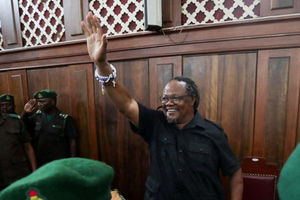
Pastor Paul Mackenzie when he appeared before a Mombasa court on November 10, 2025.
Photo credit: Kevin Odit | Nation Media Group
His childhood was marked by a difficult relationship with his father, which eventually led him to leave the family home and move in with his mother, Mwele, in Mombasa.
His grandparents also came from a polygamous family, with a background that included traditional religious practices such as shrine worship and sacrifices, known in Kamba as Mathembo.
Mackenzie attended Mwalewa Primary School before proceeding to Shimba Hills Secondary School and later Lukore Secondary School, where he completed his secondary education in 1994 with a mean grade of C minus.
After school, he joined his mother in Mombasa before travelling to Nairobi for driving lessons. In Nairobi, Mackenzie lived with his paternal uncle. On completing the course, he returned to Mombasa and ventured into the taxi business before eventually settling in Malindi, where he lived among extended family members.
He was married three times and fathered seven children. His first two wives, Agnes Mwongeli and Joyce Mwikamba, died in 2009 and 2018, respectively, under circumstances described in social inquiry reports as mysterious.
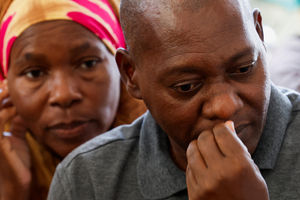
Rhoda Maweu (centre), the wife of Pastor Paul Mackenzie, follows proceedings in court on February 25, 2026.
Photo credit: Kevin Odit | Nation Media Group
His eldest son, Dan Mackenzie, recalled his mother's burial at the church premises in Furunzi, Malindi, pointing to her grave next to what used to be the GNI main church, which was renamed Times TV Hall.
“My mother was buried here,” Dan said during Nation's visit to his father's church in Malindi.
Mackenzie's third wife, Rhoda Mumbua, is among those facing murder and terrorism charges in connection with the Shakahola cases.
His stint in the taxi business made him a name in the locality, but it was religion that would eventually define Mackenzie's life.
According to a social inquiry report, Mackenzie began his spiritual mission in 2001 and became a fully-fledged televangelist in 2003, preaching through GNI. The church operated in Malindi until 2019, when it closed following a split between Mackenzie and his religious partners over spiritual and ideological differences.
He subsequently left Malindi and relocated to Bofu, popularly known as Shakahola, where his religious mission took a different turn.
To some who knew Mackenzie before Shakahola, he was a dependable friend and a preacher whose messages initially appeared harmless. But accounts from former associates, family members and followers reveal how his teachings gradually became more radical, strained relationships and reshaped the church he controlled.
One of those who knew him before his apocalyptic message took hold was Suleiman Nyanje Zero, a Malindi resident who lived in the same locality as Mackenzie.
“Mackenzie was a good man. He even wanted me to join his church, but I am not a religious person, so I did not join him, although he was my best friend,” Zero told the Nation at his home in Malindi.
Their families were close. Zero's wife helped look after Mackenzie's children, and their kids played together. He even allowed the preacher to cultivate vegetables and cassava on his land, which Mackenzie used until 2018.
But when Mackenzie declared his intention to establish Kanisa Jangwani, or Church in the Wilderness, their friendship began to fade. Zero could no longer reach him by phone, despite their previously frequent communication.
Dan told the Nation that he barely had a relationship with his father, whom he described as frequently absent. Their differences deepened when Dan refused to embrace his father's beliefs and participate in fasting.
“I never had a close relationship with my father. I have no childhood memories with him. But I forgave him for that. So, whatever jail term the court imposes on him is okay with me,” he said.
Pastor George Mwaura Kiguru, who followed him from 2011 and later served in GNI, described him as a popular preacher whose messages initially attracted many followers.
After some church leaders left, Mwaura was given a bigger role in the ministry, preaching on Times Television between 2014 and 2018.
“By then, Mackenzie was a noble preacher with good messages, and his popularity grew, especially in the coastal region,” he told the court.
But the direction of the church changed. By 2017, Mackenzie was preaching against formal education, while opposition to modern medicine and beautification also became contentious teachings.
Charles Opondo, another former GNI pastor, testified that the church's teachings were principally based on the Bible but that disagreements emerged over three subjects – education, modern medicine and Huduma Namba.
He had preached at the Bombolulu branch between 2017 and 2019, where he was the lead pastor, and participated in open-air crusades and seminars.
Mackenzie's growing influence over his followers did not happen overnight. Court testimonies reveal a gradual process through which he dismantled the church's leadership structures, tightened his grip on its finances and increasingly made his interpretation of scripture the guiding authority for members.
Paul Mackenzie during the hearing of his case at Mombasa Law Courts on July 17, 2026.
Photo credit: Kevin Odit | Nation Media Group
Mwaura told the court that in 2017, Mackenzie abolished the church's existing structure and assumed control of its operations. All branches were required to remit their collections to him.
“He further instructed us, as pastors, to theme our respective teachings around his End Times messages,” he testified.
The next step was to separate followers from institutions Mackenzie considered incompatible with his teachings. The court found that he radicalised followers through six pillars of teaching that rejected education, modern medicine and government institutions; encouraged isolation from outsiders; and urged believers to relocate to Shakahola, which he presented as a place prepared by God.
He eventually ordered that children be withdrawn from school and taken to GNI's Furunzi branch for Bible studies. Parents paid Sh200 to register each child, while teachers appointed by the preacher conducted the lessons.
His central message revolved around the End Times and the rapture, which he described as the death of the Wateule, or chosen ones, through what he called Kunyakuliwa.
According to Mwaura, the search for Ukimbizi, meaning refuge, began after Mackenzie's arrest in 2017. The Covid-19 pandemic later provided another justification for separating believers from society.
Mackenzie interpreted the pandemic as divine punishment and declared that the church should relocate to Jangwani, the wilderness.
Shakahola cult leader Paul Mackenzie (right) and his co-accused in a Shanzu court on November 20, 2023.
Photo credit: File | Nation Media Group
Drawing on Revelation 12:5-6, he presented GNI members as God's chosen remnant who needed to flee into the wilderness. During a service on September 15, 2019, he interpreted thunder and rain as divine confirmation that followers should spend three and a half years in the wilderness before being taken to heaven in June 2023.
Mwaura, who also relocated to Shakahola with his family, testified that the settlement initially involved farming. But Mackenzie's message gradually shifted from cultivating crops to preparing followers to meet Jesus.
He described the process as prolonged psychological control that left followers effectively brainwashed.
Mackenzie's plan to move his followers into the wilderness was not developed in isolation. Court testimony revealed how teachings by foreign preachers, particularly an American evangelist, helped popularise the idea of a secluded religious settlement that would eventually become the foundation of the Shakahola exodus.
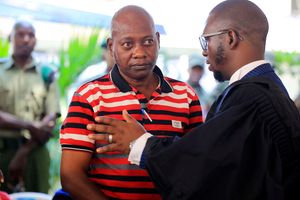
Paul Mackenzie speaks to his lawyer at the Mombasa Law Court on September 9, 2024.
Photo credit: Wachira Mwangi | Nation
A former senior GNI pastor, testifying anonymously in court, identified an American preacher known as Yeshaiah Alexander as the person who introduced the concept of Kibbutz, a communal settlement model rooted in Israel, during sermons to church leaders and followers in 2019.
The idea was to have believers live together in a secluded, farm-like community, sharing resources and pursuing spiritual fulfilment. Although Yeshaiah was not a GNI member, the witness described him as a friend of Mackenzie who attended church conferences and was invited to preach.
Other foreign preachers also visited the church, including a white preacher identified as Jude. In a recording of a May 12, 2019, service, Mwaura identified Jude preaching against formal education, hospitals, Huduma Namba and worldly beauty, while urging believers to separate themselves from society.
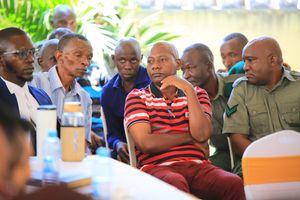
Suspected Kilifi cult leader Paul Mackenzie in Mombasa Law Court on January 23, 2024
Photo credit: Kevin Odit | Nation Media Group
The court heard that Jude's visit strengthened followers' conviction that ordinary employment and worldly pursuits were incompatible with their calling. Some government employees, teachers and medical professionals resigned. The phrase Kazi ya Mteule, or the duty of the chosen one, emerged to describe preaching as the only legitimate work for believers. Mwaura himself resigned from his job as a bus driver.
When Covid-19 struck, the Kibbutz idea gained further appeal. Mackenzie combined the teachings on communal seclusion with his interpretation of Revelation 12:6, presenting Shakahola as the wilderness where God's chosen would find refuge.
He assured followers that their needs would be met through divine providence, including manna from Christ.
The foreign preachers' documented role was in promoting ideas of separation and communal living. It was Mackenzie who adapted these teachings into his End Times message and mobilised his followers towards Shakahola, where hundreds would eventually die.
All that, today, is just a chapter in the book of horror whose climax was the death of hundreds whose kin continue to search for answers.