For residents of Loturerei village, on the outskirts of Lodwar town in Turkana Central Sub-County, getting a clean glass of water comes at a painful cost.
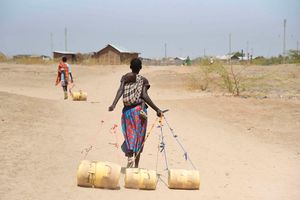
Some have to travel about 18 kilometres to Lodwar in search of safe water, while those unable to afford the journey or buy supplies from the town are left with little choice but to depend on highly saline water from local sources.
The consequences go beyond thirst. Residents say prolonged reliance on the salty water has exposed them to health complications, while the lack of a reliable supply has also frustrated plans to establish businesses and attract investment in a village strategically located along the busy Lodwar-Lokichar road.
Despite five boreholes previously drilled by development partners along the Loturerei-Napetao stream, none has yielded fresh water, leaving the community with no dependable local source.
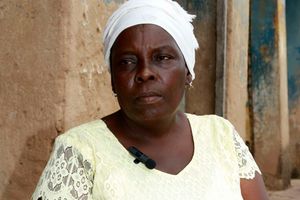
For Ms Zainab Ang’ela, the effects of drinking the water are painfully personal.
She says it causes a burning sensation when urinating, an experience that is even more distressing when children suffer the same discomfort.
"I feel pain when relieving myself after drinking the water because of the burning sensation. It is even more painful to see a child crying while urinating. Thirsty visitors are first warned that the water here is salty so that they are not affected," Ms Ang’ela said.
796278
Photo credit: Sammy Lutta | Nation
Ms Ang’ela, who hopes to establish a hotel along the highway, says the absence of clean water has made the investment difficult to realise.
"Motorists know that the centre has no clean water and they don't bother stopping for meals or even camping before proceeding with their journey. I appeal to national government agencies, development partners and the county government to either revive the water pipeline project from Napuu aquifer, use sophisticated technology to desalinate the available water or drill a fresh water borehole.
"Clean water will transform our village, improve health and drive economic growth," she said.
The community's predicament comes despite an earlier government commitment to extend clean water from the Napuu aquifer to settlements that have struggled with unreliable supplies.
In September 2019, the administration of former Turkana Governor Josphat Nanok partnered with the National Water Storage and Harvesting Authority (NWSHA) to implement a Sh72 million water project targeting communities with limited access to safe water.
The project, based at the Napuu water aquifer, was designed to supply water beyond the immediate vicinity of the source, marking a significant departure from the conventional arrangement where communities had to fetch water close to boreholes.
It involved installing a 4.6-kilometre main pipeline from one of the boreholes and connecting it to an elevated steel tank with a capacity of 300,000 litres. Water from the tank was then reticulated to more than 25,000 residents, easing the burden of long journeys in search of water.
At the time, Mr Nanok announced that the county would construct an extended pipeline from the elevated tank to Loturerei village, promising relief to residents who had for years depended on saline water.
However, the promised extension has yet to provide the community with the reliable supply it needs.
For Mr Eremon Ekiru, rainwater remains the only dependable source of fresh water for many households that cannot afford to buy supplies from Lodwar, whenever the rains come.
"We hope that the latest attempt by officials from both levels of government will provide a lasting solution. All five boreholes previously drilled along Loturerei-Napetao stream produce saline water. Using this water for domestic and livestock purposes has posed serious health challenges to our lives," Mr Ekiru said.
For those who can afford the journey, getting water from Kanam Kemer or Lodwar town costs as little as Sh10 for a 20-litre jerrican if they have access to motorcycles.
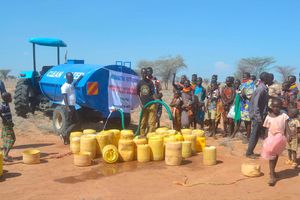
But for households without motorcycles or a reliable source of income, the alternatives are more expensive. They have to depend on water vendors using bowsers, who charge up to Sh50 for a 20-litre jerrican.
With many families already struggling financially and the region facing prolonged drought, Mr Ekiru says the county government should also consider investing in water trucking services to guarantee supplies to nearby health facilities.
"Nearby dispensaries should have uninterrupted access to fresh water for patients," he said.
There is now renewed hope following the latest assessment by officials from the county government and the State Department for Irrigation, who have been visiting the area since Monday to establish the viability of drilling a fresh water borehole.
A preliminary report by field hydrogeologist Solomon Kuria puts the groundwater depth in the area at between 115 and 120 metres.
Mr Kuria said the assessment was being undertaken under the Drought Resilience Programme in Northern Kenya, a bilateral initiative involving the governments of Kenya and Germany.
"Through the Drought Resilience Programme in Northern Kenya, which is a joint bilateral initiative between the Government of Kenya and the Government of the Federal Republic of Germany, we are planning for a new water project at Loturerei to solve their prolonged challenge of accessing clean water for both domestic use and livestock," he said.
For Loturerei residents, the assessment offers renewed hope after years of failed boreholes and unfulfilled promises.