Jaw-dropping tales of young Kenyans who sold their kidneys were the highlight of a parliamentary committee’s sittings in Eldoret on Friday, as a probe into the illicit trade continues.
Narratives of deceit and unforeseen consequences emerged as the kidney sellers recounted their experiences, underscoring the urgent need for regulation of the practice in Kenya.
One of the self-confessed kidney sellers is 23-year-old Amon Kipruto, a primary school dropout from Kipkenyo in Uasin Gishu County.
“It was in May 2024 when a person I know approached me and told me that a hospital in Eldoret was offering good money for kidney donation. The person organised a meeting where we met with a man of Asian origin to discuss how to start the process. The man told us that it was safe and healthy. On the first day, he gave me Sh50,000,” said Mr Kipruto.
Amon Kipruto (left), who claims he was paid Sh600,000 to have his kidney harvested, with his mother, Leah Jepkorir, and Nandi Hills MP Bernard Kitur during an interview on Friday.
Photo credit: Jared Nyataya| Nation Media Group
Mr Kipruto said he was taken to a private medical facility for examination to ascertain whether he was fit for the procedure. After the tests, he was confirmed medically fit.
Before donating the kidney, he claimed that he was issued a forged national identity card bearing a different name. This was designed to create the impression that he was a foreigner from Mogadishu.
“They took my ID and issued me with a fake one, showing my name as Mohammed Kipruto. They also told me to claim I was Somali from Mogadishu to avert stigma,” said Mr Kipruto.
After receiving the fake ID, he was taken to a private hospital where he was given some medication.
Following the operation to harvest his kidney, he was given a further Sh400,000. He then went into hiding, prompting his family to report him as a missing person.
His mother, Sarah Jeruto, 46, said that after she reported the matter at Simat Police Station in Kapseret Sub-County, he resurfaced.
Ms Jeruto said that when her son returned home, he looked disturbed and stressed. He then confessed to her about what had happened. She took him to Moi Teaching and Referral Hospital, where it was confirmed he had donated one of his kidneys.
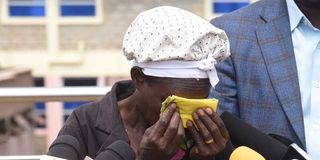
Sarah Jeruto, mother of Emmanuel Kipkosgei, one of the people who claim to have received money to have his kidney harvested, at Mediheal Group of Hospital in Eldoret City, Uasin Gishu County, cries during an interview at Boma Inn Hotel precincts.
Photo credit: Jared Nyataya| Nation Media Group
“He has become weak, with several complications. He is no longer my son who used to be healthy and jovial,” said Ms Jeruto, a single mother.
Speaking to journalists at Boma Inn Hotel in Eldoret after appearing before the Parliamentary Committee on Health, Ms Jeruto appealed to the government to help her secure justice for her son.
“I am a mama mboga. My life has been ruined by this inhumane act. I appeal to President William Ruto to help me get justice,” she said.
Mr Kipruto, who bears a scar on his abdomen from the kidney operation, said his body aches constantly.
Amon Kipruto shows the press a scar during a press briefing at Boma Inn Hotel precincts.
Photo credit: Jared Nyataya| Nation Media Group
“Since my kidney was removed, I have become sickly. I feel pain in my ribs, back, and almost all parts of my body,” said Mr Kipruto.
Another victim, 23-year-old Emmanuel Kipkosgei, also lost a kidney in similar fashion. He said he had been promised Sh1.2 million to donate his kidney at a private medical facility.
“Someone approached me and told me he could make me rich by donating my kidney,” he said.
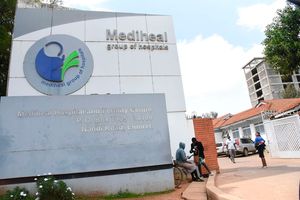
Emmanuel Kipkosgei, who claims to have received Sh450,000 to have his kidney harvested, at Mediheal Group of Hospital in Eldoret City.
Photo credit: Jared Nyataya| Nation Media Group
Upon donation, however, he was given only Sh600,000 instead of the promised Sh1.2 million. The balance, he was told, would be settled later.
Since the operation in March 2024, his life has changed. He struggles with balance and is battling several health conditions.
“It is unfortunate. I thought I was going to become rich but it has turned against me. My life is no longer the same. I have become a sick person. The money I got has not helped me,” he said.
His mother, Ms Leah Jepkorir, has urged government intervention. She said tests at Moi Teaching and Referral Hospital (MTRH) confirmed that her son’s kidney had been harvested.
“My son is always sick. The government must help me restore his health,” said Ms Jepkorir.
The two stories highlight a perturbing trend where young Kenyans are being lured into giving away their kidneys.
The National Assembly’s Departmental Committee on Health, chaired by Seme MP James Nyikal, is in Eldoret to establish the facts. It has already expressed shock over the growing number of desperate Kenyans attempting to sell their kidneys to hospitals in the region.
Hospitals continue to report a surge in desperate individuals, especially youth, offering to sell their kidneys for as little as Sh300,000.
Dr Mathew Koech, proprietor of Oak Tree Hospital, told the MPs: “Despite the saga that went viral globally, every day we receive young people willing to sell their kidneys to our hospital.”
Dr Koech, who has strongly denied his hospital’s involvement in illegal kidney trafficking, stated that young people aged between 20 and 30 frequently turn up at the hospital seeking buyers.
Victims expose kidney fraud and poor pay at Mediheal
The committee has been collecting information from hospitals, victims, security officers, and other stakeholders.
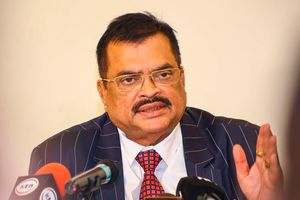
“We have been hearing testimonials from victims, police, and other stakeholders today. After this, we will make recommendations for further action,” he said.
In Kenya, selling human organs is illegal and punishable by law — though it remains difficult to police.
Insiders in the medical field say an increasing number of people are willing to sell their kidneys, sometimes approaching hospitals to ask how much they would earn.
A few years ago, Kenyatta National Hospital (KNH) posted on Facebook that questions about the price of selling a kidney were among the most common received.
“Please note that organ sale is strictly prohibited and illegal. You can only donate out of free will and not sell,” KNH management said in the post. “The only persons who are allowed to donate kidneys are the relatives of the recipient.”
The World Health Organisation (WHO) also opposes the sale of human organs, arguing that it exploits vulnerable people — especially those from poor countries — and fuels human trafficking and organised crime.
Dr Philip Cheptinga, Head of the Kidney Treatment Department at MTRH, said they have treated patients who suffered complications after donating their kidneys to hospitals in the region.
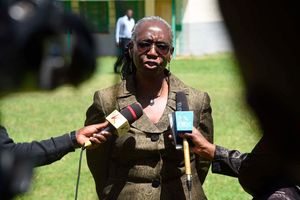
Dr. Phillip Cheptinga, a Nephrologist at the Moi Teaching and Referral Hospital in Eldoret City, Uasin Gishu County.
Photo credit: Jared Nyataya| Nation Media Group
He noted that many of the youths seeking to sell their kidneys come not only from Uasin Gishu but also from Homa Bay, Kisumu, Nandi, Trans Nzoia, Nakuru and other counties.
“Even after the saga, we continue to receive youths seeking a market for their kidneys in our hospital, with recent incidents involving individuals from Nakuru and Homa Bay,” Dr Cheptinga said.
He further revealed that even individuals who donate kidneys through legal channels often develop chronic health issues years later.
“Chronic diseases among kidney donors typically manifest around 15 years after donation, especially if the donor did not follow the correct procedure,” Dr Cheptinga explained.
He added that kidney trafficking is becoming more widespread in Kenya due to the absence of a comprehensive legal framework governing kidney donation and transplantation.
At the same time, Dr Cheptinga said there is a shortage of trained professionals in the field, noting that MTRH has only nine nephrologists instead of the required 10.