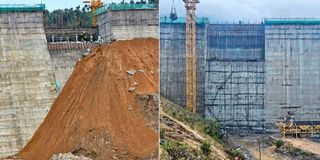
After more than a decade of waiting, residents of West Pokot County are edging closer to a reliable water supply as the multibillion-shilling Siyoi-Muruny Dam project approaches completion, raising hopes of improved livelihoods, food security and economic growth.
The project, whose construction began in 2015, is expected to address chronic water shortages in the largely arid and semi-arid county, where communities have long relied on rivers, boreholes, seasonal water pans and dams for domestic and livestock needs.
The latest update by the National Water Harvesting and Storage Authority (NWHSA) indicates that the main dam component was 95.5 per cent complete as of November 12, with the government expecting the remaining works to be completed within a week.
The milestone comes after several missed deadlines caused largely by funding constraints and implementation delays.
Once operational, the project is expected to supply clean water to approximately 350,000 people by 2035, covering Kapenguria, Makutano, Paraywa, Kabichbich, Chepyomet, Kaibos, Siyoi, Chepararia, Pertum, Korelach, Kapkoris, Nasokal, Chewoyet, Keringet, Karas, Murkwijit and Kishaunet.
The investment is expected to reduce the time households spend searching for water, improve sanitation and free up time for education, farming and other income-generating activities.
The scale of the challenge is highlighted in the National Drought Management Authority’s 2025 Short Rains Food and Nutrition Security Assessment, released in January 2026.
The assessment found that most open water sources would last only two to three months, while water pans could sustain communities for just one to two months due to inadequate rainfall, siltation and high evaporation rates.
Households in pastoral areas were walking between three and five kilometres to access water, compared with the usual two to three kilometres. Some residents spent up to two hours waiting at water points, while daily water consumption had dropped to between eight and 10 litres per person.
About 22 per cent of the county’s water facilities were also non-functional, worsening shortages.
Against this backdrop, Siyoi-Muruny is expected to provide a more dependable source by storing water during rainy seasons for use during prolonged dry spells.
Implemented by NWHSA under the Ministry of Water, Sanitation and Irrigation, the project is located in Lelan Ward, Pokot South Constituency, about 42 kilometres west of Kapenguria.
Progress on the Siyoi-Muruny Dam project in West Pokot County. Once completed, the dam is expected to improve water supply and support irrigation.
Photo credit: Pool
The dam comprises a 30-metre-high cyclopean concrete structure, with a crest length of 193 metres and reservoir capacity of 8.9 million cubic metres.
Associated infrastructure includes an 11.2-kilometre raw water pipeline, intake tower, spillway, reservoir bridge and access roads.
The water supply component also features a treatment plant at Kabichbich, designed to process 38,800 cubic metres daily at full capacity, storage tanks with a combined capacity of 17.865 million litres and more than 127 kilometres of transmission and distribution pipelines.
NWHSA Chief Executive Officer Eng Julius Mugun said the Authority was strengthening supervision and coordinating technical teams to ensure the remaining works meet the required standards.
“Our commitment at NWHSA is to ensure that strategic water infrastructure projects translate into tangible benefits for Kenyans. Siyoi-Muruny is an important investment in the future of West Pokot and the wider North Rift region,” he said.
“Our focus is not just on constructing dams but on improving livelihoods, supporting agriculture and strengthening the country’s water security.”
Beyond domestic consumption, the project is expected to support irrigation, crop diversification and increased agricultural production, reducing farmers’ dependence on unpredictable rainfall.
Livestock keepers are also expected to benefit from more reliable water supplies, reducing the distances travelled in search of water during dry seasons.
Improved availability could further stimulate economic activity in beneficiary centres by supporting businesses and institutions that depend on reliable water infrastructure.
However, the project’s success will depend on more than completing the dam wall. The treatment plant, transmission pipelines and distribution networks must also become fully operational to en-sure water reaches intended households.
During a September inspection, Principal Secretary for Water and Sanitation Julius Korir directed the contractor to increase working shifts and address outstanding challenges to meet the December 30, 2026 completion deadline.
Construction began in March 2015 and was initially expected to take 36 months, but the completion date was extended several times amid funding and implementation challenges.
NWHSA Board Chairperson Dr Jane Mwikali has also emphasised the need for communities living around major national infrastructure projects to benefit directly.
During a site visit, she said the Authority had outlined additional corporate social responsibility initiatives, including plans to construct a modern school and a health facility for neighbouring communities.
As climate variability puts increasing pressure on traditional water sources, the dam is expected to strengthen West Pokot’s resilience against prolonged dry spells.
For residents who have waited more than a decade, its approaching completion offers renewed hope of better living standards, stronger agricultural productivity and improved economic opportunities.