When President William Ruto called a meeting at State House on July 13, 2026, with leaders drawn from northern Kenya, he stated that the focus was on the government's commitment to transforming the region.
However, it has since emerged that this was not the main agenda of the meeting between the president and leaders from the counties of Isiolo, Marsabit, Garissa, Wajir and Mandera.
Garissa Governor Nathif Jama revealed that the State House meeting had focused on political numbers in the region.
“We are here because it has emerged that the five northern Kenyan counties are performing extremely poorly in terms of identification card (ID) applications and voter registration,” Governor Jama told national and county government administrators.
President William Ruto delivers his speech during the Madaraka Day celebrations at Wajir Stadium on June 1, 2025.
Photo credit: PCS
He quickly added, “This message came from the highest office in the country. As a governor or a leader in the region, you can imagine what it's like when you're called by the highest office in the land and told something that disturbs you. Hii maneno imetukera sana kama viongozi wa hii region. ”
Governor Jama said, “We left there feeling ashamed, and with good reason. We are ashamed because vetting for the ID issuance was abolished but still, we cannot achieve its intention.”
According to the Orange Democratic Movement (ODM) elected governor, President Ruto sought an explanation from the group led by Health Cabinet Secretary Adan Duale over poor voter registration in the region.
“We were told that despite removal of the discriminative ID vetting process, we could still not get our people to register to get ID cards. It came out clearly that we were not letting our people get ID cards and even those with ID cards were not registering as voters,” Governor Jama said.
He said President Ruto told them that even those locals registered to vote did not go out and vote on election day.
While signing the Presidential Proclamation on Registration and Issuance of IDs to Border Counties on February 5, 2025, President Ruto termed the practice unjust and disenfranchising.
“If it’s about vetting, let all children of Kenya be vetted equally without any discrimination,” President Ruto said then.
He made the remarks after publicly signing and reading out the decree at Orahey Grounds in Wajir Town.
“We want the people of Northern Kenya to feel equal to the rest of the country,” the President said, denying claims of hunting for more votes ahead of the 2027 general elections.
As was the case in Garissa, the governor of Wajir County was also questioned at the State House meeting.
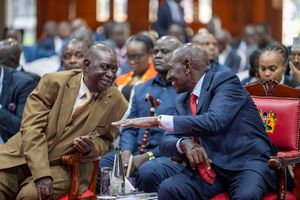
President William Ruto (Centre) Deputy President Kithure Kindiki (left), Wajir Governor Ahmed Abdullahi (right) and other State officials during the presentation of a report on Kenya's long-term transformation beyond and Vision 2023 by Kisumu Governor Anyang' Nyong'o at State House, Nairobi, on July 21, 2026.
Photo credit: PCS
Upon returning home, Governor Ahmed Abdullahi swiftly convened a meeting with all the national and county administrators, which he co-chaired alongside County Commissioner Ronald Enyakasi.
“We have a problem that needs to be fixed. We have people who are yet to register for ID cards,” he said.
Governor Abdullahi suggested that the National Registration Bureau should go into schools to help students acquire ID cards.
“We have more than 5000 students plus in our secondary schools who have attained the age of getting ID cards. Let these registration officers move into our schools and register these students. We have data showing thousands of our people in Wajir have no ID cards,” he said.
Governor Abdullahi maintained that development in Wajir would only be realised through politics, and that it was the sole responsibility of politicians to bring development to the people.
“It was the president, a politician, who brought us a stadium. We need to register as voters and support our president,” he said.
He said that the Somali community living in north-eastern Kenya is the sixth largest according to the Kenya National Bureau of Statistics (KNBS), but has the lowest voter registration rate.
Of the five governors who attended the meeting at State House, only the governors of Wajir and Garissa have met with stakeholders on the ground in an effort to boost political numbers ahead of the 2027 elections.
In Garissa, IEBC’s projection indicates 258,926 voters will be registered to vote in 2027.
“I don’t understand how with a population of about one million in Garissa, we shall only have less than 300,000 people participating in the 2027 general elections,” Governor Jama argued.
Mr Mukora Murungi, the Northeastern National Registration Bureau boss, said efforts were underway to ensure all eligible locals were facilitated in acquiring ID cards.
“We only managed 25,000 new applicants for ID cards in the region by June of last financial year and our officers are on the ground to ensure more people are captured,” Mr Murungi said.
Mr Murungi said in the Northeastern region, registration of persons is in every sub-county and is currently using chiefs and their assistants in the distribution of already processed ID cards.
Despite the NBS regional boss's assurances that ID card production was faster than before and that the vetting process had been streamlined, many people are still experiencing delays.
Many claim that, although the vetting process has shifted from physical to digital, the digital application process still takes them through the same steps as the physical one.
Mr Mohammed Aden, a community leader in the Garissa township ward, claims that the abolition of vetting has only happened on paper.
“What was abolished was the physical vetting committee, but the vetting itself still happens,’’ said Mr Aden
Speaking at the same forum, Garissa County Commissioner John Cheruiyot said that there was scope to improve both the ID application process and voter registration in the county.
'We have been working to ensure that our people get IDs and are registered as voters. We still have room to improve. We are here to discuss how we can support ID card registration,” he said.
He challenged both National Government Administrative Officers and county officials to take the lead in civic education.
“We must support this process. As administrators and leaders, we need to support our people in getting ID cards to enjoy government services. We are pledging to go the extra mile to ensure our people are registered,” he said.
Between July 2025 and May 2026, a total of 22,472 people in Garissa applied for ID cards.
However, only 16,086 cards were processed and collected by their owners, with 10,207 remaining uncollected.
A Garissa resident who attended the State House meeting on July 13 confided to Nation that President William Ruto had made it clear to the local leaders from the region that they must ensure voter registration.
“The president was not happy with our leaders. He wanted to know why, despite the process of obtaining IDs for locals being eased, our numbers were still low. He gave these leaders three months to report back on the new numbers,” our source said.