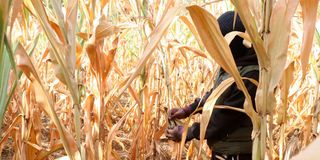
The government faces a difficult balancing act as it weighs importing maize to avert an impending food crisis while protecting local farmers who have suffered heavy losses after prolonged drought and crop diseases devastated this season's harvest.
The Ministry of Agriculture has acknowledged widespread crop failure, warning that it will negatively affect farmers' incomes and the country's food security. It has also signalled plans to import maize to bridge the expected deficit, stabilise unga prices and cushion consumers from the rising cost of living.
Principal Secretary for Agriculture and Livestock Development Dr Kipronoh Ronoh said a team of scientists is conducting a nationwide crop assessment to establish the expected maize yield and determine the volume of imports required.
Agriculture Principal Secretary Kipronoh Ronoh.
Photo credit: Dennis Onsongo | Nation Media Group
“The technical report by the team of scientists will establish the expected maize shortfall and guide the government's decision on the quantity to import to bridge the deficit,” said Dr Ronoh.
He said the assessment would also inform an emergency compensation programme for farmers who suffered crop losses, noting that many had already abandoned maize and were considering planting short-season crops such as beans and potatoes for household consumption.
“We have embarked on a comprehensive crop failure assessment to determine the impact on food security and prepare an emergency compensation plan,” he said.
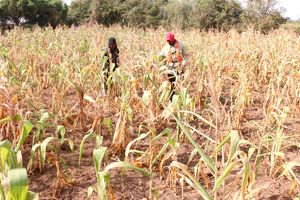
Farmers inspect their failed maize crop in Mirera, Naivasha, Nakuru County, on July 12, 2026.
Photo credit: Boniface Mwangi| Nation Media Group
Farmers in the North Rift, Kenya's grain basket, estimate that up to 50 per cent of the maize crop has been lost, increasing pressure on the government to waive import duty on maize to avert shortages.
However, farmers have urged the government to guard against abuse of duty-free imports.
“Although duty-free maize is a short-term solution to stabilise unga prices, the government must ensure influential traders do not exploit the process by bypassing the supply chain and flooding the market with cheap imports at the expense of local farmers,” said Mathew Kosgei, a farmer from Ziwa in Uasin Gishu County.
The government has maintained a cautious approach to maize imports, issuing permits only when local production is insufficient or when traders hoard grain instead of releasing it to the market.
President William Ruto has repeatedly pledged to end Kenya's dependence on imported maize, saying the country should become a net exporter of food rather than continue relying on imports.
According to the President, Kenya spends about Sh500 billion annually importing food commodities such as maize, wheat and rice; money he says should instead support local agricultural production.
President William Ruto.
Photo credit: File | Nation Media Group
The government also plans to maintain a Strategic Food Reserve of four million bags of maize, beans and rice, or their cash equivalent, to cushion the country against future food shortages.
Earlier this year, Kenya secured a bilateral agreement with Zambia to import up to one million 90-kilogramme bags of maize as a buffer against drought, declining local stocks and rising maize flour prices.
According to the 2026 Economic Survey by the Kenya National Bureau of Statistics (KNBS), maize imports rose by 51.4 per cent in 2025 to 468,109 metric tonnes, largely driven by a duty-free import window for yellow maize.
The survey also shows that food imports contributed significantly to Kenya's widening trade deficit, which reached Sh1.6 trillion.
The planned imports come as food security experts warn that Kenya is once again facing a hunger crisis.
The Kenya Food Security Outlook (June 2026–January 2027) identifies Kenya as one of the region's emerging hunger hotspots, citing poor rainfall, persistently high food prices and increasing conflicts over scarce resources.
The report estimates that 3.9 million people will require humanitarian food assistance between June and January because of drought-induced crop failure.
“The food crisis will persist in Dadaab, Kakuma and Kalobeyei refugee camps, as well as pastoral counties including Mandera, Garissa, Wajir, Marsabit and Turkana,” the report says.
It projects that food insecurity will remain severe across pastoral areas until September because of declining household incomes and rising food prices, before improving between October and January if above-average short rains materialise and improve pasture and livestock productivity.
However, Mandera, which was hardest hit by the failure of the 2025 short rains, is expected to remain in crisis through January.
To mitigate the impact of drought, the National Treasury allocated Sh9 billion earlier this year for drought response, including Sh8.5 billion for emergency food assistance and Sh500 million for livestock feed.
According to the National Drought Management Authority (NDMA), nine counties are currently in the drought "alert" phase: Wajir, Garissa, Kilifi, Marsabit, Kitui, Kwale, Kajiado, Isiolo and Tana River, while Mandera remains in the more severe "alarm" phase.
The situation has also exposed the limited capacity of many arid and semi-arid (ASAL) counties to respond to disasters independently.
Many counties continue to face funding constraints, weak early warning systems and poor coordination between national and county governments, leaving them heavily dependent on national and donor support whenever drought strikes.