In January, the Orange Democratic Movement (ODM) Party and the United Democratic Alliance (UDA) signalled a political convergence, agreeing to establish a joint negotiating team to hammer out a coalition framework as they edge closer to the 2027 General Election.
President William Ruto pushed for the formation of an eight-member structure to steer the talks, an early blueprint for what was expected to be a formal negotiation process between the two political formations.
However, months down the line, the committee remains a non-starter, stalled by shifting political currents, internal party tensions, competing “irreducible minimums” and behind-the-scenes lobbying.
At the centre of the anticipated framework are the parties’ executive directors — Oduor Ong’wen of ODM and UDA’s Nichodemus Bore — who are expected to form the institutional backbone of the negotiating architecture.
The scramble for positions has itself become a political battleground, with key players angling for influence in what is widely seen as a gateway to future benefits.
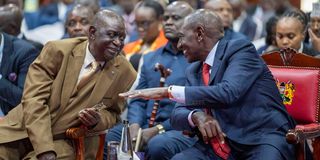
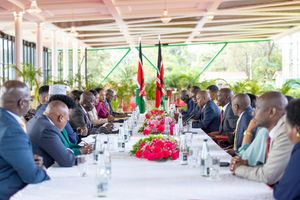
President William Ruto and ODM leader Oburu Odinga at the United Democratic Alliance (UDA)-Orange Democratic Movement (ODM) Joint Parliamentary Group meeting at the Kenya International Convention Centre, Nairobi.
Photo credit: Wilfred Nyangaresi | Nation Media Group
Entry into the team is widely viewed as strategic positioning for potential State appointments in the event of Dr Ruto’s re-election, elevating what is ostensibly a technical process into a high-value political contest.
Historically, such negotiation structures have doubled as incubators of future power. During the talks that produced the Grand Coalition Government, teams representing then-President Mwai Kibaki and Raila Odinga were composed of senior political operatives, many of whom later occupied influential Cabinet positions, underscoring how today’s negotiation table often becomes tomorrow’s centre of power.
Mr Kibaki’s team, on the other hand, comprised Martha Karua, Prof Sam Ongeri, Moses Wetang’ula and the late Mutula Kilonzo.
While the UDA Party is playing coy, ODM stalwarts are already up in arms over the composition of the team, making the four slots a high-stakes affair.
And as ODM navigates a delicate transition following the death of its long-time party leader last year, it may soon find itself confronting yet another significant challenge as it prepares to formalise a working arrangement with UDA.
The composition of ODM’s negotiating team could become the first major litmus test of the party’s internal unity ahead of the anticipated talks with President William Ruto’s ruling party.
The manner in which ODM leader Oburu Oginga manages this critical process is likely to have far-reaching implications.
Beyond preventing an internal fallout before negotiations even begin, the team will be expected to safeguard ODM’s political interests, secure a favourable agreement and deliver an outcome that resonates with the party’s supporters while protecting the aspirations of its traditional support bases.
For the ODM party leader, the composition must be above board, inspire confidence, ease disquiet within the party ranks, avert a fallout before the party sits down with its counterparts and, above all, secure a deal that will be embraced by ODM supporters and benefit its traditional bases.
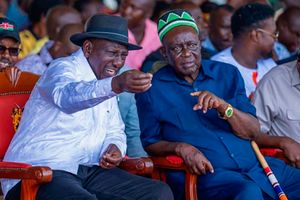
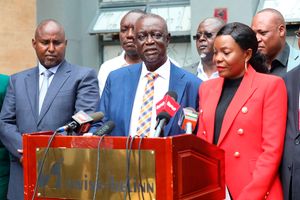
President William Ruto, ODM Party Leader Oburu Oginga and members of the Orange Democratic Movement (ODM) Central Management Committee and the United Democratic Alliance (UDA) Steering Committee during a joint consultative meeting at State House, Nairobi, on Thursday, April 23, 2026.
Photo credit: PCS
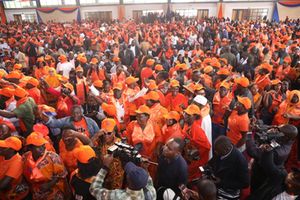
“We have to negotiate well and tell them this is what we shall get and this is what they will get. They started well with the two ministerial positions, but we will be seeking more,” Dr Oginga said during the party’s mega-rally in Kirembe, Kisumu County.
In the past, these were decisions Mr Odinga could make without being questioned. But with his death, more and more decisions made by ODM’s top hierarchy seem to be attracting criticism or outright rejection from a section of leaders within the party and the public.
Sunday Nation has established that regional balance, ethnicity, gender, experience, party loyalty and a balance between hardliners and moderates will all play a key role in determining the team’s composition.
Those whose names are being floated include deputy party leaders and governors Abdulswamad Nassir (Mombasa) and Simba Arati (Kisii), party chairperson and Homa Bay Governor Gladys Wanga, National Assembly Minority Leader Junet Mohamed and former ODM Executive Director Oduor Ong’wen.
Seasoned politician and Kisumu Governor Anyang’ Nyong’o is also being viewed as a possible member of the team because of his experience, negotiating skills and role as an ODM trustee.
Other technocrats who may join the team include former President Raila Odinga’s advisers Joe Ager, Prof Makau Mutua, Prof Adams Oloo and former Raila Odinga lawyer Paul Mwangi.
Dr Oginga last week let the cat out of the bag, stating that Mr Arati will be part of the negotiating team.
“We are going to negotiate hard. People like Arati are not foolish people. They are clever people whom we are going to put on the table to face those others and come up with a well-negotiated document which will inform the establishment of a coalition on an equal basis,” said Dr Oginga.
ODM has a strong presence in Nyanza, Western, Coast, Nairobi and North Eastern, and therefore Mr Arati will represent the Gusii region.
Should the party opt for a moderate rather than a hardliner from the Somali community and the North Eastern region, it may choose Wajir Governor Mohamed Abdullahi instead of Suna East MP Junet Mohamed.
Ms Wanga’s inclusion would not only reflect her role in strengthening ties with President Ruto and her loyalty to ODM and Dr Oginga, but would also help bridge the gender gap by representing women at the negotiating table.
She has been at the forefront of insisting that the party will accept nothing short of 50-50 power sharing. She has also been the leading proponent of zoning, a push supported by Dr Oginga.
While Dr Oginga was fronting politicians, he was categorical about who would not be part of the negotiating team, saying the experts ODM donated to the broad-based government should be excluded.
“Our experts in the broad-based government cannot lead our negotiations with UDA. There is no way they can negotiate with their boss, the President. When it reaches a point where we are facing the President face to face, they will only be saying, ‘Yes Sir, Yes Sir.’ We will need strong and tough negotiators so that we get what we want. They will not give us that,” said Dr Oginga.
This locks out Cabinet Secretaries Ali Hassan Joho (Mining), Opiyo Wandayi (Energy and Petroleum), John Mbadi (National Treasury), Wycliffe Oparanya (Co-operatives) and Beatrice Askul (East African Community and ASALs).
If he holds his ground, it means Mr Joho, the former ODM deputy party leader who is being pushed to become the Coast region’s spokesperson, may not be at the negotiating table.
From Western, Mr Oparanya, despite his experience, may also have to make way for another senior leader from the region, most likely Kakamega Governor Fernandes Barasa.
Even with about 15 months to the next General Election, the potential composition of the team is already attracting significant attention.
ODM Deputy Organising Secretary and Kisumu Woman Representative Ruth Odinga is already fronting herself as a possible member.
She argues that the exclusion should extend beyond Cabinet Secretaries to include those appointed to parastatals and parliamentary committee chairmanships through the broad-based government arrangement.
“I believe I should be at the negotiating table. We cannot have those who have been given seats by the Ruto government to lead these talks. We need sober people, maybe ODM trustees and think tanks like Adams Oloo too, in the team,” Ms Odinga told the Nation.
Political analysts, however, argue that it will be difficult for Dr Oginga’s team to negotiate aggressively with Dr Ruto because many of those likely to be selected are already viewed as sympathetic to the President.
According to historian Macharia Munene, Dr Oginga’s decision to publicly back Mr Arati was intended to counter the narrative advanced by ODM Secretary-General Edwin Sifuna.
“It is in the public domain that ODM is divided between the pro-Oburu team and the Sifuna camp of Linda Mwananchi. By choosing Arati, Dr Oginga is trying to show the public and the youth that he is bringing a younger and more abrasive leader to the negotiating table, similar to Sifuna,” Prof Munene said.
He, however, believes Mr Arati carries the same political baggage as Dr Oginga, Ms Wanga and Mr Mohamed, all of whom are viewed by critics as allies of Dr Ruto within ODM.
His proposal is that ODM reconciles the two factions and includes Mr Sifuna in the negotiating team.
“The ODM party should reconcile and bring in a new team that already has vigour and huge public appeal. They should consider Sifuna because nobody on the Oburu side can match him at the moment,” Prof Munene said.
Siaya Governor James Orengo has also said that if he were to join the negotiating table, it would only be as a presidential candidate, demanding that Dr Ruto relinquish the presidency to him and ODM.
Seeking to calm the simmering dispute, Dr Oginga insisted there was still sufficient time to strengthen ODM, resolve internal disagreements, constitute the negotiating team and prepare its demands.
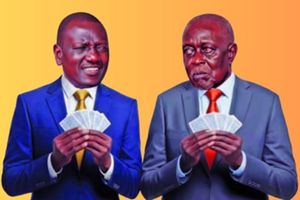
“A coalition should be formed six months before the election. So, we are not time-barred. We have more than eight months and are not in a hurry to form a pact. Even the united opposition is yet to settle on a presidential candidate. We do not want to place all our cards on the table and reveal our strategy,” he said.
ODM has already attracted criticism for appearing to negotiate in public, with leaders contradicting one another on the presidency, deputy presidency, 50-50 power sharing and whether zoning should be a deal breaker.
There are concerns that these public differences have projected an image of a divided party before formal negotiations have even begun.