George Mokuasi, a Kenyan living in the US, splits his working life between two jobs. On weekdays, the 45-year-old drives an 18-wheeler, hauling freight across US highways. On weekends, he trades the truck for a grill, cooking ugali and nyama choma at parking lots, church gardens, and rugby stadiums, where hundreds of Kenyans in the diaspora gather to eat, sing, and remember home.
It is a demanding work rhythm, but George says it is one built on passion. “The money you make doing what you enjoy, it stops being a job,” he tells Nation Lifestyle . “It becomes fun because you know you are doing what you love.”
George loves rugby. That love led him to start grilling nyama choma at rugby events, and over time it grew into a business. As a teenager, he joined Nakuru Athletics Club. “All my friends were playing rugby,” he says. From there, he graduated to Ulinzi Rugby Club, where he played through his final years of high school.
While playing for Ulinzi, George met people connected to American rugby clubs recruiting overseas talent. He applied, and a club in North Carolina responded. In the late 90s, George left Kenya as a student.
“My adaptation was not that hard because I had my family here. My sister was waiting the moment I walked off the plane,” he says.
In North Carolina, George quickly discovered that few Americans had any idea what rugby truly was. Football meant something entirely different there, and baseball ruled conversations. Most of his rugby during this period was played within military circles. George enrolled at Rockingham Community College to study sports science, hoping to build a career around the game. But life in the US came with its own pressures. School fees became a challenge, and eventually George made the difficult choice to drop out. “It was not an easy decision. My sister did not like it,” he admits, “but it is something that we had to do because of legality issues at that time.”
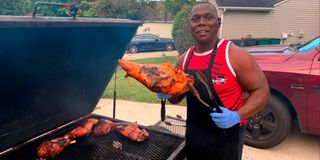
George Mokuasi, 45, prepares ugali in Dallas, Texas. He serves nyama choma and ugali at rugby events, bringing a taste of Kenya to fans far from home.
He moved to Boston, Massachusetts, where he spent three years helping run his in-laws' family business. Eventually, that chapter closed too. “I decided not to do that anymore,” he says.
Throughout these years, Texas kept calling him. Every May, George would travel to Dallas for what became known as the Kenyan Memorial Union reunion, a gathering built around rugby and community among Kenyans living in the US. Most of his close friends had already settled in Texas, and he loved the state, but his sister asked him to wait. She would not let him move permanently until she felt he had matured enough to be on his own.
In 2008, following Kenya’s post-election violence, George lost his father. The grief pushed him toward a fresh start, and he settled in Dallas, a city that would become the true launching pad for everything he is known for today.
In Dallas, George’s rugby background merged with his gift for bringing people together. Alongside his close friend Stephen Mbugua, he formed a group called Certified Party Rockers, known simply as CPR. Whenever Kenya’s national rugby team toured US cities such as Las Vegas, San Diego, and Los Angeles for tournaments, CPR was there organising the experience for Kenyan fans.
Stephen handled the negotiations, securing discounted hotel rooms so travelling Kenyans could afford a place to stay. George focused on the atmosphere, gathering fans at the stadium to sing and chant for the team. Slowly, they were building a tradition. “I’m not even bragging,” George says, “but I think the Kenyan corner started with us.” Wherever that section of singing, chanting Kenyan fans appeared in a stadium, people knew it as home. “Because where the Kenyan fans are, you will always have fun,” he says. “All we do is sing and enjoy.”
Somewhere between the hotel bookings and the stadium chants, George noticed something. Kenyan players touring for months at a stretch, hopping from Australia to New Zealand to Los Angeles, were craving something simple: ugali similar to what they eat at home. George started cooking for the players whenever they passed through, picking lessons he had learnt from his mother. What began as a favour between friends slowly became a big business.
In 2018, George and Stephen turned that instinct into a proper venture, launching what they called Steppa Cuisine. They set up food stands directly at rugby stadiums, feeding both players and fans. By 2020, cooking at these tournaments had become a regular part of their routine, something fans began to expect and look forward to.
George Mokuasi, 45, is based in Dallas, Texas, where by weekday he drives an eighteen-wheeler and by weekend he mans the grill as the Ugali Man at Rugby events, rallying the Kenyan corner with plates of nyama choma and ugali for fans far from home.
Photo credit: Pool
The turning point came in 2024, during the LA Sevens tournament. A rival host, organising a more formal event nearby, grew frustrated when rugby players and fans chose George’s parking lot cooking over her sophisticated venue. In her irritation, she mocked him publicly, calling him the ugali man as an insult, suggesting people preferred to be fed by “the ugali boy” in a parking lot rather than attend her polished event.
George did not fight the insult. He rebuilt it into something powerful. “Because of how I have been brought up growing up and everything, I chose to use the ugali man name,” he says. From that moment forward, he became, proudly, the ugali man, and his parking lot became his signature kitchen.
Since claiming the name, George has carried his grill far beyond the borders of Texas.
His first stop after the incident was Nairobi itself, cooking at the HSBC Sevens with support from Kenya Rugby Union, an experience he calls one of his proudest moments.
This year, he also travelled to Bordeaux, France, to cook for fans there. Looking ahead, he is already planning a trip to Sao Paulo, Brazil, hoping to follow the Kenyan rugby team to every league they compete in around the world.
His menu stretches well beyond ugali and nyama choma. “I serve all the Kenyan cuisine,” George says, listing dishes such as matumbo among the comfort foods he prepares for homesick fans. Interestingly, his clientele is not limited to Kenyans alone. At a weekly event called “Pure Social” in Richardson, Texas, most attendees come from different backgrounds, drawn simply by the food itself. Using vegetables sourced from a community garden connected to his church, George also prepares traditional stews that have won over American guests unfamiliar with Kenyan cooking. “These Americans, they love the traditional stews,” he said, “knowing it is organic.”
Running his business requires careful budgeting. For smaller gatherings, George typically started with around Sh380,000 covering meat and basic supplies. Larger tournaments demand far more. The LA Sevens, his biggest event to date, required a budget of roughly Sh3.2 million once he factored in renting grills, cookers, and refrigeration equipment on site.
Groups between one and 35 people are charged Sh4,500 per plate for a buffet-style meal. For groups exceeding 100 guests, he charges around Sh3,800 per plate.
Goat requires a separate arrangement entirely, since a single live goat in the US can cost as much as Sh64,000. In those cases, clients supply the goat themselves while George charges for labour and preparation.
George Mokuasi in Dallas, Texas, where he drives an 18-wheeler during the week and, on weekends, serves nyama choma and ugali as the "Ugali Man" at rugby events, bringing a taste of Kenya to fans far from home.
Photo credit: Pool
What started with small grills eventually expanded into a large smoker, purchased for about Sh645,000, big enough to roast an entire cow at once. True to his cautious approach to money, George saved steadily for the purchase rather than buying on credit. “I didn't want to buy it on credit.”
His next goal is a dedicated “Ugali Man” food truck, which would let him cook rain or shine without worrying about a blown-away tent.
His ugali business has created employment for about six people in the US. One key member, a woman he met by coincidence at church, now handles public relations for the business. The rest support him with preparation and logistics.
His full-time trucking job runs Monday through Friday, and his weekends begin the moment he parks his truck. He starts by prepping ingredients before diving into events that can run from 5pm until 2am. By 8am, he is up again, spending time with his children before the cycle restarts.
“Without them,” he said, “I wouldn’t be doing all this.”
George considers one thing far more important than a good business strategy. A Seventh Day Adventist Church, he leads the catering department at Alpha International Church in Texas. He remembers the day his pastor unexpectedly called for prayer over his cooking passion, asking the congregation to pray it would grow into something bigger. “Since those prayers, it has been a blessing through and through,” George said. “I have never lost money.”
His advice to anyone hoping to follow a similar path? “Be true to yourself,” he said. “There are people who along the way will be laughing when you start. There are people who will ridicule you. But push through that doubt. Build a brand whereby people will admire, and people will come. Just be unique.”