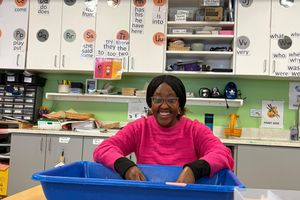
Felistar Wanjiku, a Kenyan who left home to become a housekeeper in Denmark, now has to learn to fly a plane and face nine exams on her way to achieving her dream. Twice a week, she sits in a classroom in the afternoon, wrestling with maps and weather charts.
“Navigation is driving me crazy,” she tells Nation Lifestyle. “That's the only thing that is making me not take the exams.”
Seven years ago, she could not have pictured this room. She travelled to Denmark to take care of children, cook dinners and walk the family dog.
Felistar Wanjiku, 31, is in her practical years of EUX business studies in Denmark. She arrived as an au pair in September 2019, and is now preparing for her pilot exams.
Photo credit: Pool
She is among the several Kenyan women who travel to Denmark as au pairs, where you live with host families, learn a new culture and see what life could offer.
Before she left Kenya, Felistar was earning from nails and makeup for four years. Earning just enough to cover her expenses without financial strain, she saw little reason to seek opportunities elsewhere.
Breakup and a fresh start
However, a breakup left her wanting a fresh start. “It was very heartbreaking, and I really wanted to move away from all that,” she says.
A friend who lived in Denmark helped her find a host family, and so in September 2019, Felistar arrived as an au pair. “In Denmark, the host family pays for your flight and visa,” she says. “My host family was very nice,” she says.
Au pairing is an exchange. She taught the family a little of her own language while learning theirs.
“They send you to a language school, which they pay for, to learn their language, and you try to teach them your own,” she says.
Her routine revolved around the children, household chores—cooking, cleaning and ironing—and caring for the family dog, for which she received about Sh95,000 in pocket money.
When Covid-19 hit in 2020, her host family suffered a double blow: the father, a professional footballer, was sidelined with a knee injury, and the mother’s large salon closed. Four months into the pandemic, the family could no longer afford to keep her.
New host family and a boyfriend
A second family took her in, but lockdown froze her fingerprints and new papers, and in Denmark she could not work without them. So she stayed with her boyfriend, whom she met in Denmark, until life reopened.
Then she moved to a new host family in Copenhagen, but after about five months their business slowed too.
Tired of moving from one host family to another, she thought about relocating to Norway or Sweden, or coming back home. Her boyfriend had another idea.
“You don’t have to go back to Kenya,” he told her. “We can get married.”
That kept her in Denmark, and school became the next step. Her Kenyan training did not count for much.
“The education is very different from ours,” she says. “Most foreigners just go back to school and start from scratch.”
After language school, she took a preparation class. In 2023, she began EUX business studies at Campus Vejle.
“EUX is a special Danish path that joins two kinds of learning. One part is a general school exam at gymnasium level, which is Danish upper secondary school. The other part is practical training for a working career. The course takes four and a half years, with two years in class and two and a half years working in real companies.”
“The government pays us around Sh130,000 a month while we study, and then they deduct tax, so we end up with about Sh110,000,” she says. “We can also work 20 hours a week, but not more than that, because they want us to focus on school.”
“I cleaned hotel rooms, and I was paid Sh2,500 an hour,” she says. “At the casino I worked as a bartender, and that was Sh3,500 an hour. I also worked as a waiter; I was paid Sh2,800 an hour.”
“It is a very busy life here,” she says. “But I was doing it because I wanted to get better.”
This summer, she finished the school part of EUX, and she is now in her practical years. After that, she can be fully employed. Alongside it all, she is chasing a second dream.
About two years ago, she began a pilot course that cost about Sh2.3 million, paid by her husband. As a child, she would run outside whenever a plane passed.
“I would see a plane and wonder how that thing flies,” she says.
She is not a pilot yet. She must pass nine exams, and the hardest is navigation. She also studies weather and learns how engines work.
“You have to know everything,” she says.
“I would encourage them not to give up,” she says. “Because if I had given up, maybe I would not be on the cusp of being a pilot.”
She does not pretend it is easy. Living with people you do not know, in a language you do not speak, she says, can be lonely. Her advice is to find other au pairs nearby and spend weekends together.
Mary Wanjiru, 33, another Kenyan who also travelled under the au pair programme, went back to the classroom more than once, took cleaning jobs and chased a dream she had carried since childhood.
“I’d always wanted to be a dentist, but I lost my mother and was raised by my grandmother and uncles, so that dream stayed out of reach,” she says.
In 2015, she went to Saudi Arabia to work as a housemaid. Her room was a small space at the rooftop, and she had to climb up and walk outside to reach her door at night. After three months, she told her employers her father had died so they would let her go.
“I had to lie; it was very scary sleeping there at night,” she says.
A year later, she went to Qatar to work as a housemaid only to quit because of unsuitable working conditions. She flew to Dubai on a visit visa with no contract. She went from company to company, dropping off her CV and hoping for a call.
“I was just a fighter,” she says.
Mary Njeri Wanjiru, 33, is a dental student at Aarhus University in Denmark after finishing her nursing education in 2025. She first came to Denmark as an au pair in August 2019.
Photo credit: Pool
KFC hired her, and she worked for two years. Then her friend who lived in Denmark called. A family wanted an au pair.
She landed in Denmark in August 2019 and joined her first host family in Esbjerg. After the pandemic cost the mother her job, the household had to let Mary go. She found a second placement, which lasted about seven months until that mother was laid off as well and took over child care herself.
Throughout, she kept going to language school, first at AOF (Arbejdernes Oplysningsforbund) and then at VUC, (Voksenuddannelsescenter). Both are adult education centres that help learners find their feet. The course ran from 2021 until January 2023.
In May 2023, she joined nursing school. She finished in 2025. To pay her way, she was a cleaner at a school. “I am the breadwinner in my family, so I had to work on the side to support them back home,” she says.
In January 2026, Mary began dental studies at Aarhus University.
“The Danish state covers my fees and gives a stipend of about Sh190,000,” she says.
Her proudest accomplishment is in Kenya, where her cleaning income paid for a four-bedroom house for her grandmother, who moved in this January.
“She is now in her 80s. I am the only child in my family who has managed to do this,” Mary tells Nation Lifestyle. “I don’t believe in failure. I believe in winning.”
Rosemary Wanjiru, 37, also left Kenya for the Middle East first before going to Denmark. In 2012, she worked as a housekeeper in Saudi Arabia, where she changed families twice as she was never comfortable with the job.
She came home for a month, then spent two years and three months in Jordan with a Christian family.
“The family was good,” she says.
In Jordan, a friend she met online told her about a cultural exchange between Denmark and Kenya.
“I got interested,” she says.
She arrived in Denmark in June 2018, lived with a host family, caring for the children and went to language school in the evenings.
Rosemary Wanjiru, 37, is a nutrition graduate in Copenhagen. She came to Denmark as an au pair in June 2018 and finished her studies in May 2026.
Photo credit: Pool
The course should have taken two years. It took three years because she missed classes and was asked to drop out until she was ready.
“Danish is very hard,” she says. “Most people here do not speak English, so you have to put in the effort.”
Her contract lasted two years, after which she was too old to be an au pair in another European country. She married a Danish man in 2020 and waited about seven months for her papers.
“During that wait, you don't work,” she says.
In 2021, she started language studies at the adult centre, which lasted a year.
“I also cleaned offices part-time for about Sh135,000 a month, within the 20-hour weekly limit,” she says.
In August 2023, she began college in Copenhagen to study nutrition, learning how diet can help children, mothers and older people.
She also worked weekends and holidays caring for older people, earning Sh155,000 to Sh175,000 a month after tax. The start was scary.
“You don't know people, so you get nervous,” she says. “But I had it in me that I would make it.”
She finished her rounds in May this year after a hospital internship in Copenhagen. It paid around Sh290,000 a month after tax. Today she lives in Copenhagen with her husband and their four children as she waits to get employed. Her view of success is simple.
“It's a good life as long as you are working and you are doing something,” she says.