In 2020, Ronnie Nyauchi flew to the US to join his mother. He wanted to take a break from life as things were not going the way he had envisioned after studying video editing at university.
Then the lockdown caused by Covid-19 dealt him a major blow, preventing him from landing his dream job since he was abroad and unable to travel back to the country. Unknown to him, this would actually lead the 35-year-old to a once-in-a-lifetime chance to connect with a Hollywood producer and director, and the beginning of something bigger than he could have imagined.
“I’m an assistant editor and an associate member of the American Cinema Editors (ACE). Being an associate member means I’m in a mentorship track, learning directly from established editors, attending industry events, and becoming part of that global editing community.
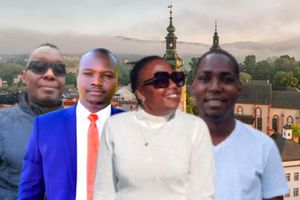
Ronnie Nyauchi (left) with Peter Elliot ACE (American Cinema Editors).
Photo credit: Pool
I’m also in the ACE Diversity Mentorship Programme, which supports people from different backgrounds. Through that, I’ve had exposure to editors behind films like Top Gun and Dune—people like Eddie Hamilton, ACE. Being in those spaces constantly reminds me how far this journey can go. I studied Communication at Daystar University. My first real break was as an intern on “Beba Beba” on NTV. When I was hired, though, it wasn’t for editing. I was supposed to be the boom mic guy. The set was chaotic—people shouting, constant tension—and I realised I needed a different kind of space. Somewhere quieter, more controlled.
That’s when I met Tony Kamau, the main editor. I asked him what he did because he seemed calm, just sitting there, working, no chaos. He told me, “This is editing. If you want to learn, grab a chair.” He spoke to the producers and said, “This is my guy.” That moment changed everything for me. After my internship, finding work was tough. I eventually got a chance to work, but assigned to wardrobe because there was already an editor. I told myself that once I got in, I’d find a way.
On my first day, I knew wardrobe wasn’t for me. I approached the editor and asked for one scene to work on after hours. I had already watched the scene while on set, so I knew exactly what I wanted to do.
That night, after everyone left, I stayed behind editing. The boss passed by and asked what I was doing. I told him, and he said, “Don’t delete anything.”
The next morning, during a production meeting, I was sent back to wardrobe duties. Then the boss remembered and asked me to play the scene. Everyone watched it, and they loved it. “That’s exactly how we imagined it,” they said.
After that, I was sent back to the wardrobe again. I remember thinking, “Here we go again,” but later that day, when we came back from shooting, there was a new desk and computer waiting for me. The boss simply said, “Ronnie, this is your desk now.”
Ronnie Nyauchi (left) with Hollywood director Seth Gordon. Ronnie is a Kenyan-US citizen who is a film Assistant Editor based in Los Angeles
Photo credit: Pool
I worked with him for about four months. After that, I started feeling the urge to create something of my own. I developed a show called “Wachokozi.” I pitched it, but the TV station said it didn’t fit their family-friendly brand. Another media house liked it but wanted me to collaborate with someone.
After that, I formed a production company. We worked with clients like the International Committee of the Red Cross (ICRC), William Lawson, Jägermeister, DTB, and Mercedes-Benz. One thing that set me apart was speed. I would shoot and edit the projects myself. If I filmed on Friday, the client would have a first cut by Monday or Tuesday. I didn’t even wait for payments to begin work and would pay the crew from my own pocket, then invoice later.
We did a lot of work, including a documentary on responding to high-impact areas like war zones.
In 2019, I saw a job posting for a producer role and decided to apply. At the interview, I found myself among former classmates.
They asked about my previous salary and expectations. I told them I was just there to work. After the interview, I didn’t feel confident about my chances. Around that time, my family was in the US, so I decided to visit for a short break. I left everything in Kenya—my car, my relationship—planning to return soon. Then the Covid-19 pandemic hit.
I remember getting an email saying a potential employer had been trying to reach me for two weeks, and that I had gotten the job. But since I was already in the US and hadn’t responded in time, they had hired someone else. They told me to reapply if I returned.
That’s when I decided to stay in the US and figure things out. It was a completely different system. When I applied for jobs, I wouldn’t hear back for months. To survive, I started working in healthcare as a certified nursing assistant (CNA).
During that time, my mum worked for an elderly couple. The man, Andrew Gordon, had filmed his entire life—family moments, milestones. His wife had dementia, and he wanted to digitise the footage so she could revisit those memories.
That was something I knew how to do from my Beba Beba days. My mum told him, “My son can do it.” He asked for my resume, and after a while, he gave me a chance.
Later, he mentioned that his son would come to discuss the project further. His son was Seth Gordon. I didn’t know him at first, but when I Googled him, I realised he was a major director with films like “Horrible Bosses”, “Modern Family” and “Four Christmases.”
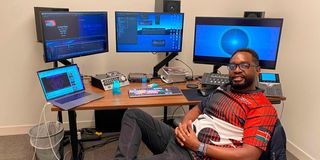
Ronnie Nyauchi.
Photo credit: Pool
They gave me a few test tapes and set me up in their Seattle home to digitise and log everything. At the same time, I was still working CNA shifts and attending nursing school because I didn’t know whether this opportunity would lead anywhere.
When Seth visited, I showed up in a suit and tie; very Kenyan interview style. He laughed and told me to relax. We went out, talked, and got to know each other. I tried to pitch myself as an editor, but he explained that’s not how the system works there.
He offered me $25 (Sh3,200) an hour to digitise tapes, working long hours, and even gave me access to their lake house for six months. I documented everything meticulously.
When I finished, they were impressed. Through a contact—DO Speaks—I learned how to position myself better in the US industry. Instead of aiming straight for editing, I decided to start as a production assistant. I emailed Seth again, this time saying I wanted to become a production assistant. That got his attention.
Soon after, I was hired as a production assistant on a documentary about Makur Maker, “The Long Game: Bigger Than Basketball.” They flew me out, covered my accommodation, and paid me hourly.
The work wasn’t glamorous—I was doing errands, laundry runs, coffee runs—but I was inside the system.
At first, I struggled. I didn’t know brands, locations, or how things worked culturally. I made mistakes and became a liability. The crew wanted to let me go, but Seth stood by me and told them to train me.
I leaned into my strengths—production. I could set up lights, prep cameras, and support the technical side better than running errands. Slowly, I became useful. The DP and assistant director began relying on me.
After production, I was invited to Los Angeles to help with filming and editing social media content for the documentary. When they needed an assistant editor, the team recommended me since I already knew the footage.
That became my first assistant editing job. I was earning $2,500 (Sh322,925) a week. I moved to Los Angeles, got an apartment, and started building my life there—though the cost of living was high.
To work in TV and film, you have to build credits in unscripted content and meet union requirements. I also had to learn Avid, since most Kenyan productions use Premiere.
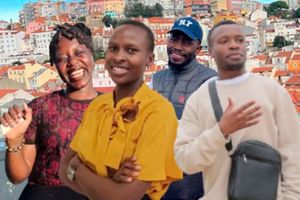
Ronnie Nyauchi (front row, left) is a Kenyan-US citizen who is a film Assistant Editor based in Los Angeles.
Photo credit: Pool
After the documentary, I had to hustle again. I applied to Mob Scene, but was advised by a mentor to focus on long-form storytelling instead of trailers.
Through networking, I eventually landed an apprenticeship on a Criminal Minds spin-off. I was honest about my lack of experience, and they trained me.
As an assistant editor, your job is to prepare everything for the editor—organise dailies, sync audio, add temp music, manage VFX notes, coordinate with sound and post-production teams. You’re essentially making the editor’s life easier.
I worked on 10 episodes and learned the workflow deeply. After that, they brought me back for more.
From there, I started networking more intentionally—meeting editors, building relationships. That’s how I met people like Harry Yoon and my mentor Kyle Bond, who has worked on major shows from ER to Scandal.
I reached out to Kyle on Instagram, asked him out for coffee, and we connected. When I travelled back to Kenya, he later invited me to join “Bridgerton” as an assistant editor. I worked on the final episode of the last season.
Before that, I had also worked on Back in Action with Jamie Foxx and Cameron Diaz, again through Seth Gordon, who has consistently supported my growth.
I’ve also worked with Peter Elliott, who has credits like “Iron Man”, “Think Like a Man”, and “Ride Along” . From him, I learned how to approach editing with precision and discipline.”