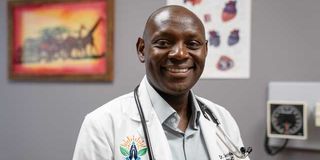
When Dr Geoffrey Mwangi boarded his flight to the United States, he was guided by a hope that would influence everything that followed. “I wanted to become a doctor and help people,” he told the Sunday Nation. “I knew that a long journey begins with a single step, and I had already taken mine.”
That step took him from Kenya to Wisconsin and then on to Spokane in Washington State, where his work would eventually transform primary care for many families.
The opportunity arose through an unexpected letter. While waiting for admission to medical school in Kenya, he received an acceptance from the University of Wisconsin–Green Bay, complete with a partial scholarship. This opened up an entirely new horizon.
“This opportunity became a crucial turning point in my life and career,” said Dr Mwangi. He seized it, even when a later offer from a Kenyan medical school tempted him to stay at home. Years later, after earning his Doctor of Nursing Practice degree, he found himself practising in Spokane and learning about the needs of a community that would become his own.
The idea of founding a clinic arose from encounters that lingered in his mind. “Some patients became emotional and told me that they had been searching for a provider like me for years,” he said. Their words revealed a gap that he could no longer ignore.
He realised that access grows from connection and a feeling of being understood by someone who knows what it means to start again in a new country.
The name of the clinic came from a gesture of appreciation. On his last day in his previous position, a colleague handed him a card with a single word written inside. “They wrote the Swahili word asante ,” he said. “That gesture left a lasting impression on me.”
After speaking with his wife, he knew that the name had to go on the door. It would serve as a daily reminder of the gratitude they had both given and received. Building the clinic was far from simple.
He describes the first year and a half as the most difficult period of his professional life. “If I had known then what I know now, I would have thought much more carefully before opening a clinic,” he said.
The insurance system proved to be the greatest obstacle. “For over a year, we received little reimbursement from insurance carriers despite actively providing care to patients,” he said. Yet he refused to turn people away. “I chose to waive patient charges rather than create a financial barrier to care.” The strain was real, but the mission remained.
Support arrived from local organisations that shared his vision. Grants helped him keep the clinic afloat during its early months. Patient numbers grew slowly at first, then steadily. Today, the clinic treats 10 to 15 patients a day, many of whom speak of the care they receive with relief.
He spends 30 to 60 minutes with new patients, listening to their stories and learning about the cultural and emotional factors that influence their health. “This approach allows me to build meaningful relationships,” he said. “It is fundamental to providing high-quality care.”
His Kenyan heritage gives him a unique insight. Many of his patients speak Swahili, and being able to speak with them in their own language removes barriers that interpreters cannot overcome. “Some aspects of healthcare can be learned through education,” he said. “Others are best understood through lived experience.”
He carries with him from home the tools of cultural nuance, lived memory and the ability to read the unspoken. These help him to understand the fears that patients often hide behind polite silence.
The work is demanding. Insurance companies deny coverage. Reimbursement arrives late or in small amounts that do not reflect the time and care he invests. There are moments when the challenges feel overwhelming.
“When you feel like quitting, think about why you started,” he said. This thought motivates him to open the clinic doors every morning.
His journey has also reshaped his family. He talks about becoming a better son, father, brother, uncle and provider. “I have gone through trials and tribulations,” he said. “I have become more attuned to the physical, emotional, and spiritual aspects of who we are.”
He hopes his children will inherit the values behind the clinic. Perseverance. Compassion. Humility. Faith. He also wants them to understand that good character creates relationships that can help a person overcome life’s challenges.
He maintains his connection to Kenya by carrying out mission work there every year. He started out in rural areas in 2010 and has since expanded to multiple regions. He does not see this as pulling him in two directions. “It has become one of my greatest strengths,” he said.
Living and practising in the United States has shown him the power of preventive care. Despite the many obstacles, he hopes to help bring more of that culture to Kenya. Infrastructure. Regulations. Cost. Access. He believes that change can begin slowly and that someone must take the first step.
To young Kenyan medics dreaming of the American promise, he offers a grounded truth: “The American Dream is real, but life doesn’t suddenly become easy just because you move to another country.”
There are opportunities, but they require effort and consistency. He recognises the hardships in both Spokane and Kenya. Yet he also recognises the strength of community. “Kenyans in Spokane are more united than divided,” he said.
“When you are away from home, that unity becomes essential.”
The next step in his journey is to bring his extensive experience in preventive care back to Kenya. Dr Mwangi, who has practised for a decade, hopes to collaborate with local healthcare providers to improve health outcomes for the Kenyan population.
As he often tells his patients, early detection leads to better results. Catching a disease early and controlling it can save lives. He has witnessed this truth repeatedly, and he is determined to take his expertise home with him. His story is shaped by service and by the courage to create something new.
It is shaped by the power of an immigrant who believed that one small step could transform a community. In Spokane, at a clinic named in gratitude, that belief has become a reality.