Cancer patients pay the price as KNH radiotherapy machine sits idle for two months
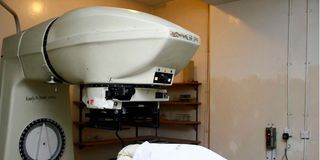
An old cobalt radiotherapy machine at Kenyatta National Hospital in Nairobi.

What you need to know:
- Kenyatta National Hospital ordinarily treats around 100 cancer patients daily through its oncology unit.
- The facility has now fallen back on an older cobalt machine, reducing capacity to 50 patients a day.
For two months, cancer patients at Kenyatta National Hospital (KNH) have been left without access to advanced radiotherapy after the facility's Linear Accelerator, known as the LINAC machine, broke down due to a lack of spare parts.
The breakdown has cut the hospital's oncology capacity in half. KNH ordinarily treats around 100 cancer patients daily through its oncology unit. With the LINAC out of service, the unit has fallen back on an older cobalt machine, reducing capacity to 50 patients a day. The remaining 50 are being turned away or redirected to other facilities.
Those who can afford alternative care have been sent to Kenyatta University Teaching and Referral Hospital and Nairobi West Hospital, where treatment is offered at a subsidised rate of Sh600. But for a significant number of patients, even that reduced cost is out of reach.
"Fifty per cent of our patients could not get our services," KNH Acting Chief Executive Officer Dr Richard Leyisampe told the National Assembly's Departmental Committee on Health during a fact-finding visit to the hospital on Monday.
"In most instances, we refer them to Kenyatta University (KU) Teaching and Referral Hospital to support them."
For those with means, the referral is a manageable inconvenience. For those without, it is something far graver.
Margaret Akinyi, 48, a cervical cancer patient diagnosed eight months ago, has been making the journey from Kawangware to KNH every week for radiotherapy. When she arrived three weeks ago and was told the LINAC was down, she assumed it would be a matter of days. Then a week passed. Then another.
LINAC-based radiotherapy
"They told me to go to KU. I asked how much. They said it was subsidised. But even with the subsidised amount, I do not have it," she says. "I sell vegetables to survive and what I make in a day is what we eat in a day. At times I am not able to make even that Sh600 for treatment."
Margaret has not received radiotherapy in three weeks. "I just pray and wait," she says. "What else can I do?"
Joseph Mutua, 61, travelled from Machakos County on Wednesday after his doctors referred him to KNH for radiotherapy following a prostate cancer diagnosis. On arriving at the oncology unit, he was told the machine had broken down and was directed to Nairobi West Hospital.
"I went there. The price they gave me was more than what I had budgeted for," he says. "I had to call my son. He is still looking for the money."
Unable to make the daily journey back to Machakos, Mr Mutua is sleeping at his nephew's house in Nairobi while he waits.
Dr James Nyikal, who heads the parliamentary committee, said the breakdown and its consequences were predictable, and avoidable.
"The truth is that some patients are missing the services they deserve," he said.
He added that the cobalt machine, while functional, is older technology that cannot replicate the precision of LINAC-based radiotherapy for certain cancers. For patients with tumours requiring targeted radiation, the gap between the two technologies is significant.
Dr Leyisampe expressed confidence that repairs to the LINAC would be completed within the week, now that the required spare parts have been sourced. But for patients who have gone two months without treatment, particularly those unable to access referral hospitals, the promise of imminent repair offers limited comfort.
Additional LINAC machines
In cancer care, delays in radiotherapy can allow tumours to grow, reduce the effectiveness of treatment, and in some cases, alter the clinical outlook entirely.
Dr Nyikal disclosed that the committee is actively exploring budgetary allocations to procure at least one, and possibly two, additional LINAC machines for the hospital.
"We are in the budget process and are going to get them some funds to at least get another LINAC or two, depending on availability of funds," he said.
"A hospital of KNH's scale and national mandate cannot afford to have its entire radiotherapy capacity down when thousands of patients depend on it."
Follow our WhatsApp channel for breaking news updates and more stories like this.