Childhood cancer: Four families, four battles, one bell of hope
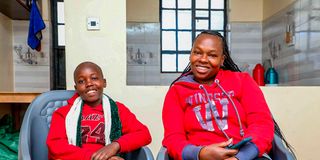
Veronicah Mutheu and her son Lenny Ndunda, 11, during an interview at their family home in Utawala, Nairobi on September 16, 2026.

What you need to know:
- Four families, including Sarah's, share how their children recently rang the bell at Kenyatta National Hospital to signal that they had finished cancer treatment.
For most children, a bell means class is starting, or a school day is ending. At Kenyatta National Hospital's Outpatient Paediatric Haemato-oncology clinic, a bell means a child has beaten cancer, at least for now.
Sarah Akinyi did not even know what ringing it meant. Then her son, Fabian, rang it with other children.
"Seeing those children ring the bell healed a part of me," she tells Nation.
Reaching that bell is a long road. When a child receives a cancer diagnosis, most parents have many questions that rarely have immediate answers. They often think of the worst possible outcomes. They wonder whether it is their fault that their child has cancer. Some families break. Others turn to traditional treatments that could be harmful. Those who cling to hope and trust doctors sometimes emerge victorious.
Four families, including Sarah's, share how their children recently rang the bell at Kenyatta National Hospital to signal that they had finished cancer treatment. These are their stories of hope.
Veronica Mutheu (Mama Lenny)
She cannot describe the excitement she felt on the day of the bell ringing.
"I just remember thinking of my journey with Lenny. I was happy to see him ring that bell. The whole cancer treatment experience was traumatising," she says.
It all started when Lenny developed constant bad breath. He went to a nearby clinic and was given a mouthwash. That did not help. He also had swelling around the lymph nodes. They went to a different hospital, where Lenny underwent a minor procedure called fine-needle aspiration biopsy. After the sample was taken, doctors went on strike, and the family had to wait at least two months to see a doctor. When they finally did, they were told that the sample was non-cancerous and that they should not worry. There was no treatment to end the swelling. After staying at home for some time, they noticed more swellings.
"We could even count them," she says.
They went to another hospital, where only an X-ray and an ultrasound were done. That hospital referred them to Kenyatta National Hospital for a biopsy. It was confirmed that Lenny had stage three Hodgkin's lymphoma. It had affected the neck and spleen. He was only eight years old.
"I knew that was a death sentence. I asked God so many questions. I didn't want to tell my son about the diagnosis. He used to say that other children have cancer, but he did not."
Lenny had six cycles of chemotherapy. He remained stable most of the time because of his positive mindset. Veronica says it was traumatising every time Lenny learnt that his friends had died.
"I saw families break in the wards. I saw children give up on living and say they just wanted to die. I still think about that ward. Anything can happen at any time; life can really humble you because nothing else matters," she says.
Veronica says it was hard to share with anyone. She mostly went to the hospital alone, crying in a matatu. She was advised to go for prayers so that her son could be delivered from bondage. She did not budge. She only listened to what the doctors said.
Lenny is now upbeat. He is working hard in school so that he can become an oncologist one day.
Sarah Akinyi (Mama Fabian)
Fabian fell ill in August 2024. At first, his family thought it was an injury from a fall. Then he started passing urine uncontrollably. Sarah, his mother, took him to hospital, and he was well for a short while. He often complained of a stomach ache and felt as though he needed to use the bathroom.
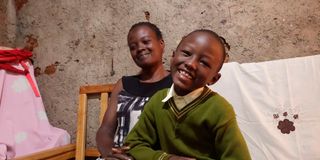
Sarah Akinyi Omolo and her son Fabian James at their house in Kibra, Nairobi, during an interview on October 14, 2026.
The next time he was unwell, Sarah noticed blood in his urine. She was alarmed. She took him to a nearby clinic again, where he was given medicine that eased his pain and some symptoms. The blood in his urine persisted. That is when Sarah sought a referral.
They visited a private Level 4 facility, which asked for an ultrasound and a magnetic resonance imaging (MRI) scan, but they could not afford them.
They were referred again to Kenyatta National Hospital. Sarah says she was scared that her child would die. Fabian was admitted, and doctors found that one of his kidneys was larger. He needed another CT scan of the stomach and chest, but Sarah could not afford both scans. She had to choose one. The stomach scan cost her Sh20,000. Fabian was then taken to the cancer ward, where social workers talked to Sarah about her son's condition. That was the first time the family had a diagnosis: Wilms tumour.
"I cried and prayed. He started chemotherapy, but it was tough for him. He lost a lot of blood, so the doctors had to stop the sessions for some time and give him a blood transfusion," says Sarah.
Later, he had to undergo surgery to remove one of the kidneys, but first he had to repeat the chemotherapy sessions. After the surgery, he had another round of chemotherapy. He recuperated well, and they could go home, but he had to go to the hospital for chemotherapy every week.
"We finished it well. Now he has no right kidney," she says.
They kept going to the facility for check-ups until they were told that there were no traces of cancer cells.
"I used to think that cancer is a killer disease and no one can be healed. I remember the week I went to the ward and many children died. I wasn't sure Fabian would get healed," she says.
Fabian rang the bell with the other children, and he has been okay. Now, his mother is struggling to get him immunity-boosting drugs because she cannot afford them.
"Seeing those children ring the bell healed a part of me. I didn't even know what it meant to ring a bell," she tells Nation.
Caring for a child with cancer meant that Sarah had to stop her clothes-selling business. She was also pregnant at the time, yet she had to be physically present in the hospital for six months.
Hannah Wanjiku (Mama James)
Hannah and her son stayed in hospital for a year without going home. She now knows cancer medicines by rote. She says it was a tough journey. They started their medical journey in 2023 at different hospitals in Kajiado County.
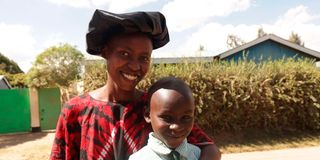
James Muchene and his mother Hannah Wanjiku in Kiserian, Kajiado County, during an interview on October 14, 2026.
Her son was constantly vomiting. From August 2023 until February 2024, he was repeatedly diagnosed with tonsillitis. It was at Kenyatta National Hospital that he was diagnosed with cancer. The person who broke the news gave her hope and told her that cancer is treatable.
"I felt emotional and guilty. People talked, asking me how my son got the disease, yet we have no cancer history in my family. When I told his dad, he also had questions about where it came from, but he was very supportive," she says.
James had stage four cancer. When the treatment started, his immunity waned. He started losing his hair. He could not comprehend what death was at that time, but his mother grieved on his behalf when he lost many friends in the hospital ward.
"It was not easy," she says.
They repeated the chemotherapy cycles. It was even tougher to get radiology services because of a machine breakdown during that period. After the treatment cycles, he had surgery, and his condition improved.
They were discharged but remained on medication. Many months later, she was called to the hospital and told that her son was free from cancer and would be among the children to ring the bell.
"This is my only child, my first son. I am happy that he is now okay. He is now in Grade Two. He should be in Grade Five now, but he is doing very well," she says.
"The journey is tough, but people can heal. I learnt that it is important to have a community around you and to show them love when they need you. Those children in the cancer ward inspired me to be resilient."
James Kahahe (Doyeen's father)
Doyeen started feeling unwell in 2022. She lived with her paternal grandmother in Murang'a. She had swelling on the left side of her body. They went to many hospitals, but they could not establish what was wrong with her. She was first admitted to Murang'a Level 5 Hospital, but getting an answer took longer than expected.
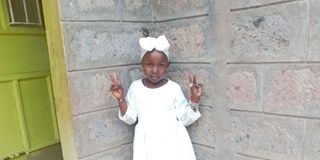
Doyeen Wanjiku Kahahe.
She was later referred to Kenyatta National Hospital, where she was admitted and stayed with her grandmother.
"I remember when the doctors called my brother and me to break the news that she had cancer," he says.
"I saw death. I had resigned myself to the idea that my child was going to die young. I was devastated," he adds.
Doyeen had chemotherapy two months after diagnosis, and the swelling subsided. She was even discharged and went back to Murang'a, but the swelling recurred. They knew that she also needed surgery, but it took close to a year before she had it. She stayed in hospital with her father for about seven months after the surgery.
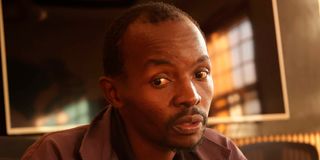
James Kahahe during an interview at Nation Centre in Nairobi on October 14,2026.
"I lost many friends. I realised people leave when you have a sick person. I remember one day she stayed in bed for a week without speaking to me, and I thought I would lose her," he says.
"My daughter is the one who assured me that she would be well. I had my own business, but I lost it during that period."
When he learnt that his daughter was okay, the first thing he did was thank God. He says God was always his first and last option. His daughter is now in Grade Four and was taken in by a foster parent.
"The government should help caregivers. While I give thanks that my daughter is free from cancer, I am now jobless, and I have no fall-back plan," he says.
Experts
Dr Mary Rukwaro, a medical officer in the Paediatric and Oncology Unit at Kenyatta National Hospital, says seeing the children get better after months of treatment gives her hope. She says the whole process may be daunting, but it is fulfilling to have a positive outcome.
She says different types of cancer are common in the country. They include leukaemia, lymphomas (both Hodgkin's and non-Hodgkin's), Wilms tumours, brain tumours, bone tumours and cancers related to the nerves.
She explains that adult cancers are easier to explain because there could be risk factors, such as long-term environmental and lifestyle exposures, that predispose adults to cancer. Adults may also have a genetic mutation.
For children, she explains that they are still growing and their cells are dividing rapidly. When cells divide, there might be mutations or changes that bring about abnormal cells, leading to cancer.
She says the treatment of childhood cancer is slightly different from that of adult cancer. There are three types of treatment: chemotherapy, radiotherapy and surgery. The difference for children is that the dose is reduced and given according to the child's weight.
She explains that some forms of treatment cannot be used for children of a certain age.
"For radiotherapy, if a child is younger than three years and has a brain tumour, there usually are risks versus benefits. Because the child is growing, we don't want to affect their brain development," she explains.
"We want the child to be cured, and once they are cured, we want them to have a healthy life," she adds.
She says the bell ringing is proof that cancer care goes beyond any barriers that exist. She acknowledges that most children come to the hospital late for diagnosis and treatment, so they mostly end up dying.
"Having one or two patients surviving gives us hope to continue working for that one child, so that you can provide them with a better future," she says.
On the barriers, she says the whole system is a challenge. It starts with the parent recognising that the child has symptoms. Then it depends on how fast they take the child to hospital, and whether the health practitioner has a high index of suspicion that it may be cancer.
"Most of the time, the child will be treated for common illnesses for a prolonged period before someone notices that something is wrong. We also don't have as many diagnostic tests, so the children are brought to the referral centre for that," she says.
She says there are financial challenges, and most parents may not even afford to bring their children to a referral facility.
Some children are not in the ward the whole time, and when they go back home, there are cases of abandonment.
Josephat Nthae, a paediatric oncology nurse at Kenyatta National Hospital, tells Nation that even though it was hard at first, he has come to love the job.
He says sensitising the family about cancer and walking with them goes a long way.
"It is very devastating to break such news to a family. They will first deny, and then, as a nurse, you have to communicate very clearly about the treatment options available. You have to be clear in communication because these are minors," he says.
"Sometimes there is conflict between the parents and the extended family on how to give this treatment. It is your work to communicate clearly and show the essence and the scientific approach to treating cancer," he adds.
He says that in most low- and middle-income countries, cure rates are still low, at between 20 per cent and 30 per cent.
It is the nursing team that administers medicines on time and also educates the family on expected side effects.
Cancer has psychosocial effects on the family. Some forms of cancer have a treatment regimen of up to 12 weeks.
"We hear a lot in the wards. We have theories of witchcraft, and these are myths that are demystified throughout treatment by a nurse," he says.
He says healing for children is not just about the treatment but also about their well-being.
"When you are planning care, it is important to plan it so that, as these children receive treatment, they can receive at least minimum education in the hospital. That way, when they go back into the community, they can catch up with their counterparts in class. It is also good to communicate to them what they are going through in age-appropriate language," he says.
He also says a nurse has to know how to apply ethical principles with children and also practise autonomy. Sometimes there are bad days that could expose these health officers to legal issues.
"We have had ugly situations where families do not accept that their child died of cancer alone and instead claim negligence," he says.
"My goal is not so much to cure the disease as to make sure we give the best we can. We alleviate pain and suffering as we manage the disease. Cancer should not be a death sentence. It has a cure. People who have cancer, or children who have cancer, and their families should be treated with dignity and respect in society, in hospitals, and in the communities," he adds.